TL;DR:
- Use a comprehensive toolkit combining exchanges, aggregators, and social channels for real-time crypto insights.
- Verify market signals through price trends, on-chain metrics, and fundamental project analysis.
- Rely on multiple confirming signals and layered analysis rather than chasing hype or single metrics.
The crypto market never sleeps, and neither does the noise. Every day brings a flood of new tokens, viral tweets, and price alerts competing for your attention, making it genuinely hard to separate real opportunities from well-packaged hype. Most investors either freeze up or chase every trend, and both approaches cost money. We believe there is a better way. A clear, repeatable framework exists for filtering out the chaos and zeroing in on data-backed signals before the crowd catches on. This guide walks you through exactly that process, from building your toolkit to verifying opportunities with multiple layers of evidence.
Table of Contents
- Gather your market intelligence toolkit
- Analyze price trends and on-chain metrics
- Dig into project fundamentals and social signals
- Spot emerging trends and avoid common pitfalls
- Use factor models and empirical strategies for smarter decisions
- The real edge: Blending signals, not chasing hype
- Take the next step with crypto market analysis tools
- Frequently asked questions
Key Takeaways
| Point | Details |
|---|---|
| Use trusted sources | Start with reputable exchanges and data aggregators to track new and promising tokens. |
| Check on-chain activity | Analyze wallet and transaction data to spot early momentum and whale action. |
| Verify fundamentals | Research project teams, whitepapers, and real use cases before investing. |
| Beware common traps | Avoid low-liquidity coins, aggressive social promos, and use scam detectors for safety. |
| Embrace data-driven models | Leverage factor models and historical trends for smarter decision-making. |
Gather your market intelligence toolkit
With the challenge outlined, your first step is ensuring you have the right toolkit for real-time market intelligence. You cannot spot opportunities you are not watching for, so setting up your sources properly is non-negotiable.
The foundation of any solid crypto research workflow starts with the right mix of exchanges, aggregators, and social channels. Each serves a different purpose, and together they give you a 360-degree view of what is moving and why.
Essential sources to have active:
- Major exchanges: Coinbase, Binance, Kraken
- Data aggregators: CoinMarketCap and CoinGecko
- Social channels: Twitter/X, Reddit, Telegram project groups
- News feeds: CoinDesk, The Block, crypto-specific Google alerts
| Platform | Primary use | Key feature |
|---|---|---|
| Coinbase | Trading, listings | Regulated, trusted vetting process |
| Binance | Trading, research | Largest volume, fast new listings |
| Kraken | Trading, analysis | Strong security, margin tools |
| CoinMarketCap | Aggregation | Price, volume, market cap tracking |
| CoinGecko | Aggregation | On-chain data, developer activity |
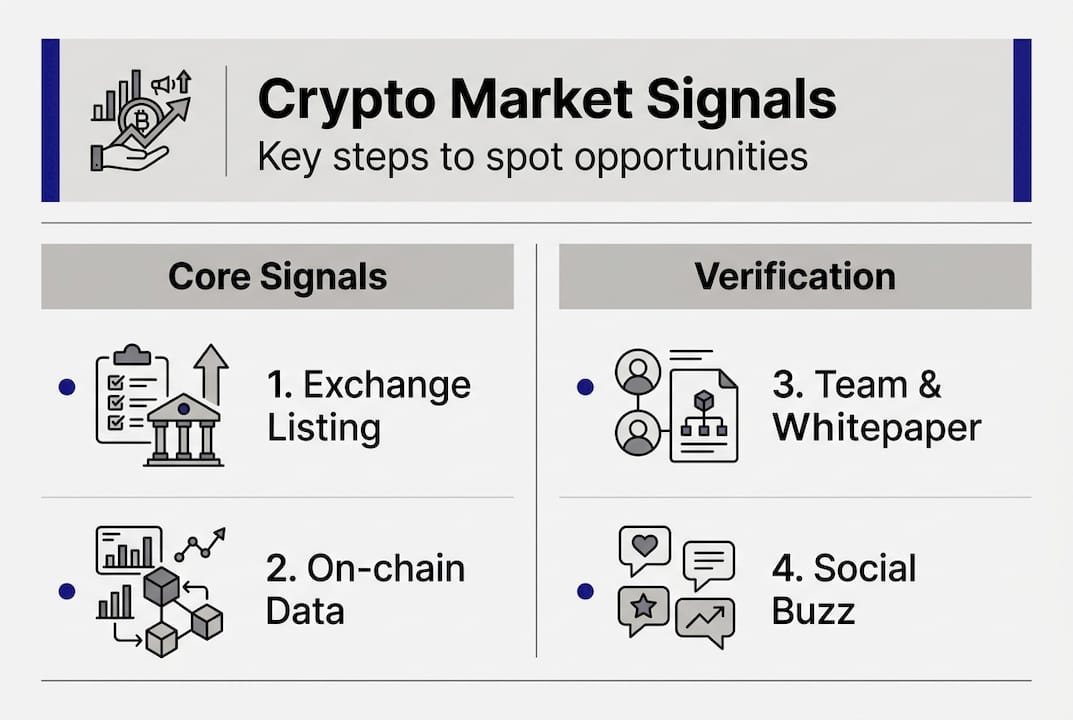
One thing many investors overlook is how powerful exchange listings actually are as a signal. Major exchange listings on platforms like Coinbase, Binance, and Kraken indicate that a token has passed serious scrutiny, including legal and technical review. That vetting process is a genuine quality filter, not just a formality. Separately, data aggregators like CoinMarketCap and CoinGecko let you track price trends, volume, market cap, liquidity, and new listings all in one place, which cuts your research time significantly.
Social channels add qualitative context. Monitor them for early buzz, but treat social hype with healthy skepticism. Organic community growth is a positive sign. Coordinated promotions are usually not.
For an integrated view of all these signals, our crypto market analysis tool brings these data streams together in one dashboard, so you spend less time switching tabs and more time making decisions.
Pro Tip: Set up automated alerts on CoinMarketCap or CoinGecko for new listing notifications. You will get notified the moment a token appears, giving you a head start before broader attention kicks in.
Analyze price trends and on-chain metrics
With your sources in hand, the next step is turning raw data into actionable insights using price and on-chain analysis. Numbers only tell a story when you know how to read them.
Here is a practical step-by-step process to follow when evaluating any token’s price activity:
- Check the price chart over multiple timeframes. Look at 7-day, 30-day, and 90-day views. Consistent upward momentum across timeframes is more meaningful than a single-day spike.
- Confirm volume is expanding. Price moves on thin volume are fragile. Expanding volume alongside rising prices signals genuine demand.
- Assess liquidity depth. Low liquidity means even a modest buy or sell order can move the price sharply, creating slippage risk.
- Review exchange inflows and outflows. Large inflows to exchanges often precede selling pressure. Large outflows suggest holders are moving coins to cold storage, which is a bullish sign.
- Track active and new wallet addresses. On-chain metrics like new and active addresses signal adoption, while whale movements point to major upcoming trends.
Key stat: New address spikes on-chain often correlate with subsequent price rises, making address growth one of the earliest leading indicators available to retail investors.
Think of on-chain data as looking at a city from above. You can see which neighborhoods are getting busy and which are emptying out before the local news even reports on it. That kind of forward visibility is a genuine edge.

For deeper trend reading, our guides on analyzing crypto trends and visualizing crypto data walk you through exactly how to interpret these signals without needing a data science background.
Pro Tip: Free explorer dashboards like Etherscan and Nansen offer solid on-chain visibility without a paid subscription. Start there before committing to premium tools.
Dig into project fundamentals and social signals
Raw data can indicate momentum, but verifying project fundamentals and social channels adds context to your findings. A coin can look great on a chart and still be built on nothing.
Evaluating fundamentals means examining the whitepaper for clarity, assessing the team’s track record, understanding real-world use cases, and analyzing tokenomics, including total supply, distribution schedule, and token utility.
Core fundamentals checklist:
- Whitepaper: Clear problem statement, realistic roadmap, technical depth
- Team: Named, verifiable backgrounds, prior successful projects
- Use case: Solves a real problem, not just a rebranded concept
- Tokenomics: Reasonable supply, fair distribution, genuine utility
- Community: Active, organic, two-way engagement across channels
Social signals matter too, but the quality of engagement beats quantity every time. Check Twitter/X, Reddit (particularly Reddit crypto communities), and Telegram groups. Are developers responding to questions? Are community members having real conversations, or just posting price predictions and moon emojis?
“Not all hype is equal: growing communities with real developers matter more than simple follower counts.”
Red flags to watch for include a missing or vague whitepaper, an anonymous team with no verifiable history, unclear token utility, and unusually aggressive promotion on social media. These patterns appear consistently in projects that later collapse.
Scam detectors like Token Sniffer can run automated checks on a contract’s code, looking for known vulnerabilities and rug pull mechanics. Using one before investing in any new token is a simple but effective filter. For a structured approach to all of this, our guide on mastering market analysis covers the full evaluation process in plain language.
Spot emerging trends and avoid common pitfalls
After evaluating projects, you are ready to pull signals together, spot sustaining trends, and double-check for red flags before acting.
| Emerging trend signal | Risky pattern |
|---|---|
| Steady TVL growth in DeFi protocol | Sudden, unexplained TVL spike |
| Rising active addresses over weeks | One-day address surge then drop |
| Developer commits increasing | No GitHub activity |
| Organic community growth | Mass-bought followers and bot engagement |
| Exchange listing after review | Anonymous team launching unknown token |
Total Value Locked (TVL), the total amount of assets deposited in a DeFi protocol, is one of the most reliable early adoption signals available. Rising TVL over multiple weeks means real users are committing real capital, not just speculating. You can track TVL across protocols using DeFiLlama, which aggregates this data for free.
Low liquidity risks slippage, meaning your buy or sell order executes at a worse price than expected. Aggressive promotion combined with low liquidity is a particularly dangerous combination, often signaling a coordinated pump-and-dump.
Token Sniffer and similar tools can flag rug pull mechanics automatically. Combine those checks with DeFi TVL checks for a layered defense against scams.
Final verification checklist before acting:
- Is price momentum supported by expanding volume?
- Are on-chain metrics like active addresses trending upward?
- Does the team and whitepaper check out?
- Is community engagement organic and two-way?
- Has TVL grown steadily, not spiked suddenly?
- Did a scam detector return a clean result?
- Is liquidity deep enough to avoid excessive slippage?
Our resources on crypto trend analysis and reducing crypto trading risk cover each of these points in more depth.
Use factor models and empirical strategies for smarter decisions
For a data-driven edge, sophisticated investors can add factor models and backtested strategies to their toolkit. Factor models break down asset returns into explainable components, and they translate surprisingly well into crypto.
The four main factors to understand are Market (broad crypto market exposure), Size (smaller tokens tend to outperform in early cycles), Value (underpriced assets relative to fundamentals), and Momentum (assets with recent strong performance continuing that trend).
| Factor | What it signals | Best market phase |
|---|---|---|
| Market | Overall direction of crypto market | All phases |
| Size | Small-cap outperformance potential | Bull market early stage |
| Value | Underpriced relative to fundamentals | Bear or recovery market |
| Momentum | Continuation of recent price trend | Bull and early recovery |
Factor models like Market, Size, Value, and Momentum have been shown to explain crypto returns meaningfully, with momentum and value showing positive performance specifically during bear markets. That finding challenges the common assumption that bear markets offer no opportunity at all.
Practically, you can apply factor filters by screening for tokens showing momentum over a 30 to 90-day window, then cross-referencing with value metrics like market cap relative to on-chain activity. Our guides on market analysis in crypto and analyzing crypto with models explain how to build these filters step by step.
Pro Tip: Combining factor model signals with on-chain data gives you much higher conviction entries. When momentum, growing addresses, and solid fundamentals all point the same direction, that alignment is worth paying attention to.
The real edge: Blending signals, not chasing hype
After methodically identifying and verifying signals, it helps to step back and consider what actually separates investors who do well from those who do not. In our experience, it is rarely about having a secret indicator. It is about cross-verification.
No single metric is sufficient on its own. Price momentum without fundamental backing is just noise. Strong fundamentals without price or volume confirmation can mean a project is early or simply overlooked. On-chain data offers a unique edge over traditional technical analysis, but even that gets overridden by major news events or broad market shifts.
The investors we see succeed consistently are the ones running a checklist, not chasing the loudest story on Twitter. Volatility and social narratives can send even experienced traders in the wrong direction. What you can repeat systematically, you can improve over time. What you do impulsively is harder to learn from.
That is why frameworks matter more than predictions. We encourage you to build your own layered verification habit using CryptoCracker’s trend indicator as one part of that system, not the whole answer. The goal is conviction built from multiple confirming signals, not from one perfect prediction.
Take the next step with crypto market analysis tools
Ready to put what you have learned into action? The framework in this guide works, and CryptoCracker’s tools are built to make running it faster and more consistent.

Our Crypto Market Analysis Tool automates many of the steps covered here, from tracking price trends and on-chain signals to monitoring new listings and flagging risk patterns. Pair that with our crypto trend analysis guide for a structured learning path, and explore our start crypto investing strategies resource to connect your analysis directly to actionable portfolio decisions. Less time gathering data means more time making informed moves.
Frequently asked questions
Which signals matter most for early crypto opportunities?
Combine exchange listings on platforms like Coinbase, Binance, and Kraken with on-chain data like active addresses, organic social buzz, and verified project fundamentals for the most reliable early signals. No single source is enough on its own.
How can I avoid scams and ‘rug pulls’ when hunting for new tokens?
Research the project team thoroughly, run the contract through a tool like Token Sniffer, and treat low liquidity paired with aggressive social promotion as a serious warning sign before committing any capital.
Do factor models really help forecast crypto prices?
Factor models like momentum and value have shown measurably positive performance in bear markets specifically, but they work best as one layer in a broader analysis process rather than a standalone forecasting tool.
How do I set up alerts for new crypto listings?
CoinMarketCap and CoinGecko both offer alert features that notify you when new tokens are listed or when price and volume thresholds are triggered, making it easy to stay informed without constant manual checking.