Starting crypto investing feels overwhelming when you face 70-80% price swings, countless platforms, and complex jargon. Whether you’re buying your first Bitcoin or refining advanced strategies, understanding preparation steps, risk management, and automation tools makes the difference between panic selling and steady growth. This guide walks you through essential strategies, security practices, and portfolio management systems that help both novices and experienced investors navigate cryptocurrency markets with confidence and clarity.
Table of Contents
- Key takeaways
- Understanding crypto investing essentials
- Exploring effective investment strategies
- Leveraging portfolio management and automation tools
- Understanding risks, tax implications, and best practices for safety
- Discover premium crypto investing tools with CryptoCracker
- How to start crypto investing FAQs
Key Takeaways
| Point | Details |
|---|---|
| Choose reputable exchange | Start by selecting a regulated exchange with strong security features and transparent fee structures. |
| Enable two factor authentication | Set up two factor authentication immediately to protect accounts from unauthorized access. |
| Dollar cost averaging | For beginners, invest fixed amounts regularly to reduce timing risk and smooth volatility. |
| Use hardware wallets | Store long term holdings offline on hardware wallets to guard against online hacks. |
Understanding crypto investing essentials
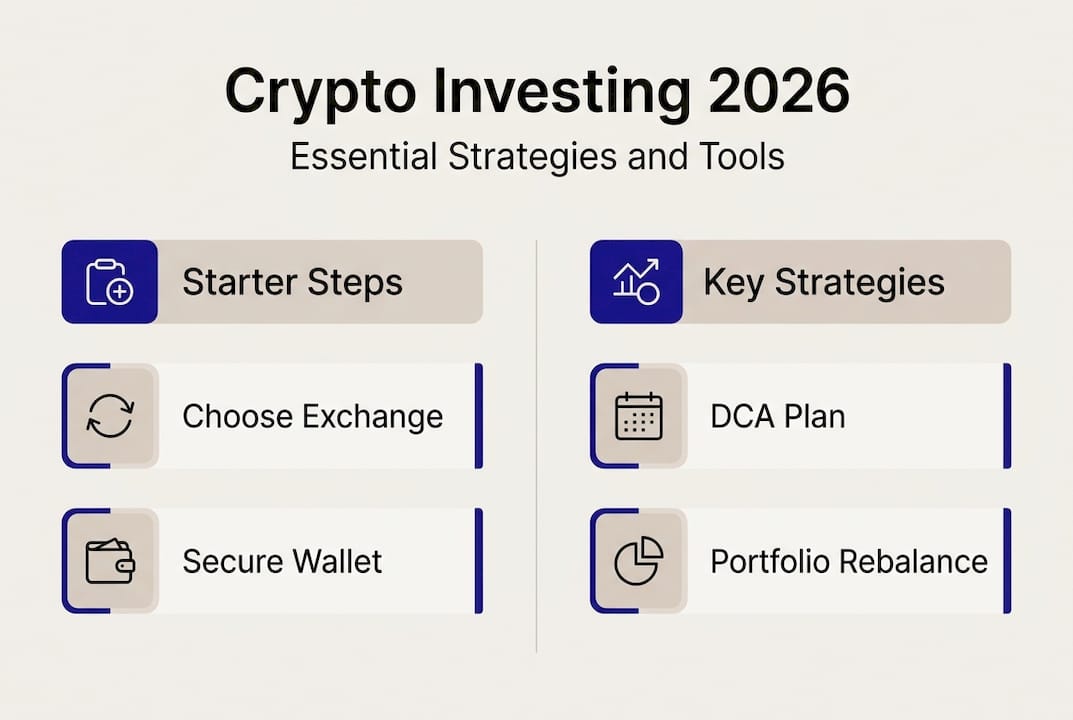
Before buying your first cryptocurrency, you need a solid foundation. Starting crypto investing as a novice requires choosing a reputable exchange, completing KYC verification, funding your account, buying coins, and enabling security features. This preparation protects your capital and sets you up for long-term success.
Select an exchange with strong security credentials and regulatory compliance. Platforms like Coinbase, Crypto.com, and Kraken offer user-friendly interfaces, insurance protection, and established track records. Compare fee structures because trading costs add up quickly. Most exchanges charge 0.5-2% per transaction, which impacts your returns over time.
Complete Know Your Customer verification by submitting government-issued identification and proof of address. This step ensures compliance with anti-money laundering regulations and unlocks full platform features. Verification typically takes 24-48 hours, so plan ahead before market opportunities arise.
Fund your account using bank transfers rather than credit cards. Bank transfers cost less and avoid cash advance fees that credit cards impose on crypto purchases. Start with a small amount you’re comfortable losing while you learn platform mechanics and market behavior.
Pro Tip: Enable two-factor authentication immediately after account creation. This security layer prevents unauthorized access even if someone steals your password.
Buy established cryptocurrencies like Bitcoin and Ethereum first. These assets have the longest track records, deepest liquidity, and strongest developer communities. Use market orders for immediate execution at current prices, or limit orders to specify your maximum purchase price.
Consider crypto trading strategies that match your risk tolerance and time commitment. Dollar-cost averaging works well for beginners because it removes timing pressure. You invest fixed amounts on regular schedules regardless of price, which smooths out volatility over months and years.
Store long-term holdings in hardware wallets like Ledger or Trezor. These physical devices keep private keys offline, protecting assets from exchange hacks and online threats. Leave only trading amounts on exchanges for convenience.
Understand basic terminology before diving deeper. Blockchain refers to the distributed ledger technology underlying cryptocurrencies. Wallets store your private keys, not actual coins. Gas fees compensate network validators for processing transactions. Learning crypto investing basics prevents costly mistakes and builds confidence.
Exploring effective investment strategies
Your investment approach should match your experience level, risk tolerance, and time horizon. Novices benefit from simple, consistent strategies while experienced investors can implement more sophisticated tactics.
Dollar-cost averaging eliminates the impossible task of timing market bottoms. Weekly $10 Bitcoin DCA from 2019-2024 returned +202%, outperforming most active traders who tried picking perfect entry points. This strategy works because it forces you to buy more coins when prices drop and fewer when prices rise, naturally averaging your cost basis.

Lump-sum investing can outperform DCA during sustained bull markets when prices consistently rise. If you have capital available and strong conviction in long-term growth, deploying it immediately captures more upside. However, this approach requires emotional discipline to hold through inevitable corrections.
Pro Tip: Combine both strategies by investing a lump sum in stable assets while dollar-cost averaging into higher-risk altcoins. This balances immediate exposure with gradual risk accumulation.
Experienced investors implement stop-loss orders, technical analysis, and position sizing of 1-5% per trade to manage downside risk. Stop-loss orders automatically sell positions when prices hit predetermined levels, limiting losses during unexpected crashes. Set stops 10-15% below entry prices for volatile assets, tighter for stable ones.
Portfolio rebalancing maintains target allocations as different assets grow at different rates. If Bitcoin surges from 50% to 70% of your portfolio, rebalancing sells some Bitcoin to buy underweighted assets. This disciplined approach forces you to take profits from winners and add to laggards, which often improves long-term returns.
Risk management principles protect capital during inevitable drawdowns. Never allocate more than 5% of your total portfolio to any single cryptocurrency. Limit your entire crypto exposure to 10-20% of investable assets unless you have high risk tolerance and long time horizons. These guardrails prevent catastrophic losses from wiping out your financial progress.
| Strategy | Best For | Risk Level | Time Commitment |
|---|---|---|---|
| Dollar-cost averaging | Beginners, volatile markets | Low to Medium | 5 minutes monthly |
| Lump-sum investing | Bull markets, high conviction | Medium to High | One-time setup |
| Active trading | Experienced traders | Very High | Several hours daily |
| HODLing with rebalancing | Long-term investors | Medium | 1 hour quarterly |
Active trading demands significant time, expertise, and emotional control. Most retail traders lose money because transaction fees, taxes, and poor timing erode returns. Only pursue active trading after mastering crypto investment strategies through paper trading and small position sizes.
Leveraging portfolio management and automation tools
Technology transforms complex portfolio management into simple, automated processes. Modern platforms track performance, execute strategies, and provide alerts without constant manual intervention.
Portfolio management tools like Delta, CoinStats, CoinGecko, and CryptoStash aggregate holdings across multiple exchanges and wallets into unified dashboards. CryptoStash supports over 300 exchanges and provides real-time profit and loss calculations, tax reporting data, and performance analytics. These tools eliminate spreadsheet maintenance and reduce calculation errors.
Coinrule and similar automation platforms enable automatic portfolio rebalancing based on predefined rules. Set target allocations for each asset, and the platform executes trades when holdings drift beyond tolerance bands. This removes emotional decision-making during market extremes when fear and greed cloud judgment.
Pro Tip: Start with conservative rebalancing thresholds of 10-15% drift before triggering trades. Tighter bands increase trading frequency and costs without necessarily improving returns.
Automated savings plans help accumulate assets through scheduled investments regardless of market conditions. Configure weekly or monthly purchases that execute automatically, ensuring you never miss contributions due to busy schedules or market hesitation. This consistency compounds over years into substantial positions.
| Tool Category | Examples | Primary Benefit |
|---|---|---|
| Portfolio trackers | Delta, CoinStats, Blockfolio | Unified performance view |
| Automation platforms | Coinrule, 3Commas | Rule-based trading |
| Tax reporting | CryptoStash, Koinly | Simplified compliance |
| Savings automation | Swan Bitcoin, CryptoCracker | Consistent accumulation |
Price alerts notify you when assets hit target levels for buying or selling. Set alerts 20-30% below current prices to catch dip-buying opportunities, and 50-100% above for profit-taking levels. Notifications keep you informed without obsessively checking prices throughout the day.
Explore crypto management tools and tax solutions that integrate tracking with compliance reporting. These platforms calculate capital gains, generate tax forms, and maintain audit trails that satisfy regulatory requirements. Proper record-keeping from day one prevents headaches during tax season.
Consider platforms that automate crypto trading based on technical indicators and market signals. Advanced users can backtest strategies, optimize parameters, and deploy bots that execute trades faster than manual processes. Start simple before layering complexity.
Automated crypto savings programs remove the discipline burden by treating crypto like retirement contributions. Set percentages of income to invest automatically, and watch positions grow through market cycles without active management.
Understanding risks, tax implications, and best practices for safety
Cryptocurrency investing carries substantial risks that demand careful consideration and protective measures. Understanding threats and compliance obligations keeps your investments secure and legal.
Crypto volatility reaches 70-80% drawdowns during bear markets, with exchange hacks causing $15 billion in losses and 95% of projects ultimately failing. These statistics aren’t meant to scare you away but to calibrate expectations and position sizing appropriately. Never invest money you need for living expenses, emergencies, or short-term goals.
Exchange hacks remain a persistent threat despite improving security. Mt. Gox, Coincheck, and numerous smaller platforms have lost customer funds to sophisticated attacks. Use exchanges primarily for trading, not storage. Transfer long-term holdings to hardware wallets or secure custody solutions you control.
Scams proliferate in crypto markets due to limited regulation and irreversible transactions. Avoid promises of guaranteed returns, pressure to act immediately, or requests to send funds to unlock larger amounts. If an opportunity sounds too good to be true, it almost certainly is.
Pro Tip: Research projects thoroughly before investing. Check team credentials, read whitepapers, verify partnerships, and assess community engagement. Legitimate projects have transparent development, active GitHub repositories, and regular communication.
Invest only 1-5% of your total portfolio in cryptocurrency unless you have exceptionally high risk tolerance. This allocation allows meaningful upside participation while limiting downside damage to your overall financial health. Adjust percentages based on age, income stability, and other assets.
Crypto taxation treats holdings as property, triggering capital gains on sales, trades, and even purchases using crypto. Every transaction creates a taxable event requiring cost basis tracking and gain calculation. Active trading increases short-term capital gains taxed at ordinary income rates, significantly reducing after-tax returns.
Maintain detailed records of every transaction including dates, amounts, prices, and counterparties. Export transaction histories from exchanges monthly and store them securely. Tax software integrates with major platforms to automate reporting, but verify accuracy before filing.
Stay updated on regulatory changes affecting crypto investors. Governments worldwide are implementing new rules for exchanges, stablecoins, and DeFi protocols. Subscribe to regulatory newsletters and consult tax professionals familiar with cryptocurrency to ensure ongoing compliance.
Use hardware wallets for cold storage of significant holdings. These devices cost $50-200 but protect thousands or millions in assets. Store recovery seed phrases in secure, separate locations like safety deposit boxes or fireproof safes. Never store seeds digitally where hackers can access them.
Diversify across multiple cryptocurrencies and asset classes. Concentrating in a single coin amplifies risk if that project fails or loses favor. Spread investments across large-cap, mid-cap, and carefully selected small-cap cryptocurrencies while maintaining positions in traditional assets like stocks and bonds.
Discover premium crypto investing tools with CryptoCracker
Implementing the strategies and practices covered requires powerful tools that simplify execution and monitoring. CryptoCracker provides professional-grade automation, analysis, and portfolio management designed for investors at every experience level.
Our platform integrates directly with Coinbase through secure API connections, enabling real-time portfolio tracking, automated rebalancing, and intelligent trade execution. You maintain full control while leveraging sophisticated algorithms that optimize entry and exit timing based on market conditions and your personal strategy.

Discover crypto trading secrets that separate successful investors from those who struggle. Our educational resources and proprietary indicators help you identify opportunities others miss while avoiding common pitfalls that destroy capital.
Explore our comprehensive crypto trading strategies guide that walks through proven approaches for different market conditions. Whether you prefer conservative dollar-cost averaging or active momentum trading, CryptoCracker provides the infrastructure to execute consistently.
Benefit from automated crypto savings plans that build wealth steadily without requiring constant attention. Set your allocation preferences, and our system handles the rest, ensuring you never miss accumulation opportunities during market dips.
How to start crypto investing FAQs
What is the safest way to start investing in crypto?
Begin with reputable exchanges like Coinbase or Kraken, complete identity verification, enable two-factor authentication, and start with small amounts in established cryptocurrencies like Bitcoin and Ethereum. Transfer long-term holdings to hardware wallets for maximum security. Only invest funds you can afford to lose completely.
How does dollar-cost averaging benefit new investors?
Dollar-cost averaging removes timing pressure by investing fixed amounts on regular schedules regardless of price. This approach automatically buys more coins when prices drop and fewer when prices rise, smoothing your average cost over time. It eliminates the emotional stress of trying to pick perfect entry points and historically outperforms lump-sum investing during volatile markets.
What tools can help manage a crypto portfolio effectively?
Portfolio tracking apps like Delta, CoinStats, and CryptoStash aggregate holdings across exchanges into unified dashboards with real-time profit and loss calculations. Automation platforms like Coinrule enable rule-based rebalancing and trading. Tax software integrates transaction histories to simplify compliance reporting. These tools reduce manual work and improve decision-making consistency.
How are cryptocurrency investments taxed?
Cryptocurrencies are taxed as property, meaning every sale, trade, or purchase using crypto triggers a capital gain or loss calculation. Holding assets over one year qualifies for long-term capital gains rates, while shorter periods face ordinary income rates. Active trading significantly increases tax obligations, so maintain detailed transaction records and consult tax professionals familiar with crypto.
What risks should new investors be aware of?
Crypto markets experience 70-80% drawdowns during bear cycles, with high volatility creating emotional stress. Exchange hacks have caused billions in losses, and 95% of cryptocurrency projects ultimately fail. Scams targeting inexperienced investors are common. Limit crypto to 1-5% of your total portfolio, use hardware wallets for storage, research projects thoroughly, and never invest more than you can afford to lose.