TL;DR:
- Cryptocurrency trading involves buying, selling, and exchanging digital assets with a focus on market psychology and risk management.
- Success depends on understanding order types, platform selection, and maintaining disciplined trading habits.
- Proper tools, strategies, and emotional control are essential to navigate high volatility and maximize rewards.
Most investors think cryptocurrency trading is just buying and selling coins. The reality is far more nuanced, and that gap between perception and truth is exactly where costly mistakes happen. Cryptocurrency trading is the buying, selling, or exchanging of digital currencies like Bitcoin and Ethereum on specialized exchanges to profit from price fluctuations. But the mechanics behind that simple definition involve market psychology, risk management, order types, platform selection, and more. This guide cuts through the noise and gives you a clear, practical foundation so you can trade with confidence rather than guesswork.
Table of Contents
- What is cryptocurrency trading?
- Understanding how crypto trading works
- Risks and rewards: What every trader should know
- Tools and strategies for smarter trading
- Our take: What most traders miss in the crypto market
- Level up your crypto trading with smarter tools
- Frequently asked questions
Key Takeaways
| Point | Details |
|---|---|
| Trading basics clarified | Cryptocurrency trading involves buying, selling, or exchanging digital assets to profit from price movements. |
| Risk versus reward | Crypto trading offers high potential returns but comes with significant risks such as volatility and scams. |
| Strategic tools help | Using the right wallets, platforms, and trading strategies can make your crypto investments safer and smarter. |
| Start small, learn fast | Begin with modest trades to minimize losses while building knowledge and confidence in the crypto market. |
What is cryptocurrency trading?
Now that you understand why misconceptions can be costly, let’s break down exactly what cryptocurrency trading involves. At its core, crypto trading means participating in a global digital marketplace where assets change hands around the clock, seven days a week. Unlike traditional investing, where you might hold a stock for years, crypto trading can span seconds, hours, or months depending on your strategy.
The main activities are buying (acquiring an asset at a target price), selling (exiting a position for profit or to limit loss), and exchanging (swapping one digital currency for another). The assets you trade vary widely. Bitcoin remains the dominant force by market capitalization, Ethereum powers decentralized applications and smart contracts, and thousands of altcoins like Solana, Cardano, and Chainlink offer alternative opportunities and risks.
Not all exchanges are built the same. Here is a quick breakdown of the main types:
- Centralized exchanges (CEX): Platforms like Coinbase or Binance that act as intermediaries, holding your funds and matching orders. Easy to use but require trust in the platform.
- Decentralized exchanges (DEX): Peer-to-contract platforms like Uniswap where trades happen directly on the blockchain. More control, but steeper learning curve.
- Peer-to-peer (P2P) exchanges: Platforms that connect buyers and sellers directly, often with escrow protection. Useful for flexible payment methods.
Understanding choosing exchanges is one of the most important early decisions you will make. Here is how crypto trading compares to traditional stock market trading:
| Feature | Crypto trading | Stock market trading |
|---|---|---|
| Trading hours | 24/7, 365 days | Weekdays, set hours |
| Regulation | Evolving, varies by region | Heavily regulated |
| Volatility | Extremely high | Moderate |
| Asset types | Coins, tokens, NFTs | Stocks, ETFs, bonds |
| Entry barrier | Low (start with $10) | Moderate (brokerage required) |
The low entry barrier is one of crypto’s most appealing features, but it also attracts inexperienced participants who underestimate the complexity involved.
Understanding how crypto trading works
With the foundation in place, let’s walk through how to actually execute a trade and the strategies that help traders succeed. The process is more structured than most beginners expect, and each step matters.
Here is a step-by-step example of a basic trade:
- Create and verify your account on a reputable exchange. Most platforms require identity verification to comply with anti-money laundering regulations.
- Fund your account by depositing fiat currency (like USD or EUR) or transferring existing crypto from a wallet.
- Select your asset. Research the coin you want to trade. Look at price history, trading volume, and market sentiment.
- Choose your order type. This is where most beginners get confused, and it is worth slowing down here.
- Place the order and monitor it. Confirm the transaction details before submitting.
- Manage the position. Set alerts or stop-loss levels to protect your capital if the market moves against you.
The three order types you need to understand are market orders (execute immediately at the current price), limit orders (execute only when the asset hits your target price), and stop-loss orders (automatically sell if the price drops to a set level to cap your losses). Each serves a different purpose depending on your strategy and risk tolerance.
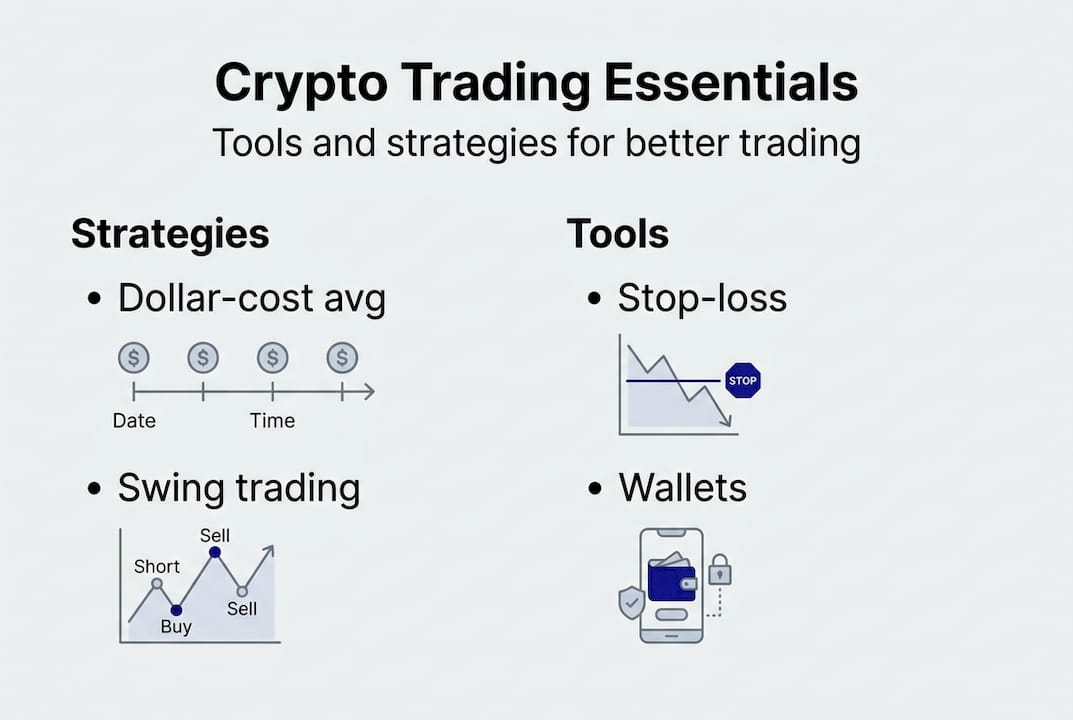
Beginner trading strategies like dollar-cost averaging (buying fixed amounts at regular intervals) or swing trading (holding positions for days or weeks to capture price swings) are far more manageable starting points than day trading, which demands constant attention and experience.

Pro Tip: Start with no more than 1 to 2 percent of your total investment budget on any single trade. This keeps losses manageable while you build real experience without the emotional pressure of large positions.
The crypto trading benefits for modern investors are real, but they only materialize when you approach the market with a clear process rather than impulse decisions.
Risks and rewards: What every trader should know
Knowing how to trade is just half the battle. Understanding the risks and rewards is crucial to making informed decisions. The crypto market offers genuine opportunity, but it also carries dangers that are unlike anything in traditional finance.
On the reward side, the market runs 24/7, meaning you can act on news or price movements at any hour. Global accessibility means anyone with an internet connection can participate. And the potential for high returns, while not guaranteed, has made early adopters significant wealth.
But the risk profile is equally striking. Extreme volatility, leveraged liquidations, and regulatory shifts are real threats, and fees ranging from 0.6 to 1.2 percent per maker/taker trade can quietly erode your returns over time.
“The crypto market’s 24/7 nature and high return potential come with extreme volatility, liquidation risk in leveraged trades, regulatory uncertainty, and low liquidity for smaller altcoins. Scams and high fees are persistent concerns for every level of trader.” — Investopedia
Here are the most common pitfalls beginners should actively avoid:
- FOMO trading: Buying at the peak of a price surge because everyone else seems to be doing it.
- Ignoring fees: Small percentages compound quickly across multiple trades and eat into profits.
- Over-leveraging: Using borrowed funds amplifies both gains and losses, and liquidation can wipe out your entire position.
- Skipping security basics: Leaving funds on exchanges rather than in personal wallets increases exposure to hacks.
- Chasing altcoins blindly: Low-liquidity coins are easier to manipulate and harder to exit quickly.
Good crypto risk reduction starts with awareness. Understanding crypto trading fees and following solid crypto security tips are not optional extras. They are the baseline for anyone serious about protecting their capital.
Tools and strategies for smarter trading
Once you are aware of the risks and rewards, the next step is to leverage the right tools and strategies for smarter trading and portfolio management. The difference between a trader who survives market downturns and one who does not often comes down to preparation and tooling.
Choosing the right wallet and platform matters more than most people realize. A good wallet selection guide will help you understand the difference between hot wallets (connected to the internet, convenient but vulnerable) and cold wallets (offline storage, more secure for long-term holdings).
Here is a comparison of key risk management tools and their features:
| Tool | Primary function | Best for |
|---|---|---|
| Stop-loss orders | Auto-sell at set price floor | Limiting downside on open positions |
| Portfolio trackers | Monitor performance across assets | Diversification and rebalancing |
| Trading bots | Execute trades based on rules | Automating repetitive strategies |
| Price alert apps | Notify on price thresholds | Staying informed without constant monitoring |
| Analytics platforms | Market data and trend analysis | Informed entry and exit decisions |
Pro Tip: Set price alerts for every asset you hold. You do not need to watch charts all day. Alerts let the market come to you, so you respond with a clear head rather than in a panic.
For managing volatility specifically, these strategic approaches make a real difference:
- Dollar-cost averaging: Invest fixed amounts regularly to smooth out price swings over time.
- Portfolio diversification: Spread holdings across different asset classes and risk levels.
- Position sizing: Never allocate more than you can afford to lose on a single trade.
- Rebalancing: Periodically adjust your portfolio back to your target allocation as prices shift.
A solid crypto risk assessment process, combined with the right tools, transforms trading from guesswork into a repeatable system. And as investing in crypto evolves, the traders who build systems rather than chase trends are the ones who stay in the game longest.
Our take: What most traders miss in the crypto market
Having explored the tools and strategies, let’s zoom out for a fresh perspective on what really separates successful crypto traders from the rest. Here is the uncomfortable truth: most traders spend the majority of their time looking for the next big coin and almost no time building the habits and systems that protect them when markets turn.
We have seen it repeatedly. A trader gets lucky on two or three trades, develops overconfidence, takes on more risk, and then a single bad position wipes out months of gains. The market does not reward prediction. It rewards discipline.
Emotional control is not a soft skill in crypto. It is a survival skill. Fear and greed drive more trading decisions than data does, and that is precisely why most retail traders underperform. The expert trading insights that actually move the needle are rarely about timing the market. They are about building a process you can follow consistently, even when the market feels chaotic.
Pro Tip: Treat every trade as a learning event. Keep a simple journal noting why you entered, what happened, and what you would do differently. Patterns emerge fast, and those patterns are your real edge.
Level up your crypto trading with smarter tools
Ready to put these lessons into practice? Understanding the concepts is the first step, but applying them consistently is where most traders struggle without the right support.

At CryptoCracker, we built our platform specifically to remove that friction. Our portfolio optimization tools give you a real-time view of your holdings, while our market analysis tool surfaces the data you actually need without drowning you in noise. If you want personalized guidance, our trade recommendation tool delivers actionable suggestions tailored to your portfolio and risk profile. Whether you are just starting out or refining an existing strategy, CryptoCracker makes smarter trading genuinely accessible.
Frequently asked questions
Is cryptocurrency trading safe for beginners?
Cryptocurrency trading carries significant risks including extreme volatility and scams, so beginners should start with small amounts and prioritize education before committing serious capital.
What are maker and taker fees in crypto trading?
Maker and taker fees are transaction costs charged by exchanges, and they typically range from 0.6% to 1.2% per trade depending on the platform and your trading volume.
How do I choose the right crypto trading platform?
Look for platforms with strong security practices, transparent fee structures, and support for the coins and trading tools that match your investment goals.
Can I automate cryptocurrency trades?
Yes, many platforms and third-party tools offer trading bots and automation features that execute trades based on rules you define in advance, reducing the need for constant manual monitoring.
What is the best risk management strategy for crypto traders?
Combining portfolio diversification, stop-loss orders, and consistent position sizing gives you the strongest defense against the volatility and liquidation risks that define the crypto market.