Navigating cryptocurrency markets without a clear analysis process is like sailing without a compass. 98% of crypto traders lose money, often because they lack systematic decision-making frameworks. This guide walks you through a proven step-by-step approach to analyzing crypto markets, combining technical indicators, on-chain data, and risk management strategies. Whether you’re just starting out or looking to refine your trading process, you’ll discover how to make confident, data-driven investment decisions that align with your financial goals.
Table of Contents
- Why A Deliberate Crypto Analysis Process Matters
- Preparing For Crypto Market Analysis: Tools And Knowledge Essentials
- Executing The Crypto Market Analysis Process: Step-By-Step Guide
- Verifying Analysis Results: Tracking Performance And Adapting Strategies
- Explore CryptoCracker Tools For Smarter Crypto Market Analysis
Key takeaways
| Point | Details |
|---|---|
| Chart fundamentals matter | Understanding candlesticks, support levels, patterns, and volume helps you identify trends and reversals with confidence. |
| Combine analysis types | Merging technical indicators with on-chain data reveals market sentiment before mainstream news catches on. |
| Automate to reduce emotion | Trading bots and automated tools eliminate fear and greed, executing strategies consistently without human bias. |
| Track and adapt continuously | Monitoring performance against your analysis helps refine strategies as market conditions evolve. |
Why a deliberate crypto analysis process matters
Crypto trading presents unique challenges that separate it from traditional markets. Extreme volatility, 24/7 trading cycles, and rapid technological shifts create an environment where emotional decisions often lead to devastating losses. Without a systematic approach, you’re essentially gambling rather than investing.
Setting clear investment goals forms the foundation of any successful analysis process. Are you seeking short-term gains through day trading, building long-term positions, or generating passive income? Your objectives determine which analysis methods matter most. A day trader prioritizes different indicators than someone accumulating Bitcoin for retirement.
Analysis is a deliberate process, not a shot in the dark. It starts with your goals and leads to confident, well-reasoned execution.
Deliberate analysis transforms uncertainty into actionable intelligence. Instead of reacting to price swings with panic or euphoria, you evaluate data objectively and execute predetermined strategies. This discipline separates profitable traders from the majority who chase pumps and dump at losses.
Automated tools offer a powerful advantage by removing human emotional biases from the equation. Fear causes traders to exit winning positions too early, while greed keeps them holding losers too long. Algorithms execute your strategy precisely as designed, whether markets surge or crash. Platforms offering market analysis crypto capabilities help you maintain discipline even when emotions run high.
Key benefits of a structured process include:
- Consistent decision-making framework across all market conditions
- Reduced emotional trading that leads to impulsive mistakes
- Clear criteria for entering and exiting positions
- Ability to backtest strategies before risking real capital
- Documented track record for continuous improvement
Preparing for crypto market analysis: tools and knowledge essentials
Before diving into analysis, you need the right foundation. The global crypto market reached USD 5.7 billion and projects to hit USD 11.7 billion by 2030, making professional-grade tools increasingly accessible to retail investors. Understanding which resources matter most saves time and prevents analysis paralysis.
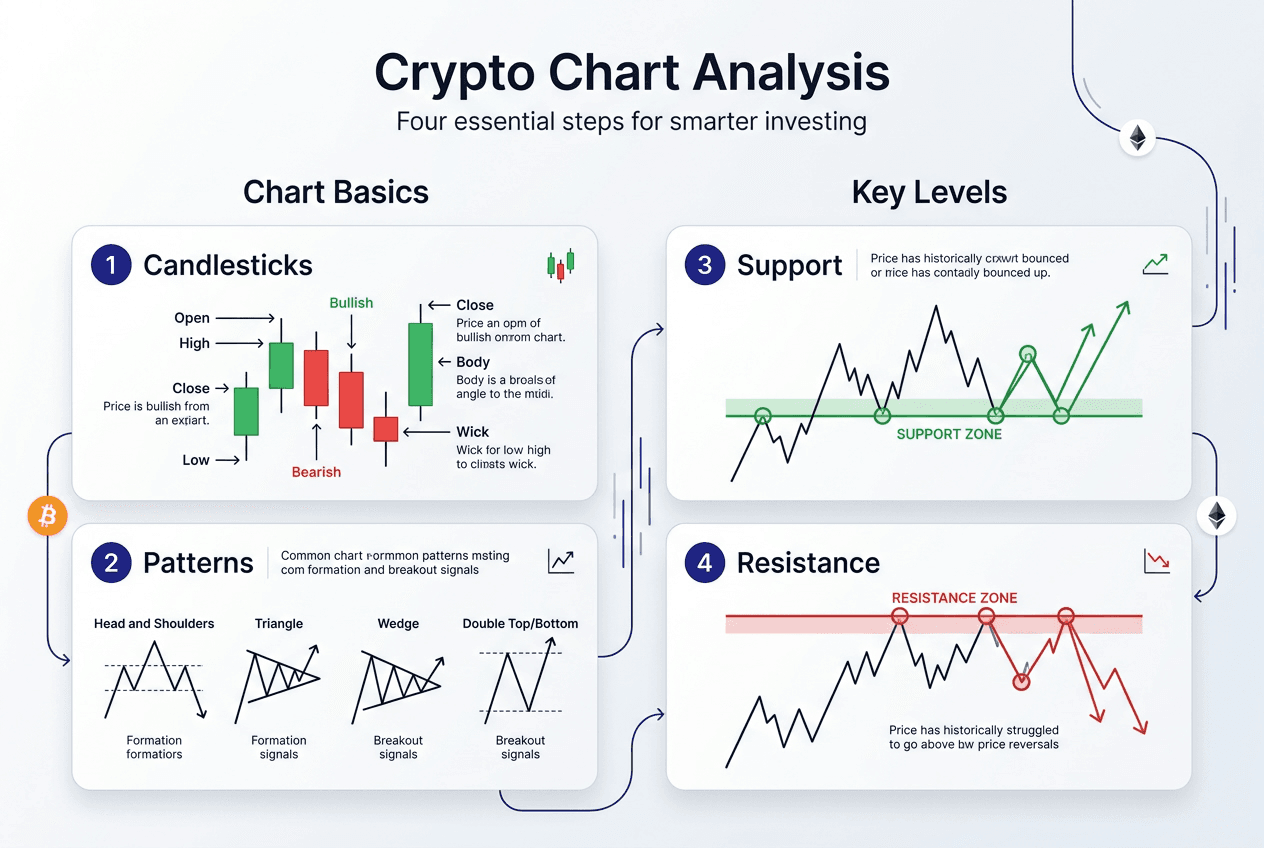
Candlestick charts form the visual backbone of technical analysis. Each candlestick shows opening price, closing price, highest point, and lowest point for a specific time period. Green or white candles indicate price increases, while red or black show decreases. Patterns like doji, hammer, and engulfing candles signal potential reversals or continuation.

Support and resistance levels mark psychological price zones where buying or selling pressure historically concentrates. Support represents a floor where demand prevents further declines, while resistance acts as a ceiling where supply blocks advances. Breaking through these levels often triggers significant price movements as stop-losses activate and new positions open.
Reading crypto charts requires understanding four core elements: candlesticks, support/resistance levels, chart patterns, and volume. Volume confirms whether price movements have genuine momentum or represent low-conviction noise. High volume breakouts carry more weight than moves on thin trading activity.
On-chain data provides insights unavailable through price charts alone. Metrics like active addresses, transaction volume, exchange inflows/outflows, and whale movements reveal what major holders are doing behind the scenes. This information often predicts price changes before they appear on charts.
| Tool Type | Primary Use | Skill Level | Cost Range |
|---|---|---|---|
| Basic charting platforms | Price visualization, simple indicators | Beginner | Free to $20/month |
| Advanced technical analysis | Multiple timeframes, custom indicators | Intermediate | $30 to $100/month |
| On-chain analytics | Blockchain data, whale tracking | Intermediate | $50 to $300/month |
| Automated trading platforms | Strategy execution, portfolio management | All levels | $25 to $200/month |
Pro Tip: Start with free tools to learn fundamentals before investing in premium platforms. Many paid services offer trial periods where you can test features against your specific trading style and goals.
Building knowledge takes deliberate practice. Focus on mastering one or two indicators thoroughly rather than superficially learning dozens. The crypto market analysis tool approach emphasizes depth over breadth, helping you recognize patterns faster and execute with greater confidence. Resources like the ultimate crypto analysis guide provide structured learning paths that prevent overwhelm.
Executing the crypto market analysis process: step-by-step guide
Systematic execution transforms preparation into profitable action. Following a consistent process ensures you evaluate every opportunity through the same rigorous lens, reducing the influence of mood or market hype on your decisions.
-
Define your investment objective clearly. Specify your time horizon, risk tolerance, and target return. A swing trader seeking 10% gains over two weeks uses different analysis than a long-term holder accumulating for five years. Write down your goal before analyzing any asset.
-
Conduct fundamental analysis to identify promising assets. Evaluate the project’s technology, team, use case, competitive advantages, and adoption metrics. Strong fundamentals don’t guarantee short-term price increases but provide downside protection during market corrections. Look for projects solving real problems with growing user bases.
-
Apply technical analysis to determine entry and exit points. Most successful traders use just 2-3 indicators combined with price action analysis. Common combinations include moving averages with RSI, or MACD with volume. Identify your preferred timeframe and stick with it consistently.
-
Integrate on-chain data to refine timing. Combining chart and blockchain data enhances decision-making in crypto trading. If technical indicators suggest buying but exchange inflows spike dramatically, whales might be preparing to sell. Conversely, exchange outflows during consolidation often precede rallies as holders move coins to cold storage.
-
Implement strict risk management parameters. Calculate position size based on your total portfolio and the specific trade’s risk/reward ratio. Set stop-loss orders immediately after entering positions. Never risk more than 2% of your portfolio on a single trade, regardless of conviction level.
-
Execute trades according to your predetermined plan. Resist the urge to override your analysis based on last-minute news or social media sentiment. Your systematic process accounts for probabilities over time, not individual trade outcomes. Some losing trades are inevitable even with perfect analysis.
-
Document every trade with entry reasoning and expected outcomes. This record becomes invaluable for identifying which analysis methods work best for your style. Note the indicators you relied on, market conditions, and your emotional state when entering the position.
Pro Tip: Use the trend indicator guide to understand how different market phases require adjusted strategies. Bull markets reward momentum following, while bear markets favor contrarian approaches at key support levels.
The difference between gambling and trading lies in your process. Gamblers hope for favorable outcomes, traders execute strategies with positive expected value over many iterations.
Automation eliminates execution errors that plague manual trading. You might identify the perfect setup but hesitate at entry, then chase the move at worse prices. Or you plan to exit at a specific target but hold too long hoping for more. The crypto trade recommendation tool removes these psychological barriers by executing precisely as programmed, whether you’re awake or asleep.
Verifying analysis results: tracking performance and adapting strategies
Analysis without verification creates a false sense of competence. You might remember winning trades vividly while forgetting losers, leading to overconfidence in flawed methods. Rigorous tracking reveals what actually works versus what feels right.
Automated portfolio management tools provide objective performance measurement. They calculate metrics like Sharpe ratio, maximum drawdown, win rate, and average gain/loss automatically. These numbers tell the truth about your analysis quality better than subjective memory ever could.
| Verification Method | Accuracy | Time Investment | Best For |
|---|---|---|---|
| Manual spreadsheet tracking | Moderate | High | Learning fundamentals |
| Portfolio tracking apps | High | Low | Casual investors |
| Automated analytics platforms | Very high | Very low | Active traders |
| Professional backtesting software | Highest | Moderate | Strategy developers |
Smart risk management is crucial in the volatile crypto market. Stop-loss features protect against catastrophic losses when analysis proves wrong. Position sizing ensures no single mistake destroys your portfolio. Trailing stops lock in profits as winning trades advance.
The cryptocurrency market evolves rapidly, requiring continuous strategy adaptation. The cryptocurrency market of 2026 has evolved from a retail-dominated speculative arena into a highly sophisticated, institutional-grade asset class. Strategies that worked in 2024 might fail today as market structure changes.
Key adaptation practices include:
- Review performance monthly to identify deteriorating strategy effectiveness
- Test new indicators on historical data before deploying with real capital
- Adjust position sizes based on changing volatility conditions
- Recognize when market regimes shift from trending to range-bound
- Stay informed about regulatory changes affecting specific cryptocurrencies
Pro Tip: Set calendar reminders for quarterly strategy reviews. Markets change gradually, making it easy to miss deterioration until significant losses accumulate. Regular reviews catch problems early when adjustments cost less.
The portfolio optimization methods you employ should evolve as your capital grows. A $5,000 portfolio tolerates higher risk concentration than a $500,000 one. Rebalancing frequency, diversification requirements, and drawdown limits all scale with portfolio size and your changing life circumstances.
Continuous learning separates long-term winners from those who experience brief success then fade. Markets reward those who adapt faster than competitors. Read analysis from traders with different styles, study historical market cycles, and maintain intellectual humility about what you don’t know. The moment you think you’ve mastered crypto is precisely when the market teaches expensive lessons.
Explore CryptoCracker tools for smarter crypto market analysis
Implementing the analysis process described above becomes significantly easier with purpose-built tools designed for crypto investors. CryptoCracker offers comprehensive crypto market analysis tool features that integrate technical indicators, performance tracking, and automated execution in one platform. Instead of juggling multiple subscriptions and manually correlating data, you access everything through a unified dashboard.

The portfolio optimization features help you maintain ideal asset allocation as market conditions shift. Automated rebalancing ensures you’re always positioned according to your risk parameters without constant manual intervention. Combined with the ability to automate crypto trading, you gain the discipline of institutional investors while maintaining full control over your strategy. Explore how these tools can enhance the analysis methods you’ve learned and accelerate your path to consistent crypto investing success.
FAQ
What are the core elements to focus on in crypto chart analysis?
Reading crypto charts requires understanding four core elements: candlesticks, support/resistance levels, chart patterns, and volume. Candlesticks show price action within specific timeframes, revealing momentum and sentiment. Support and resistance levels mark psychological zones where buying or selling pressure concentrates, often triggering reversals when broken. Chart patterns like head and shoulders or triangles signal potential trend changes. Volume confirms whether price movements have genuine strength or represent low-conviction noise. Together, these elements help you identify high-probability entry and exit points while filtering out false signals that trap inexperienced traders.
How does on-chain data improve crypto market analysis?
On-chain data provides insights into market sentiment and potential price changes before mainstream news. Metrics like active addresses reveal growing or declining network usage, often preceding price movements by days or weeks. Exchange inflows suggest selling pressure as holders move coins to trade, while outflows indicate accumulation as investors transfer to cold storage. Whale wallet movements show what large holders are doing, giving you advance warning of potential supply shocks. This blockchain-level intelligence complements technical analysis by revealing what’s happening beneath surface price action, helping you avoid bull traps and identify genuine accumulation phases.
What risk management strategies should crypto investors use?
Smart risk management is crucial in the volatile crypto market. Stop-loss orders automatically exit positions when prices move against you by a predetermined amount, preventing small losses from becoming catastrophic. Position sizing limits how much capital you risk on any single trade, typically 1-2% of your total portfolio. Diversification across multiple assets reduces correlation risk, ensuring one failed investment doesn’t destroy your entire portfolio. Trailing stops lock in profits as winning trades advance, protecting gains from sudden reversals. Discipline matters more than any specific technique, as the best risk management plan fails if you override it during emotional moments.
Why is automation important in crypto trading today?
Algorithmic trading accounts for over 80% of volume on major crypto exchanges, fundamentally changing market dynamics. Bots execute thousands of trades per second, exploiting tiny inefficiencies faster than humans can perceive. Human traders face limitations that automation solves, including emotional decision-making, inconsistent execution, and inability to monitor markets 24/7. Automated systems execute your strategy precisely as designed, whether you’re sleeping, working, or on vacation. They eliminate fear that causes premature exits and greed that keeps you holding too long. In 2026’s institutional-grade crypto markets, competing without automation puts you at a severe disadvantage against sophisticated algorithms and professional trading desks.