TL;DR:
- Most crypto traders experience losses due to reactive, emotion-driven decision-making without systematic analysis. Using multiple analysis methods—technical, fundamental, and on-chain—paired with reliable tools improves decision-making and reduces risk. Building a structured, multi-layered approach enhances trading consistency and long-term profitability.
Most people who trade cryptocurrency lose money. Not a few, not even half — 98% of crypto traders experience losses when they trade without a systematic approach. That number is striking, and it raises an obvious question: what separates the minority who profit from the overwhelming majority who don’t? The answer, almost universally, is market analysis. This guide breaks down what market analysis actually means, why it matters for every investor at every experience level, which tools make it accessible, and how to start applying it to your own portfolio right now.
Table of Contents
- Why market analysis is essential for crypto traders
- Types of market analysis in crypto trading
- Essential tools and platforms for smarter crypto analysis
- How systematic analysis improves crypto trading outcomes
- What most traders get wrong about market analysis and how to fix it
- Connect analysis to action: Smarter trading with CryptoCracker
- Frequently asked questions
Key Takeaways
| Point | Details |
|---|---|
| Systematic analysis wins | Most successful traders rely on data-driven frameworks to beat random, emotional approaches. |
| Use multi-method tools | Blending technical, fundamental, and on-chain analysis provides the clearest market insights. |
| Right tools matter | Choosing the right platforms, from beginner dashboards to expert analytics, improves your decision quality. |
| Automation boosts discipline | Trading bots and systematic analysis help remove bias and manage trades consistently over time. |
Why market analysis is essential for crypto traders
Crypto markets move fast. Prices can swing 20% in a single day, narratives flip overnight, and sentiment can turn on a single tweet from an influential voice. Without a structured way to evaluate what’s actually happening, most traders fall back on gut feeling, fear, and social buzz. That’s a recipe for loss.
“Market analysis enables systematic, data-driven decision-making, reducing emotional biases and significantly improving entry and exit timing for crypto traders.” — Thales Capital Research
The research is clear: systematic analysis frameworks produce measurably better outcomes than reactive, emotion-driven trading. When you analyze markets methodically, you stop chasing price spikes and start recognizing patterns. You stop panicking during dips and start identifying real buying opportunities. That shift alone is transformational.
Beginners often assume analysis is something only professionals do. That assumption is one of the most expensive mistakes a new trader can make. Market analysis is not about having a finance degree or spending 12 hours a day reading charts. It’s about having a repeatable process for evaluating information before making a decision.
Here’s what systematic market analysis actually protects you from:
- Impulsive buying driven by fear of missing out (FOMO), which often leads to buying near the top of a price cycle
- Panic selling during normal market corrections, locking in losses that would have recovered with patience
- Over-concentration in assets based purely on hype rather than verified fundamentals
- Chasing social media tips from influencers who may not hold the positions they recommend
- Missing exit signals because there’s no framework to recognize when a trend is reversing
Our crypto market analysis guide expands on these concepts in depth. But the core principle is simple: data beats emotion, every single time. The more you can analyze crypto quickly and confidently, the better your decisions become. Consistency follows structure, and structure starts with understanding the types of analysis available to you.
Types of market analysis in crypto trading
Not all market analysis is the same. There are three primary categories, and each one reveals a different layer of the market. Smart traders use all three together. Beginners can start with one and build from there.
Technical analysis (TA) is the most widely used approach. It focuses on price charts, trading volume, and mathematical indicators to identify patterns and predict future price movements. Tools like moving averages, RSI (Relative Strength Index), MACD (Moving Average Convergence Divergence), and support/resistance levels are all part of TA. Platforms like TradingView make this accessible even for new traders, with visual overlays that take the guesswork out of reading charts.
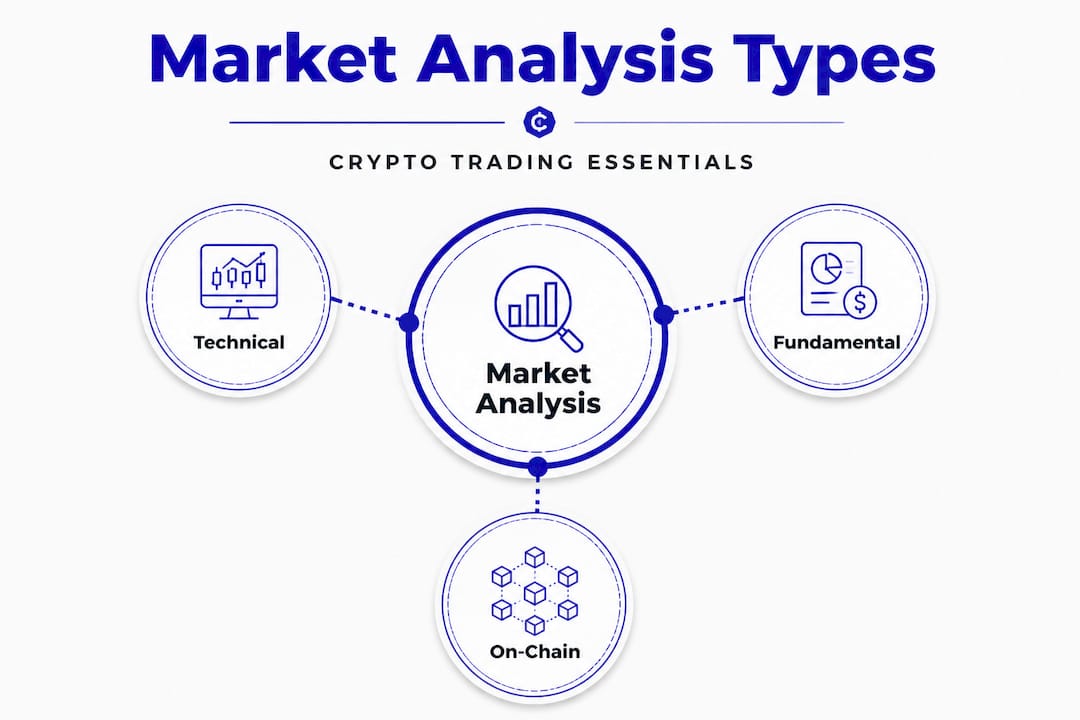
Fundamental analysis (FA) looks beyond the price to evaluate the actual value of a project. This includes examining the development team, the project’s whitepaper, token utility, partnerships, and broader macroeconomic factors. Is this project solving a real problem? Does it have genuine adoption? Is the team credible? These questions help you assess whether an asset is worth holding for the long term.
On-chain analysis is the most advanced type, and it’s unique to crypto. Because blockchain transactions are public, tools like Glassnode and Dune Analytics let you see what’s actually happening on the network — how many wallets are holding Bitcoin, how much capital is flowing into exchanges, whether large holders (often called “whales”) are accumulating or selling. This data can reveal crypto trends that price charts alone won’t show you.
Here’s a quick comparison of each approach:
| Analysis type | Best for | Key tools | Time horizon | Complexity |
|---|---|---|---|---|
| Technical analysis | Entry/exit timing | TradingView, RSI, MACD | Short to medium term | Beginner to intermediate |
| Fundamental analysis | Long-term valuation | CoinGecko, project whitepapers | Medium to long term | Intermediate |
| On-chain analysis | Market sentiment, whale tracking | Glassnode, Dune Analytics | Short to long term | Intermediate to advanced |
Research confirms that professional traders rely on multi-method frameworks, while retail investors tend to rely on a single type of analysis or worse, pure social sentiment. That gap in approach is a major driver of the gap in results. Understanding the role of on-chain analytics in crypto investing is an important step in moving from reactive to proactive trading. You can also explore our trend analysis guide to see how technical and on-chain signals work together in practice.
Pro Tip: Start with technical analysis to learn chart reading, then layer in fundamental research for the projects you hold long-term. Add on-chain tools once you’re comfortable with the first two. Building habits one step at a time prevents overwhelm and keeps you consistent.
Essential tools and platforms for smarter crypto analysis
Understanding the types of analysis is one thing. Knowing which specific tools to use is what turns theory into action. Fortunately, the crypto ecosystem has produced an impressive range of platforms, many of them free or low-cost, that bring serious analytical power to everyday investors.
For beginners, the easiest starting point is CoinMarketCap or CoinGecko. Both platforms provide real-time market data, price histories, trading volumes, market cap rankings, and basic project information. They’re clean, intuitive, and free. You can quickly compare assets, check 24-hour performance, and research projects without any technical background.
For intermediate users, TradingView is the gold standard. It provides advanced charting with hundreds of technical indicators, drawing tools, and the ability to set price alerts. You can overlay moving averages, plot Fibonacci retracements, and use custom scripts created by the community. Many experienced traders spend the majority of their analysis time here.
For advanced users, Glassnode and Dune Analytics provide deep on-chain data. Glassnode tracks metrics like the Bitcoin HODL waves (how long different groups have been holding), exchange inflows and outflows, and miner behavior. Dune lets you write custom queries directly against blockchain data, making it a powerful research tool for those who want to go deep.

Here’s a side-by-side look at the most popular tools:
| Tool | Best for | Cost | Learning curve |
|---|---|---|---|
| CoinMarketCap | Market data, rankings | Free | Very low |
| CoinGecko | Project research, data | Free | Very low |
| TradingView | Technical charting | Free/Paid | Moderate |
| Glassnode | On-chain analytics | Paid (free tier) | Moderate to high |
| Dune Analytics | Custom blockchain queries | Free/Paid | High |
| Trading bots | Automated execution | Varies | Moderate |
Key benefits of using purpose-built analysis tools include:
- Speed: Real-time data means you act on current information, not yesterday’s price
- Clarity: Visual dashboards remove the need to interpret raw numbers
- Objectivity: Indicators strip emotion from decision-making
- Automation: Bots and alerts execute your strategy without you watching the screen 24/7
Our market analysis toolbox brings many of these capabilities into one unified platform, so you’re not juggling five different browser tabs during volatile market conditions. If you want to simplify how you act on your analysis, our crypto trading recommendations feature translates market signals into clear, actionable suggestions.
Pro Tip: Set up price alerts on TradingView for assets you’re watching. This removes the urge to constantly check prices and keeps you informed only when something meaningful happens. Less screen time, better decisions.
How systematic analysis improves crypto trading outcomes
Let’s talk numbers, because this is where the argument for systematic analysis becomes undeniable. Studies show that structured trading strategies achieve 35 to 40% win rates with profit factors above 1.0 in crypto markets. That might not sound impressive at first, but here’s the key insight: you don’t need to win most of your trades to be profitable. You need your winning trades to be larger than your losing ones. Systematic strategies achieve this by defining rules in advance and sticking to them.
Compare that to random, sentiment-driven trading. Without analysis, you’re essentially flipping a coin on timing, but with the odds stacked against you because you’re trading emotionally, often buying high and selling low. Systematic approaches flip that dynamic.
For traders who want to go even further, hybrid models combining LSTM neural networks with ARIMA statistical forecasting have been shown to reduce prediction error by 32 to 64% compared to single-method approaches. These are the kinds of techniques that institutional desks use. They’re becoming more accessible thanks to platforms that automate the heavy lifting.
Here’s a simple, practical checklist to systematize your own analysis process:
- Check macro conditions first. Is the broader market trending up or down? Bitcoin’s direction often sets the tone for the entire crypto market.
- Identify your asset’s trend. Is the price making higher highs and higher lows (uptrend) or lower highs and lower lows (downtrend)?
- Review key support and resistance levels. Where has price reversed before? These levels often repeat.
- Check relevant on-chain metrics. Are exchange inflows rising (potential selling pressure) or falling (potential supply squeeze)?
- Assess project fundamentals. Is there recent news, partnerships, or development activity that affects the asset’s value?
- Set a clear entry, target, and stop-loss before you trade. Know your exit before you enter.
Automation is where this process becomes truly powerful. When you automate your crypto analysis, you remove the emotional interference that causes most losses. Alerts trigger, rules execute, and your strategy runs consistently regardless of whether you’re feeling confident or anxious that day. Pairing automation with solid trading strategies creates a repeatable system that compounds over time.
Pro Tip: Document every trade you make, including your reasoning, the signals you used, and the outcome. Reviewing this log monthly reveals patterns in your decision-making that you can improve. Most profitable traders are also diligent record-keepers.
What most traders get wrong about market analysis and how to fix it
We’ve reviewed the research, worked with investors across experience levels, and noticed a consistent pattern in how traders fail. And it almost never comes down to a lack of intelligence or effort. It comes down to a flawed approach to analysis itself.
The most common mistake is overreliance on a single signal. A trader discovers RSI, uses it for a few successful trades, and becomes convinced it’s the answer to everything. Then the market shifts, RSI gives a false signal, and a significant loss follows. No single indicator, no single method, and no single data source is reliable in isolation. Crypto markets are influenced by too many variables for any one lens to capture them all.
The second major error is treating social media as market analysis. Twitter trends, Telegram calls, and Reddit hype are not data. They’re noise with an agenda. Research consistently shows that retail investors relying on hype and social sentiment underperform those using structured, multi-method frameworks. The professionals who consistently generate returns are cross-verifying signals across technical charts, fundamental project research, and on-chain metrics before making a move.
The fix is a shift in mindset. Stop looking for the perfect indicator that tells you exactly when to buy and sell. That holy grail doesn’t exist. Instead, focus on building a process where multiple independent signals align before you commit capital. When your technical setup looks bullish, on-chain data shows accumulation, and fundamentals are solid, your conviction should be high. When only one signal is flashing, be cautious.
This approach is what mastering the crypto market analysis process is really about. It’s not about complexity for its own sake. It’s about building enough data points that your decisions stop being guesses and start being informed judgments. That transition is where consistent trading begins.
Connect analysis to action: Smarter trading with CryptoCracker
Understanding market analysis is a powerful first step. Applying it efficiently, every day, without drowning in data or juggling dozens of tools, is where most investors get stuck.

That’s exactly what we built CryptoCracker to solve. Our market analysis tool brings key technical indicators, market data, and performance trending signals into a single, clean dashboard that makes analysis actionable rather than overwhelming. You don’t need to be a data scientist to read it. You do need a reliable system, and we provide that. Our crypto trading recommendations feature translates complex signals into plain-language suggestions you can act on with confidence. Pair that with our portfolio tracking tools to track your portfolio performance over time, and you have everything you need to move from learning to consistent, informed investing.
Frequently asked questions
What is market analysis in crypto trading?
Market analysis in crypto trading is the process of reviewing data, trends, and blockchain activity to make better-informed buy or sell decisions. It enables systematic, data-driven decision-making that reduces the emotional mistakes most traders make.
Which are the best tools for analyzing crypto markets?
Popular tools include TradingView for charts, CoinMarketCap or CoinGecko for crypto data, and Glassnode or Dune Analytics for on-chain metrics. Top crypto trading tools cover a range of use cases from beginner dashboards to advanced blockchain data exploration.
How does market analysis help reduce risk in trading?
Systematic market analysis minimizes emotional decisions and improves entry and exit timing, which lowers losses and increases consistency over time. Reducing emotional biases through structured analysis is one of the most reliable ways to protect your portfolio.
Is relying on social media or hype a good strategy?
No. Studies show that following social media hype leads to significantly worse outcomes compared to using systematic analysis with proven market indicators. Market indicators consistently outperform social sentiment data in predicting crypto price movements.
Do professionals use different analysis strategies than beginners?
Yes, professionals blend technical, fundamental, and on-chain methods to build more reliable trade setups. Multi-method professional frameworks outperform the single-indicator or hype-based approaches that many beginners start with.