TL;DR:
- Investors often overlook trading fees, which can significantly erode profits, especially through hidden costs.
- Fee transparency includes revealing spreads, slippage, withdrawal, and deposit charges, not just visible trading fees.
- Reducing fee drag through platform selection and monitoring can greatly enhance long-term portfolio performance.
Most investors spend hours researching which coins to buy, yet they rarely scrutinize the fees they pay to trade them. That oversight is surprisingly costly. A Frankfurt School study found that total roundtrip trading costs vary enormously across exchanges, with some platforms charging over 12 times more than others for the same transaction. When fees are that opaque, even a well-timed investment can quietly bleed profits before you ever see them. Understanding fee transparency is not a bonus skill for advanced traders. It is the foundation of smarter, more profitable investing for anyone in the crypto space.
Table of Contents
- What is crypto fee transparency?
- How hidden fees erode crypto profits
- Spotting hidden costs: What to look for in trading platforms
- Long-term portfolio impact: The compounding effect of crypto fees
- Turning transparency into profits: Strategies that work
- The uncomfortable truth: Most investors underestimate fee drag
- Track, optimize, and profit with smarter crypto fee monitoring
- Frequently asked questions
Key Takeaways
| Point | Details |
|---|---|
| Fee transparency is crucial | Clear understanding and monitoring of all fees is vital for sustained crypto profitability. |
| Small costs have big impact | Tiny percentage differences in fees can compound into major losses or savings over time. |
| Know hidden fees | Look beyond headline rates to spot spreads, slippage, and other hidden trading costs. |
| Use transparent tools | Prefer exchanges and tracking platforms that clearly display all cost components. |
| Review fees regularly | Consistent monitoring and optimization of fee structures maximizes your crypto returns. |
What is crypto fee transparency?
Fee transparency means that a trading platform clearly discloses every cost associated with buying, holding, and selling cryptocurrency. That includes the obvious items like transaction fees, but also the less visible ones like spreads, slippage, and withdrawal charges. Many platforms make the first category easy to find and bury the rest in fine print or platform mechanics.
Understanding fee transparency basics starts with knowing what you are actually looking for. Here is a breakdown of the most common fee types every crypto investor should recognize:
- Trading fees (maker and taker): Charged when you place or fill an order. Makers add liquidity to the order book; takers remove it. Taker fees are usually higher.
- Spreads: The gap between the buy price and the sell price on any given asset. Platforms often widen this gap to generate revenue, especially on “simple buy” products.
- Slippage: The difference between the price you expected and the price you actually received, most common on large orders or illiquid trading pairs.
- Withdrawal fees: Charged when you move crypto off an exchange, and these vary widely by coin and network.
- Deposit fees: Less common but present on some platforms, especially for fiat currency deposits via card.
What makes this especially tricky is that some platforms advertise zero trading fees while quietly widening spreads and slippage, meaning you still pay, just not in a way that shows up in your fee summary. For active traders, this invisibility is a real problem. For novices, it can feel like the market is working against them when it is actually the platform mechanics doing the damage.
How hidden fees erode crypto profits
Now that we know what fee transparency is, here is how hidden costs can devastate even smart investing strategies.
The numbers here are striking. The Frankfurt School study compared total roundtrip trading costs across major European exchanges and found a staggering range:
| Exchange | Total roundtrip cost | Relative cost |
|---|---|---|
| Bitvavo | 0.53% | Lowest |
| Kraken | 0.98% | 1.85x more |
| Coinbase | 6.45% | 12x more |
That is not a minor variation. A 6.45% roundtrip cost means that every time you buy and then sell a position, you lose 6.45% of the trade value to fees before accounting for any market movement. For a $10,000 trade, that is $645 gone. On Bitvavo, the same trade costs $53. The gap is enormous, and it explains why two investors with identical strategies can achieve very different outcomes simply based on where they trade.
“Small fee differences can turn profitable strategies into losses. The total cost of trading, not just the headline fee, is what determines whether a strategy is viable or not.” — Frankfurt School of Finance & Management
Zero-fee platforms are another area where investors get caught off guard. These platforms are not charities. They generate revenue by inflating spreads and increasing slippage rather than charging explicit trading fees. For someone making one small purchase per month, the impact might be manageable. For high-frequency traders or anyone moving significant volume, the cumulative effect of hidden spread costs quickly outpaces what a transparent, low-fee exchange would charge.
High-liquidity pairs generally have tighter spreads, which helps reduce the invisible cost. Low-liquidity pairs are where costs spike fast. If you are trading smaller altcoins, slippage alone can add 1 to 3% to every transaction without ever appearing in your fee summary. When you are analyzing trading fees, it is essential to factor in the full picture, not just what the platform highlights in its pricing page.
Spotting hidden costs: What to look for in trading platforms
After seeing the cost impact, it is vital to know how to pick platforms that will not erode your profit before you even start. The good news is that with the right checklist, this is not as complicated as it sounds.
Here is what to evaluate before committing to any exchange:
- Does the platform disclose the true roundtrip cost? Look for total cost estimates that include both the buy and sell transaction, including spreads, not just the per-trade fee percentage.
- Are live spreads visible before you confirm a trade? A transparent platform shows you the current bid-ask spread in real time, especially on the order entry screen.
- Is slippage information available for large trades? Some platforms show price impact warnings when an order is large enough to move the market. If yours does not, that is a red flag.
- Does the platform separate maker and taker fees clearly? These two rates can differ significantly, and knowing which applies to your typical order type matters.
- Are withdrawal and network fees disclosed upfront? Look for a clear fee schedule that covers every coin you intend to withdraw, not just the major ones.
Pro Tip: Avoid the “simple buy” interface on most exchanges for anything beyond your very first purchase. According to Coin Bureau’s analysis, these simplified modes often carry spreads of 1 to 2% on top of trading fees, while the advanced trading interface on the same platform offers significantly lower effective costs. Switching tabs can literally save you money on every single trade.
For experienced traders, the checklist does not stop at fee rates. You should also be evaluating order-book depth, because a platform with competitive headline fees but shallow liquidity will cost you more in slippage on meaningful position sizes. Combining both metrics gives you the full picture. Understanding crypto investing best practices and actively reducing crypto trading risk go hand in hand when you start treating fees as seriously as you treat entry price.
Long-term portfolio impact: The compounding effect of crypto fees
Understanding costs in the moment is crucial, but the real significance is in how they add up over time. Fee drag is one of the most underappreciated forces in portfolio performance, and the math gets uncomfortable fast.
Consider a straightforward example. If you trade $20,000 worth of crypto per month, a 0.3% reduction in your effective fee rate saves you $60 per month. That is $720 per year. But if you are talking about a 0.3% lower roundtrip fee, applied to both the buy and the sell, you are looking at $18,000 saved annually at that volume. Over a seven-year period, factoring in compounding returns on money retained rather than paid out in fees, a 2% cost advantage can compound to over $48,000 in additional portfolio value.
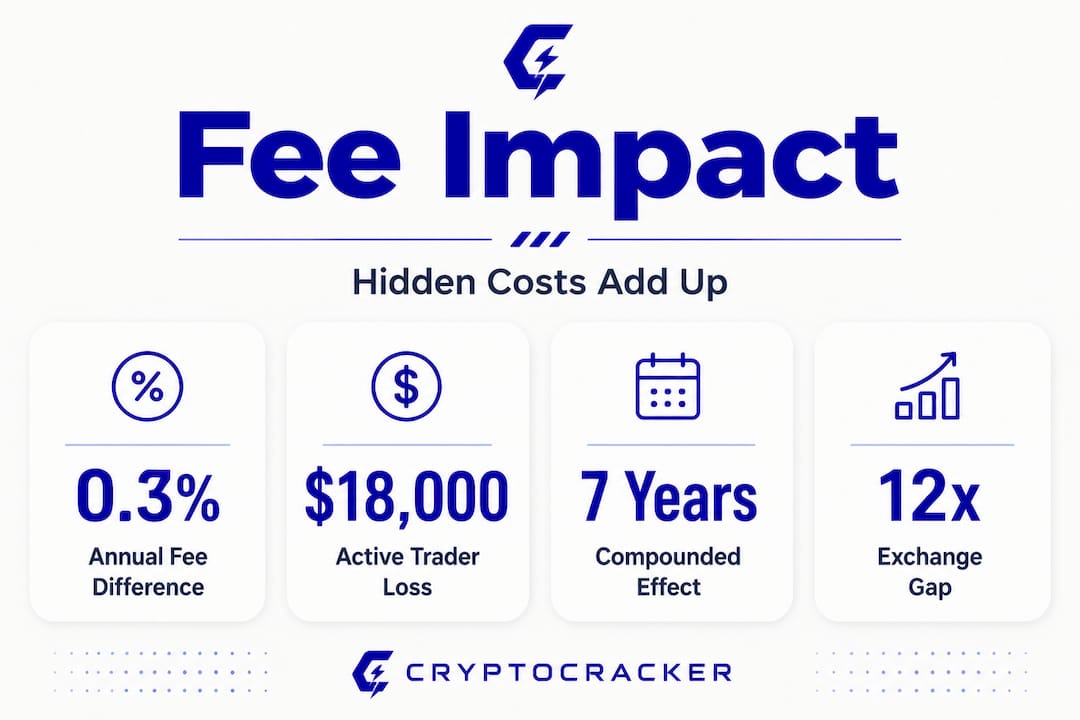
| Annual trading volume | Fee rate difference | Annual savings | 7-year compounded impact |
|---|---|---|---|
| $240,000 | 0.3% | $720 | ~$7,500 |
| $240,000 | 1.5% | $3,600 | ~$37,000 |
| $240,000 | 2.0% | $4,800 | ~$48,000+ |
These figures are not hypothetical luxuries for institutional traders. Even a retail investor making regular monthly trades can find themselves on the wrong side of these numbers if they never review their platform costs. The compounding effect works against you just as powerfully as it works for you in investment growth.
Here are the most effective ways to minimize compounding fee losses over time:
- Review your platform fees every quarter. Exchanges update their fee structures, and what was competitive a year ago may no longer be.
- Use transparent platforms that show full roundtrip costs. If you cannot see what you are paying, you cannot manage it.
- Favor high-liquidity trading pairs. Tighter spreads and lower slippage on popular pairs like BTC/USD or ETH/USD mean your effective cost is lower even if the headline fee is the same.
- Monitor fee changes and notifications. Set alerts or review changelog notices from your exchange so you are never surprised by a fee structure update.
- Avoid platforms that rely on spread-based revenue. If the trading fee is zero, look harder for where the real cost is hiding.
Exploring portfolio-boosting strategies alongside fee optimization gives you a compound advantage, reducing what leaves your portfolio while maximizing what grows inside it.
Turning transparency into profits: Strategies that work
Once you understand the landscape, here is how to actively apply this knowledge to every part of your portfolio and profit plan. Awareness alone does not generate savings. Action does.
Start with a simple audit of your recent trading history:
- Review your last 10 trades and compare the advertised fee to what you actually paid, including spreads and slippage.
- Calculate your true roundtrip cost for each trade by adding the entry and exit costs together, including any spread-related differences from the market price at the time.
- Identify which trades used “simple buy” modes and estimate what you would have paid using the advanced interface instead.
- Flag any trades on low-liquidity pairs where slippage added significant unplanned cost.
- Document your total fee spend over the last three months and project it annually.
This process often surfaces a number that surprises even experienced investors. The Frankfurt School study shows that fee structures vary dramatically across platforms, and most investors have never done this kind of direct audit for themselves.
Pro Tip: Pair your choice of transparent exchange with an automated portfolio monitoring tool that tracks true net returns, not just asset price changes. Real-time visibility into fee impact is the difference between knowing your fees in theory and actually catching them when they creep up. Many platforms quietly adjust spreads over time, and without monitoring, those changes go unnoticed until they have already cost you.
For those ready to act, exploring easy crypto trading strategies built around fee-efficient execution is a natural next step. Smart trading is not just about when you enter and exit. It is about how much of every gain you actually keep.
The uncomfortable truth: Most investors underestimate fee drag
Here is our honest take, and it is one we think the industry does not say loudly enough: behavioral habits, not lack of information, are the real reason most investors ignore fee drag.
Crypto investing is emotionally driven. People focus on which coin will 3x, which narrative is building, and which project has the best team. The grinding reality of transaction costs feels like a boring admin problem, not a strategic one. That psychological tendency to focus on the exciting upside and ignore structural costs is the platform’s best friend, and your portfolio’s quiet enemy.
We have seen the data firsthand. The Frankfurt School research confirms that fee differences of 12x between major exchanges exist in plain sight, yet most users never compare them. Platform marketing makes this worse. “Zero fees!” is a powerful slogan even when it is technically misleading. Users trust it, skip the fine print, and pay the invisible cost every time they trade.
The realities behind crypto trading include this uncomfortable dynamic: platforms are well-incentivized to keep their true cost structure confusing. True transparency demands that you treat fees as a recurring strategic variable, not a one-time setup decision. Review them the same way you would review your positions. Update your assessment when platforms change their structures. And never assume that a simple-looking interface is also a cheap one.
Smart investors we admire treat fee optimization as seriously as coin selection. It is not glamorous. But it is one of the very few levers in crypto investing that you can control directly, regardless of market conditions.
Track, optimize, and profit with smarter crypto fee monitoring
Fee transparency is not just a concept worth understanding. It is a competitive advantage you can act on starting today. The investors who consistently outperform over the long term are not always the ones with the best market calls. They are often the ones who understand exactly what every trade costs them and refuse to let invisible fees quietly shrink their portfolio.

At CryptoCracker, we built our platform specifically to eliminate this blind spot. Our portfolio tracking dashboard gives you real-time visibility into your actual trading costs, not just asset prices, so you can see fee drag as it happens. And our portfolio optimization tools go further, helping you identify where your fees are highest and suggesting actionable ways to reduce them. Whether you are a first-time investor or an active trader managing significant volume, CryptoCracker makes fee transparency something you can see, understand, and act on, without needing a finance degree to do it.
Frequently asked questions
What are the most common hidden fees in crypto trading?
The most common hidden fees include spreads, slippage, and penalties on forced liquidations, which many platforms do not disclose upfront. Zero-fee platforms are especially likely to recover revenue through inflated spreads.
How much can small fee differences really cost an investor?
Even a 0.3% difference in trading fees can add up to $18,000 annually for active traders, while a 2% advantage compounds to over $48,000 in portfolio value over seven years.
Which investors are most at risk from poor fee transparency?
Active traders, those trading illiquid altcoins, and users of simplified “simple buy” interfaces are most exposed, since hidden spreads of 1 to 2% are common in those modes without clear disclosure.
Can platforms legally hide crypto trading fees?
Most regulated platforms are required to disclose their official trading fee rates, but costs like spread inflation, slippage, and liquidation penalties are often technically legal to omit from headline pricing, meaning they fall on investors to investigate independently.