TL;DR:
- Building a structured crypto savings plan involves choosing the right method, executing consistently, and monitoring regularly.
- Diversify your savings across multiple platforms, understand risks, and incorporate DCA for long-term growth.
- Use automated tools and platforms for easier, disciplined investment and yield management over time.
Watching your crypto portfolio surge one week and shrink the next is genuinely frustrating, especially when you know the potential is there but the gains keep slipping away. Most investors buy, hold, and hope for the best. That’s not a strategy. It’s a wish. We built this guide because you deserve something better: a repeatable, step-by-step approach to growing and protecting your crypto wealth, regardless of where the market stands today. Follow along and you’ll leave with a concrete plan you can act on right now.
Table of Contents
- What you need to start your crypto savings plan
- Step 1: Choose your savings method
- Step 2: Execute your savings plan (with real examples)
- Step 3: Monitor results and avoid common mistakes
- When safe isn’t always best: A fresh look at crypto savings risk and reward
- Build your savings with smarter crypto tools
- Frequently asked questions
Key Takeaways
| Point | Details |
|---|---|
| Prepare essentials | Secure wallets, the right accounts, and safety checks are critical before starting your crypto savings journey. |
| Choose method wisely | Flexible, fixed, and DeFi savings each offer unique rewards and risks—pick what matches your needs. |
| Automate for consistency | Regular, automated contributions like DCA help harness long-term market growth without emotional errors. |
| Monitor and adjust | Regularly reviewing your plan and learning from mistakes keeps your crypto savings both safe and effective. |
What you need to start your crypto savings plan
Now that you know why a structured plan is crucial, let’s set up everything you need to get started before committing any funds.
Before you put a single dollar to work, you need the right foundation. Skipping this step is one of the most common mistakes new investors make, and it often leads to lost funds or missed yields. Think of this as your pre-flight checklist.
The core requirements:
- A verified account on a reputable centralized exchange (Coinbase, Binance, Kraken)
- A secure self-custody wallet for any assets you want to hold independently (MetaMask, Ledger)
- Two-factor authentication (2FA) enabled on every account you use
- A written record of your seed phrases stored offline
- A clear understanding of how much you can afford to lock away versus keep liquid
Once those basics are covered, you need to understand the three main environments where crypto savings happen. Each one works differently and carries its own risk profile.
CeFi (centralized finance) platforms are run by companies that manage your funds on your behalf, similar to a bank. They’re easy to use and often offer flexible access to your money. Yields typically sit between 1% and 5% for stablecoins and major coins. DeFi (decentralized finance) platforms run on smart contracts with no central authority. They can offer higher yields but come with smart contract risk and greater complexity. Staking involves locking up certain cryptocurrencies to support a blockchain network’s operations in exchange for rewards.
Here’s a comparison of the major options to help you decide where to start:
| Tool/Method | Typical Yield | Flexibility | Key Risk | Account Needed |
|---|---|---|---|---|
| CeFi flexible savings | 1–5% | High (redeem anytime) | Platform insolvency | Exchange account |
| CeFi fixed savings | 3–8% | Low (locked 7–120 days) | Lock-up, insolvency | Exchange account |
| DeFi yield farming | Variable | Medium | Smart contract bugs | Crypto wallet |
| Staking (PoS) | 4–12% | Low to medium | Slashing risk, lock-ups | Wallet or exchange |
One critical point that surprises many beginners: crypto savings accounts carry no FDIC insurance. If a platform collapses, as happened with Celsius and FTX, you may lose everything you deposited. The BIS has warned that major crypto exchanges are increasingly functioning as shadow banks without the safeguards traditional banks provide. Understanding this reality before you invest is not pessimism. It’s preparation.
To assess a platform’s reputation, look for transparent proof of reserves, a long operating history, clear terms around withdrawals, and active security audits. You can explore the crypto savings account basics to understand how different structures work before committing funds. And if you’re completely new to the space, the beginner crypto investing guide is a great place to build your foundational knowledge first.
Pro Tip: Never keep more than 20% of your total crypto holdings in any single savings platform. Spreading across two or three providers limits your exposure if one fails.
Step 1: Choose your savings method
With your tools and accounts in place, the next step is to select the most fitting savings method for your goals and risk profile.
This is where personalization matters. There’s no single best method for everyone. Your choice should depend on how long you can afford to leave funds untouched, how comfortable you are with complexity, and what yield expectations are realistic for you.
Here’s a direct comparison of the three main approaches:
| Method | Expected Yield | Access to Funds | Complexity | Best For |
|---|---|---|---|---|
| Flexible savings (CeFi) | 1–5% | Anytime | Low | Beginners, short-term goals |
| Fixed savings/staking (CeFi) | 3–8% | Locked 7–120 days | Low to medium | Medium-term goals |
| DeFi yield farming | Variable (often high, but volatile) | Usually flexible | High | Experienced users |
| Proof-of-Stake staking | 4–12% | Varies by network | Medium | Intermediate users |
In 2026, DeFi yields have compressed significantly, with stablecoin yields in some DeFi protocols falling to around 2.6% for USDC, which actually sits below traditional savings account rates of 3.14%. That’s a meaningful shift. It means the “high yield” justification for taking on DeFi risk is eroding, and choosing wisely matters more than ever.
How to pick the right method for your situation:
- Ask yourself how soon you might need this money. If there’s any chance you’ll need it within 30 days, stick to flexible savings only.
- Define your risk tolerance honestly. If the thought of a platform going offline keeps you up at night, CeFi flexible is your safest starting point.
- Consider your technical comfort level. DeFi requires you to interact with wallets, approve smart contracts, and monitor liquidity pools. If that sounds unfamiliar, start with centralized options.
- Review the current yield environment. With yields converging toward traditional finance rates, extra risk doesn’t always come with meaningful extra reward right now.
- Start with one method before adding others. Mastering flexible savings on a major exchange first gives you practical experience without overcomplicating your setup.
For most beginners, automating crypto savings through a centralized exchange’s flexible savings product is the most practical starting point. It’s low friction, fully reversible, and lets you build good habits without steep learning curves. Platforms like Binance offer a clean process: navigate to Earn, select Flexible, choose your coin, enter your amount, and interest begins accruing on a daily or hourly basis, with the ability to redeem back to your spot wallet whenever you choose.
Step 2: Execute your savings plan (with real examples)
Once you’ve chosen your method, it’s time to get practical. Let’s make your first deposit and see how a long-term mindset pays off.
Execution is where most plans fall apart. People intend to invest regularly but get distracted, wait for the “right moment,” or get spooked by a price dip and pause their contributions. The solution is to make the process as mechanical and emotion-free as possible.
Step-by-step deposit process for CeFi flexible savings:
- Log in to your exchange and complete any required identity verification if you haven’t already.
- Transfer funds from your bank account or convert existing crypto to your chosen savings coin (Bitcoin, ETH, or a stablecoin like USDC).
- Navigate to the Earn or Savings section of the platform following the Binance Flexible Savings steps as a reference model.
- Select your coin and enter the amount you want to subscribe. Start small if this is your first time.
- Confirm the subscription. Your funds will now begin earning interest, credited to your account automatically.
- Set a calendar reminder for your next contribution date so savings become a regular habit rather than a spontaneous decision.
Now let’s talk about the strategy that makes consistent investing genuinely powerful: Dollar-Cost Averaging (DCA). DCA means investing a fixed dollar amount at regular intervals regardless of price. When the price is high, you buy fewer units. When the price is low, you buy more. Over time, this smooths out the impact of volatility and builds a position steadily.
The results speak for themselves. Investing $10 weekly in Bitcoin from 2019 through 2024 turned a $2,610 total investment into $7,913, a return of approximately 202%. That outpaced both gold and the Dow Jones over the same period. Even more striking, a fear-based DCA strategy applied from 2018 through 2025, where investors bought slightly more during market downturns, returned around 1,145% compared to a standard buy-and-hold approach that returned 1,046%. Consistent, disciplined contributions beat trying to time the market.
A practical DCA case study:
Imagine you set aside $50 every Monday to buy Bitcoin. In a month where prices are high, you buy 0.0008 BTC. The following month, prices drop 30%, so your $50 buys 0.0011 BTC. After 12 months of $50 weekly contributions ($2,600 total), your average cost per coin is lower than if you had invested the full $2,600 on day one. This is the core logic. You stop trying to predict the market and simply let time and consistency do the work.
Pro Tip: Set up an automatic recurring buy on your exchange or use a crypto investing best practices framework to schedule your contributions in advance. Removing manual decisions from the equation dramatically improves consistency.
Step 3: Monitor results and avoid common mistakes
Executing is crucial, but ongoing monitoring and avoiding pitfalls will ultimately determine your success.
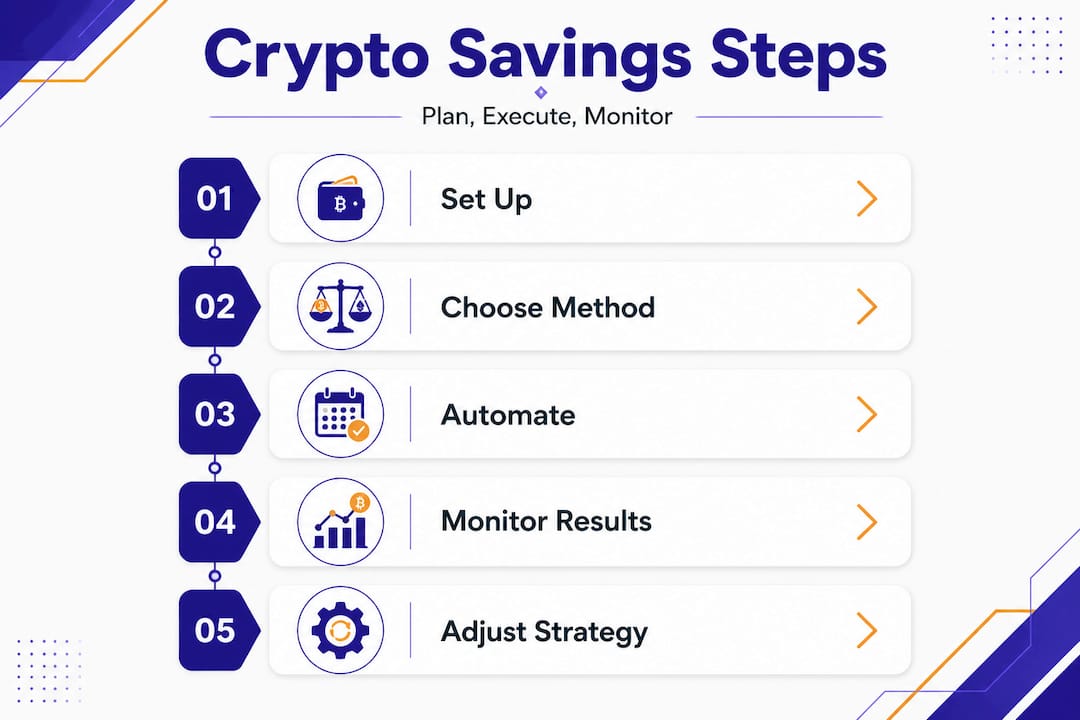
Many investors deposit funds and forget about them entirely. That feels like discipline, but it can actually expose you to risks that build up quietly over time. A platform’s yield rate might drop significantly. A lock-up period might trap your funds when you need liquidity. Or a security event might give you just hours to act before access is restricted.
Your regular monitoring checklist:
- Weekly: Check your account balance and confirm interest is accruing correctly. Note any announcements from the platform about rate changes or policy updates.
- Monthly: Review the current yield rate and compare it to alternatives. If rates have dropped significantly, consider reallocating to a better option.
- Quarterly: Audit your full portfolio allocation. Are you still within your comfort level for how much is locked versus liquid?
- Ongoing: Monitor news about any platform you use. Changes in regulatory status, leadership, or financial health are early warning signals.
The most common mistakes to avoid:
- Ignoring lock-up periods and then needing funds urgently, only to find them inaccessible for another 60 days
- Putting too much capital into a single platform without diversifying
- Forgetting to update your security settings after a password change or new device login
- Chasing the highest yield without investigating the underlying platform’s stability
- Assuming that because a platform was safe last year, it’s automatically safe today
Safety warning: Crypto savings carry real risks that traditional bank accounts do not. DeFi yields have fallen to 2.6% for some stablecoins, meaning the risk premium is shrinking. There is no FDIC protection here. Platform insolvencies like Celsius and FTX have wiped out billions in customer funds without warning. Stay alert, stay diversified, and never invest funds you cannot afford to lose.
To protect your assets actively, look into crypto safety strategies that go beyond basic passwords. Hardware wallets, multi-factor authentication, and using a dedicated email address for crypto accounts are among the most effective protective layers. Reviewing security best practices regularly keeps your approach current as threats evolve.
When safe isn’t always best: A fresh look at crypto savings risk and reward
Here’s the angle most crypto content misses: playing it too safe can actually work against you.
Consider this scenario. You keep all your crypto in a CeFi flexible savings account earning 2.5% annually. Inflation runs at 3.5%. Your real-world purchasing power is declining even though your balance is technically growing. The numbers say you’re earning. The reality says you’re falling behind. That’s the quiet danger of over-cautious crypto savings.
We’re not suggesting recklessness. What we’re saying is that risk needs to be understood dynamically, not just feared. In 2026, crypto exchanges functioning as shadow banks without regulatory safeguards means even “safe” CeFi options carry structural risk that isn’t fully visible to the average user. Ironically, thinking you’ve eliminated risk by choosing a familiar platform might make you less vigilant about that platform’s actual stability.
Think of it like choosing a route to work. The road you’ve driven a hundred times feels safe. But if there’s an unannounced road closure or a structural problem with a bridge you cross every day, familiarity isn’t the same as safety. The same logic applies to crypto savings platforms.
The smarter approach is a blend. Put the bulk of your savings into lower-risk, flexible options where you maintain access and visibility. Allocate a smaller portion, maybe 15 to 25%, to a moderate-risk approach like proof-of-stake staking on a well-established network. Use DCA for your growth-focused Bitcoin or Ethereum holdings. This layered structure means you’re building real wealth through appreciating assets while still maintaining liquidity and some income through yield.
This is exactly why starting with a clear crypto investing strategy from day one matters more than waiting for market conditions to feel perfect. Conditions never feel perfect. But a well-structured plan keeps you moving forward regardless.
Risk is not the enemy. Unexamined risk is.
Build your savings with smarter crypto tools
With a step-by-step savings plan in place, leveraging professional tools can make sticking to your strategy far easier.
You now have the framework. The real question is: how do you stay consistent over months and years without constant manual effort?

CryptoCracker is built specifically for this challenge. Our platform connects to your Coinbase account via secure API and gives you a real-time view of your portfolio performance, yield tracking, and savings progress all in one dashboard. You can set up automated crypto savings contributions that run on your schedule, removing the friction that causes most people to drift from their plan. Our portfolio optimization tools analyze your current allocation and surface data-driven suggestions to improve your yield-to-risk ratio. And through our crypto savings services, you can explore the savings structures best suited to your goals with clarity and confidence. No complexity, no guesswork.
Frequently asked questions
Is my crypto safe in savings accounts or staking platforms?
Crypto savings accounts and staking platforms are not insured, meaning you can lose funds due to hacks, platform insolvency, or forced lock-ups, as seen with Celsius and FTX.
What’s the best crypto savings method for beginners?
Flexible savings on major exchanges are the easiest starting point because your funds stay accessible and the subscription process is straightforward, with interest accruing daily and no lock-up periods.
How much can I earn with a crypto savings plan?
CeFi flexible savings yield 1–5% annually in 2026, while a disciplined DCA approach in Bitcoin has historically delivered much higher long-term returns, though past performance never guarantees future results.
Can I withdraw my funds anytime from crypto savings accounts?
Flexible savings accounts allow redemptions at any time, but fixed savings and staking often lock your funds for periods ranging from 7 to 120 days, so always check terms before committing.