TL;DR:
- Fintech platforms simplify trading with user-friendly interfaces, education, and scalable tools for all investors.
- They offer lower fees, higher liquidity, and 24/7 market access compared to traditional brokers.
- AI and automation enhance risk management and trading efficiency, making advanced strategies accessible to everyone.
Many crypto investors blame market volatility when their portfolios underperform. The real culprit is often something far more controllable: the wrong trading platform. Most people assume all platforms are roughly equal, that fees are fees and charts are charts. But the gap between a basic exchange and a purpose-built fintech platform can mean the difference between reactive guessing and confident, data-driven decisions. In this article, we break down how fintech platforms simplify trading, cut costs, integrate AI, and compare to DeFi alternatives, so you can make platform selection work as part of your strategy, not just a footnote.
Table of Contents
- How fintech platforms simplify crypto trading for everyone
- Cost, liquidity, and access: The fintech edge over traditional brokers
- AI, automation, and risk: How fintech tools power confident decision-making
- Fintech vs. DeFi: Centralization, regulation, and risk management
- What most traders miss when choosing crypto trading platforms
- Ready to trade smarter? Explore CryptoCracker solutions
- Frequently asked questions
Key Takeaways
| Point | Details |
|---|---|
| User-friendly for all | Fintech platforms simplify crypto trading with intuitive interfaces and guided tools for every experience level. |
| Lower costs, better access | Enjoy reduced transaction fees, deeper liquidity, and access to markets around the clock. |
| AI and automation edge | Leverage built-in AI, analytics, and risk management to trade smarter and manage your portfolio efficiently. |
| Centralized safety and regulation | Benefit from regulatory oversight, fraud protection, and streamlined experiences not found in DeFi. |
| Hidden value in platform choice | Choosing the right fintech platform sets up both beginners and pros for long-term trading success. |
How fintech platforms simplify crypto trading for everyone
Now that we’ve challenged common assumptions, let’s see how fintech platforms actually make trading easier for every level of investor.
The biggest barrier most new investors face isn’t market knowledge. It’s interface overwhelm. Fintech platforms are built around the idea that complexity should live under the hood, not on the screen. Clean dashboards, guided onboarding flows, and plain-language tooltips mean you can place your first trade without a finance degree. That’s not a small thing. It’s the difference between trying and quitting.
For newer traders, the benefits of crypto trading on a well-designed fintech platform are immediate. Features that matter most at the beginner stage include:
- Fractional shares: Buy a piece of Bitcoin for $10 instead of waiting until you can afford a full coin.
- One-click execution: Instant order placement without navigating multiple confirmation screens.
- Guided onboarding: Step-by-step setup that explains each feature as you go.
- In-app education: Tutorials, glossaries, and market explainers built directly into the platform.
- Demo or testnet modes: Practice trading with simulated funds before risking real capital.
Experienced traders aren’t left behind either. Fintech platforms for crypto trading offer simplified interfaces for novices and simultaneously provide algorithmic bots, AI analytics, margin trading, and portfolio rebalancing tools for advanced users. The same platform scales with you.
This scalability matters because your needs evolve. A tool that works for your first $500 investment should still be useful when you’re managing a diversified $50,000 portfolio. The best fintech platforms are built with that growth path in mind.
Education is woven into the experience on secure, user-friendly crypto platforms. Rather than sending you to a separate website or PDF, you learn as you trade. That ongoing skill development compounds over time, just like a good investment.
Pro Tip: Before committing real funds to any new platform, spend at least a week in demo mode. You’ll discover quirks in the interface, test your strategy logic, and build confidence without any financial downside.
Cost, liquidity, and access: The fintech edge over traditional brokers
With usability covered, it’s essential to consider the real-world advantages fintech platforms have in cost, liquidity, and market access.
Fees are the silent drain on any trading strategy. A 1% transaction fee sounds minor until you’re making dozens of trades per month. Over a year, that cost compounds into a significant drag on returns. Fintech platforms are built to compete aggressively on price, and the numbers reflect that.
Fintech platforms offer lower transaction costs ranging from 0.05% to 0.25%, compared to traditional broker fees of 0.1% to 1%, alongside enhanced liquidity, 24/7 access, and automated risk management. That fee gap is not trivial, especially for active traders.
| Feature | Fintech platforms | Traditional brokers |
|---|---|---|
| Transaction fees | 0.05% to 0.25% | 0.1% to 1% |
| Market hours | 24/7 | Limited (weekdays) |
| Liquidity | High (aggregated) | Varies by asset |
| Order book transparency | Full visibility | Often opaque |
| Maker fees (high volume) | Under 0.05% | Rarely available |
Liquidity is another area where fintech platforms pull ahead. Fintech exchanges offer transparent order books, maker fees below 0.05%, and Bitcoin trading volumes exceeding $20 billion, while traditional brokers may offer smoother execution for illiquid assets through internalization. For most retail and professional crypto traders, the fintech liquidity advantage is clear.
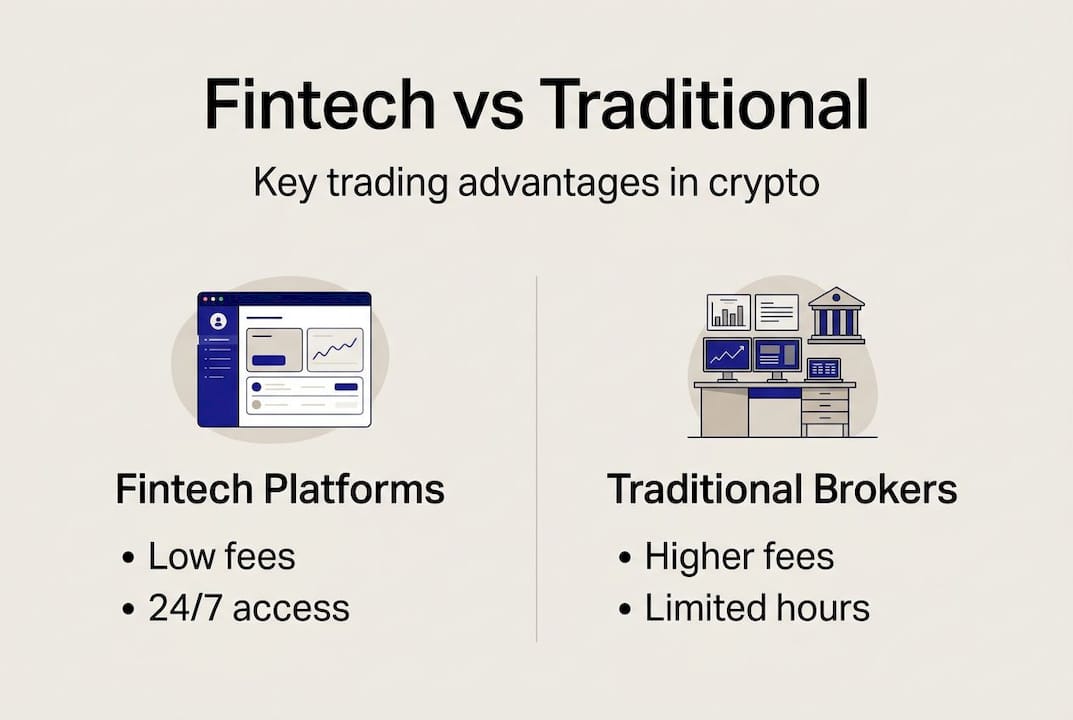
Market access is where the gap becomes impossible to ignore. Traditional brokers operate on weekday schedules tied to stock exchange hours. Crypto markets don’t care about weekends or holidays. A fintech platform lets you act on a market move at 2 a.m. on a Sunday. That kind of access isn’t a luxury. It’s a necessity in a market that never sleeps.
The COVID-19 period illustrated this vividly. During peak volatility in March 2020, traders on fintech platforms could respond in real time while those relying on traditional brokers faced delays, limited hours, and execution gaps. Speed and access directly translated into better outcomes.
Using analytics in crypto investing alongside low-cost fintech infrastructure is how serious investors build a structural edge over time, not just a lucky trade here and there.
AI, automation, and risk: How fintech tools power confident decision-making
Beyond cost and access, fintech platforms deliver major advantages with AI, automation, and data-driven risk management.

Artificial intelligence in trading isn’t science fiction anymore. It’s running quietly in the background of the platforms you use every day, analyzing price patterns, flagging anomalies, and suggesting portfolio adjustments before you’ve even noticed a shift in the market. The question isn’t whether AI matters. It’s whether your platform is using it well.
AI and ML integration provides predictive analytics, algorithmic trading, and fraud detection, and empirical data shows ML strategies outperform buy-and-hold approaches with higher Sharpe ratios during volatile periods. A higher Sharpe ratio means better returns relative to the risk taken. That’s the goal of every serious investor.
Here’s what AI and automation actually do for your portfolio on a well-built fintech platform:
- Predictive analytics: Identifies price trend signals based on historical and real-time data.
- Algorithmic trading: Executes buy/sell orders automatically based on pre-set rules, removing emotion from the equation.
- Automated rebalancing: Keeps your portfolio aligned with your target allocation without manual intervention.
- Stop-loss automation: Exits a position at a defined loss threshold, protecting you from catastrophic drawdowns.
- Fraud detection: Flags unusual account activity instantly, adding a layer of security beyond passwords.
The ML strategies for crypto trading that once required a quant team are now accessible through fintech platforms with a few configuration steps. That democratization of sophisticated tools is one of the most underappreciated shifts in investing over the past five years.
“ML-based trading strategies consistently demonstrate higher risk-adjusted returns compared to passive buy-and-hold strategies, particularly during high-volatility market conditions.”
If you’re serious about automating crypto trading, start with a single automation rule, monitor it for 30 days, and expand from there. Using crypto market analysis tools alongside your automation setup helps you verify that the logic is performing as expected.
Pro Tip: Never set an algorithm and forget it. Market conditions shift, and a rule that worked in a bull market can accelerate losses in a downturn. Review your automation settings at least monthly.
Fintech vs. DeFi: Centralization, regulation, and risk management
To round out your understanding, it’s vital to compare fintech platforms with fast-growing DeFi alternatives and see how risks and rewards stack up.
Decentralized finance, or DeFi, is the idea of running financial services on blockchain networks without any central authority. No company holds your funds. No compliance team reviews your transactions. That sounds liberating, and in some ways it is. But it also means no safety net.
Fintech offers convenience and speed through centralized custody, while DeFi provides decentralization without intermediaries but carries higher smart contract risks and volatility. Regulated fintech platforms like Coinbase also tend to yield higher listing returns for assets compared to unregulated alternatives.
| Feature | Fintech platforms | DeFi platforms |
|---|---|---|
| Custody | Centralized (platform holds funds) | Self-custody (you hold keys) |
| Regulation | Compliant with local laws | Largely unregulated |
| Speed | Fast, optimized | Varies by network congestion |
| Smart contract risk | Minimal | High |
| User experience | Streamlined | Often complex |
| Recovery options | Account recovery available | None if keys are lost |
Choosing between fintech and DeFi isn’t a binary decision. Many experienced investors use both. Here’s a practical framework for evaluating which suits your situation:
- Assess your technical comfort. DeFi requires managing private keys, wallets, and gas fees. If that sounds unfamiliar, start with fintech.
- Define your risk tolerance. Smart contract bugs have cost DeFi users billions. Fintech platforms carry counterparty risk, but regulatory oversight limits exposure.
- Consider your goals. Yield farming and liquidity provision are native to DeFi. Portfolio tracking, automated savings, and tax reporting tools are fintech strengths.
- Check regulatory context. If you’re operating under EU regulations, a compliant fintech platform provides legal clarity that most DeFi protocols cannot.
- Think about recovery. Losing access to a fintech account is recoverable. Losing your DeFi private key is permanent.
Understanding the DeFi vs fintech models helps you use trend analysis for smarter investing within whichever infrastructure fits your strategy best.
What most traders miss when choosing crypto trading platforms
With all the features, benefits, and trade-offs clear, let’s step back to address what most traders get wrong when picking their trading tools.
We see it constantly. Investors spend hours researching which coin to buy and about five minutes choosing where to buy it. That’s backwards. The platform is the infrastructure your entire strategy runs on. Getting it wrong compounds negatively, just as getting it right compounds positively.
The traders who struggle most aren’t usually making bad market calls. They’re paying too much in fees, missing automation tools they didn’t know existed, or holding positions without stop-loss protection because their platform doesn’t offer it. These aren’t market problems. They’re infrastructure problems.
Many investors also assume that AI and automation features are reserved for institutional traders or developers. They’re not. The real secret of crypto trading is that the best fintech platforms have made these tools accessible to anyone willing to spend an afternoon learning the settings. The edge isn’t hidden. It’s just underused.
Make platform selection a deliberate part of your strategy. Evaluate fees, automation depth, risk controls, and data quality before you place your first trade. The market is unpredictable. Your infrastructure doesn’t have to be.
Ready to trade smarter? Explore CryptoCracker solutions
If you’re ready to put these advantages into practice, CryptoCracker provides direct access to the cutting-edge tools covered above.
CryptoCracker brings together everything we’ve discussed into one accessible platform. From the market analysis tool that gives you real-time data visualizations, to portfolio optimization features that keep your allocations aligned with your goals, the platform is built for investors who want results without unnecessary complexity.

New users can explore the platform’s features with a guided setup that mirrors the demo-first approach we recommend. Whether you’re just starting out or looking to add automation and analytics to an existing strategy, CryptoCracker’s trading indicators and dashboard tools give you the fintech edge without the learning curve. Your next smarter trade starts here.
Frequently asked questions
What makes fintech platforms better for crypto trading than traditional brokers?
Fintech platforms have lower transaction costs and higher liquidity, plus they operate 24/7, giving traders access and cost advantages that traditional brokers simply cannot match.
Are AI and automation features in fintech platforms suitable for beginners?
Absolutely. Fintech platforms offer simplified interfaces and educational tools that guide beginners through automation setup, making AI-enhanced trading accessible without requiring technical expertise.
What are the major risks of fintech platforms compared to DeFi platforms?
Fintech is centralized and regulated, whereas DeFi is decentralized but carries higher smart contract risks, meaning fintech reduces certain technical risks while introducing counterparty and regulatory trade-offs.
How do fintech platforms improve risk management for crypto traders?
They provide automated stop-loss and diversification tools alongside real-time risk analytics, giving traders protective mechanisms that most traditional platforms do not offer.
Can professional traders also benefit from using fintech platforms?
Yes. Advanced tools and low maker fees benefit high-volume traders through deeper liquidity, algorithmic trading capabilities, and cost structures that scale favorably as trading volume increases.