Most people assume that making money in crypto requires constant chart-watching, complex technical analysis, and split-second decisions. The data tells a very different story. 92% of active traders underperform simple buy-and-hold strategies over time. That means the majority of people working the hardest at trading are actually earning less than those who set up a simple, automated approach and step back. This guide breaks down what simplified crypto trading is, why it consistently works, and the exact strategies and tools you need to get started today.
Table of Contents
- What is simplified crypto trading?
- Core strategies: Dollar-cost averaging and HODL
- Simplified trading versus active trading: What the data shows
- Choosing platforms and tools: Making simplified trading easy
- Psychological and lifestyle benefits of simplified crypto trading
- How to get started: A simplified trading workflow for 2026
- Take the next step with automated crypto solutions
- Frequently asked questions
Key Takeaways
| Point | Details |
|---|---|
| DCA and HODL outperform | Simple strategies like Dollar-Cost Averaging and HODL historically beat most active trading in crypto. |
| Automation lowers risk | Automated trading reduces fees, emotional mistakes, and saves time for all investors. |
| Platforms make it easy | Begin with reputable exchanges featuring DCA bots for simple, low-effort crypto investing. |
| Better lifestyle balance | Simplified trading frees you from daily stress and enables long-term portfolio growth with little oversight. |
What is simplified crypto trading?
Simplified crypto trading refers to user-friendly platforms, apps, and automated strategies that make cryptocurrency trading accessible by reducing complexity. Instead of requiring you to read order books or predict market cycles, simplified trading leans on automation, clear dashboards, and rules-based investing. The goal is to remove friction so you can invest consistently without needing a finance degree.
Platforms like Robinhood and Revolut have made this mainstream by offering commission-free trades and clean interfaces that anyone can navigate. But simplified trading is not just about easy apps. It is a philosophy: invest regularly, automate where possible, and let compounding do the heavy lifting. Whether you are exploring crypto trading strategies for beginners or you have been in the market for years, this approach fits.
Here is what simplified crypto trading typically includes:
- Fractional investing: Buy a slice of Bitcoin for as little as a few dollars
- Automated recurring purchases: Set it and forget it on a weekly or monthly schedule
- Portfolio tracking dashboards: See your performance at a glance without spreadsheets
- Low or zero trading fees: Keep more of your returns
- Clear performance indicators: Know when your portfolio is trending up or down without guesswork
“The best investment strategy is one you can stick to. Simplicity removes the barriers that cause most investors to quit or make costly mistakes.”
If you are just getting started, demystifying crypto investment is a great place to build your foundational knowledge before diving into specific strategies.
Core strategies: Dollar-cost averaging and HODL
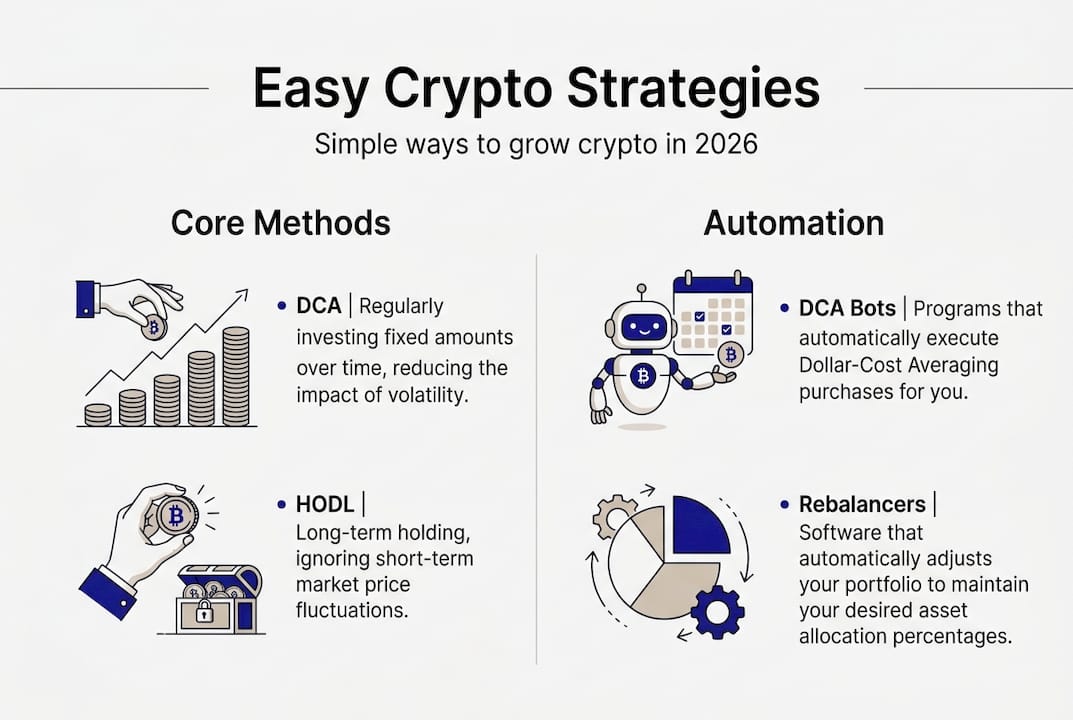
Two strategies dominate the simplified trading world: Dollar-Cost Averaging (DCA) and HODL. Both are straightforward, proven, and require minimal active management. Understanding them is the foundation of any smart, low-effort crypto portfolio.
Dollar-Cost Averaging (DCA) means investing fixed amounts at regular intervals regardless of the current price. Instead of trying to time the market and buy at the perfect low, you buy consistently. When prices drop, your fixed amount buys more coins. When prices rise, it buys fewer. Over time, this averages out your cost per coin and removes the stress of guessing market direction.

HODL (Hold On for Dear Life) is the strategy of buying and holding crypto assets long-term, ignoring short-term price swings. It sounds passive, but it is actually one of the most effective approaches in crypto history. The weekly BTC DCA from 2018 to 2026 produced approximately 1,145% returns, outperforming the vast majority of active traders over the same period.
Here is a side-by-side look at how DCA performs over different timeframes:
| Timeframe | Strategy | Approximate return |
|---|---|---|
| 2018 to 2026 | Weekly BTC DCA | ~1,145% |
| 2019 to 2024 | Weekly BTC DCA | ~202% |
| Same periods | Average active trader | Underperformed both |
How to implement DCA in four steps:
- Choose a reputable, low-fee exchange that supports recurring purchases
- Decide on a fixed amount you can invest weekly or monthly without stress
- Set up an automated crypto savings schedule so purchases happen without manual action
- Track performance quarterly using crypto trend indicators to stay informed without obsessing over daily prices
Pro Tip: Start with an amount so small it feels almost insignificant. Even $10 per week builds a meaningful position over years, and starting small removes the psychological pressure that causes most people to quit during market dips.
DCA bots take this a step further by automating the entire process. You set the rules once, and the bot executes purchases on schedule. This is especially useful for portfolio optimization because it removes human emotion from the equation entirely.
Simplified trading versus active trading: What the data shows
Active trading sounds exciting. The idea of catching a 30% move in a single day is appealing. But the reality for most investors is very different from the highlight reel. Let’s look at what the research actually shows.
Simple strategies like DCA and HODL consistently outperform active trading for the average investor. The reasons are not complicated: lower fees, fewer emotional mistakes, and the power of compounding over time. Active trading racks up transaction costs, triggers tax events, and exposes you to the psychological traps of fear and greed.
“95% of active funds underperform their benchmarks, primarily due to fees and emotional decision-making.”
Here is how the two approaches compare directly:
| Factor | Simplified trading (DCA/HODL) | Active trading |
|---|---|---|
| Time required | Minutes per month | Hours per day |
| Transaction fees | Low | High |
| Emotional stress | Low | High |
| Average long-term return | Outperforms most active traders | Underperforms for 92%+ of traders |
| Skill required | Minimal | Advanced |
| Tax complexity | Low | High |
The advantages of simplified trading at a glance:
- Lower costs: Fewer trades mean fewer fees and fewer taxable events
- Better risk control: Spreading purchases over time reduces exposure to bad timing
- Less time: You reclaim hours every week that active traders spend on charts
- Emotional stability: No panic selling, no FOMO buying, no regret spirals
- Consistent results: Rules-based investing beats gut-feel decisions over the long run
For those who want to boost their crypto portfolio without taking on excessive risk, simplified strategies offer the best risk-adjusted returns available to everyday investors. If you want to go deeper on market signals, crypto trend analysis tools can add a layer of insight without requiring you to become a full-time trader.
Choosing platforms and tools: Making simplified trading easy
The right platform makes all the difference between a strategy you stick with and one you abandon after a bad week. Here is what to prioritize when choosing where to trade.
First, look for exchanges that support automated recurring purchases. Reputable exchanges like Kraken and Binance allow you to automate DCA with minimal fees, which is the single most important feature for a simplified trading setup. Security reputation, regulatory compliance, and customer support quality matter just as much as the fee structure.
Key features to evaluate when choosing a platform:
- Automation support: Can you schedule recurring buys without manual action each time?
- Fee transparency: Are trading fees, withdrawal fees, and spread costs clearly disclosed?
- Portfolio tracking: Does the platform show your performance history in a clear visual format?
- Security standards: Does it offer two-factor authentication and cold storage for assets?
- User interface: Is the dashboard intuitive enough that you will actually use it regularly?
Pro Tip: Avoid platforms that make money primarily from your trading activity. Their incentives are misaligned with a simplified, low-frequency strategy. Look for platforms with flat subscription models or transparent per-trade fees.
For those ready to take their setup further, a dedicated crypto management platform can consolidate tracking, automation, and analysis in one place. Streamlining your trading workflows reduces the friction that causes most investors to make impulsive decisions. If you want to go fully hands-off, automating crypto trading through integrated tools is the logical next step.
Psychological and lifestyle benefits of simplified crypto trading
The financial case for simplified trading is strong. But the lifestyle case might be even more compelling for most people. Crypto markets run 24 hours a day, 7 days a week. Active traders are essentially on call around the clock. That is not sustainable, and it is not enjoyable.
Simplicity provides a genuine edge through lower costs, better emotion control, and significant time savings. When your strategy runs on autopilot, you stop checking prices every hour. You stop second-guessing every dip. You stop losing sleep over a red candle at 3 a.m.
“The investor who does nothing often outperforms the investor who does everything. Discipline is the real alpha.”
Here is what simplified trading gives back to your daily life:
- Time: Reclaim 5 to 15 hours per week that active traders spend monitoring markets
- Mental clarity: No more constant anxiety about whether to buy, sell, or hold
- Consistency: Automated strategies execute even when you are on vacation or busy with work
- Freedom from FOMO: A rules-based approach removes the fear of missing out on every new coin
- Better decisions overall: Less stress leads to clearer thinking across all areas of life
For investors focused on building wealth over years rather than days, long-term crypto savings strategies align perfectly with this mindset. You invest, automate, and let time do the work.
How to get started: A simplified trading workflow for 2026
Ready to put this into practice? Here is a clear, step-by-step workflow that works for both first-time investors and experienced traders looking to simplify their approach.
For all experience levels, the data is clear: start with automated DCA on low-fee platforms, monitor quarterly, and avoid over-optimization. Simple rules consistently outperform complex models in real-world portfolio studies.
- Pick a reputable exchange: Choose a platform with low fees, strong security, and built-in automation. Kraken, Binance, and Coinbase are solid starting points.
- Set up a recurring DCA purchase: Start with Bitcoin or Ethereum. Set a weekly or monthly amount that fits your budget without strain.
- Monitor quarterly, not daily: Check your portfolio every three months. Adjust only if your financial situation changes significantly, not because the market moved.
- Add experimentation carefully: Once your core DCA position is established, experienced investors can allocate a small percentage (5 to 10%) to grid bots or copy trading for diversification.
Pro Tip: Treat your DCA contribution like a utility bill. It goes out automatically on the same date every month, and you do not think twice about it. That mindset shift alone will improve your long-term results.
If you are still figuring out the basics, getting started with crypto covers everything from choosing your first wallet to making your first purchase with confidence.
Take the next step with automated crypto solutions
You now have a clear picture of why simplified trading works and exactly how to implement it. The next move is putting the right tools in place so your strategy runs smoothly without constant manual effort.

CryptoCracker is built specifically for investors who want the power of data-driven insights without the complexity of professional trading terminals. The platform offers automated crypto savings tools, real-time portfolio dashboards, and personalized recommendations that align perfectly with DCA and long-term holding strategies. Whether you are just starting out or looking to scale an existing portfolio, CryptoCracker portfolio optimization gives you a clear view of where you stand and what to do next. Start with the crypto wallet guide to make sure your assets are stored and managed securely from day one.
Frequently asked questions
Is simplified crypto trading only for beginners?
No. Simplified trading methods benefit both beginners and experienced investors by reducing risk, cutting costs, and removing emotional decision-making from the process.
Can you automate all of your crypto trading strategies?
Most core strategies like DCA and portfolio rebalancing can be automated on reputable exchanges like Kraken and Binance, though very advanced or custom strategies may still require some manual input.
Does Dollar-Cost Averaging (DCA) always outperform lump-sum investing?
Not always. During prolonged bull markets, lump-sum may outperform DCA, but DCA excels at minimizing regret, managing volatility, and keeping investors consistent through market cycles.
How much do you need to start with simplified crypto trading?
You can start with just a few dollars. Platforms like Robinhood and Revolut offer fractional investing and low minimums, making it easy to begin building a position regardless of your budget.
Which cryptocurrencies are best-suited for simplified trading?
Bitcoin and Ethereum are the go-to assets for DCA and long-term holds. Prioritizing BTC and ETH for your core portfolio gives you the best combination of liquidity, track record, and long-term growth potential.