TL;DR:
- Starting in 2026, EU crypto exchanges must report all user transactions to tax authorities.
- Proper recordkeeping of all taxable crypto activities is essential for compliance and tax savings.
- Compliance with DAC8 rules prioritizes accurate reporting over aggressive tax optimization.
Crypto tax compliance in the EU has never been more pressing. Starting in 2026, DAC8 rules require EU crypto exchanges to report all user transactions to tax authorities, dramatically reducing the room for error or omission. What used to feel like a gray area is now, effectively, a lit room. For EU investors, this shift means that even honest mistakes in your records can trigger audits or penalties. The good news? A clear, step-by-step approach to managing your crypto taxes not only keeps you compliant but also opens the door to real, legal tax savings. Let’s walk through exactly how to do it.
Table of Contents
- Understanding crypto’s tax obligations in the EU
- Preparing your crypto records: What you need to track
- Calculating your crypto taxes: Key methods and pitfalls
- Minimizing your crypto taxes legally in the EU
- Why compliance-first beats optimization for crypto investors in 2026
- Crypto tax management made simple with CryptoCracker
- Frequently asked questions
Key Takeaways
| Point | Details |
|---|---|
| Major tax events | Crypto sales, swaps, spending, and income are almost always taxable across the EU. |
| Accurate record-keeping | Build a detailed ledger tracking dates, costs, and transaction types for full compliance. |
| Leverage legal deductions | Loss harvesting and holding period exemptions can minimize taxes when allowed by local rules. |
| Compliance over shortcuts | With new 2026 reporting, complete transparency and documentation are your best defenses against errors and audits. |
Understanding crypto’s tax obligations in the EU
Before you can manage your crypto taxes, you need to know what actually triggers a tax bill. Not every crypto activity counts as a taxable event, but several common actions do. According to EU tax rules, taxable events typically include selling crypto for fiat currency, swapping one cryptocurrency for another, spending crypto on goods or services, and receiving crypto income through staking, mining, or airdrops.
Holding crypto is generally not taxed across most EU countries. If you buy Bitcoin and simply hold it, no tax is owed until you take action. That said, there are notable exceptions. Some countries apply wealth taxes or have specific rules for long-term holders, so it is worth checking your country’s local rules.
Here is a quick look at key differences across major EU countries:
| Country | Capital Gains Rate | Holding Period Exemption | Loss Carryforward |
|---|---|---|---|
| Germany | 0% after 12 months | Yes, over 12 months | Indefinite |
| France | 30% flat | No | Within tax year |
| Spain | 19% to 28% | No | Up to 4 years |
| Italy | 26% | No | Up to 4 years |
| Netherlands | Box 3 wealth tax | No | Limited |
As you can see, country rules vary significantly. What works well for a German investor may not apply in France or Spain. Understanding where you stand is the foundation of solid EU taxable events in crypto planning.
The biggest shift in 2026 is DAC8. This EU directive means all crypto platforms operating in the EU must report user transaction data to tax authorities starting January 2026. The practical implication for you as an investor is straightforward: tax authorities now see what exchanges see. Underreporting is no longer a calculated gamble. It is a near-certain risk. Investors familiar with tax rules for Irish crypto investors will recognize how quickly enforcement can tighten when reporting infrastructure improves.
Key taxable events to be aware of:
- Selling crypto for euros or any fiat currency
- Swapping between cryptocurrencies (e.g., ETH to BTC)
- Paying for goods or services with crypto
- Receiving staking, mining, or airdrop rewards
- Earning crypto interest from lending platforms
With crypto regulation changes accelerating across the EU, getting your fundamentals right now puts you ahead of the majority of retail investors.
Preparing your crypto records: What you need to track
Once you are clear on what activity is taxable, organizing your records can make or break your compliance and tax-saving efforts. Good recordkeeping is not optional anymore. It is your first line of defense.
Every transaction record should capture the following information:
- Date and time of the transaction
- Transaction type (buy, sell, swap, income)
- Amount of crypto involved
- Fiat value at the time of the transaction (in your local currency)
- Cost basis (what you originally paid for the crypto)
- Fees paid (exchange fees, gas fees, withdrawal fees)
- Platform or wallet where the transaction occurred
- Resulting balance after the transaction
Tracking all of this might sound like a lot, but it directly determines your gain or loss calculations. Missing even one of these fields, especially acquisition cost and fees, can produce inaccurate tax figures.
Here is a sample structure for your transaction ledger:
| Date | Type | Asset | Amount | Fiat Value (EUR) | Cost Basis (EUR) | Fees (EUR) | Platform |
|---|---|---|---|---|---|---|---|
| 2026-01-15 | Buy | BTC | 0.5 | 22,000 | 22,000 | 15 | Coinbase |
| 2026-03-04 | Sell | BTC | 0.25 | 13,500 | 11,000 | 10 | Coinbase |
| 2026-04-10 | Staking | ETH | 0.1 | 300 | 300 | 0 | Platform |
Building a step-by-step ledger like this ensures that when tax season arrives, you are not scrambling to reconstruct months of transactions from memory or scattered screenshots.

One point that many investors overlook: always reconcile your software-generated summary with your manual ledger. Crypto tax tools are helpful, but they can misclassify transactions or miss data from certain wallets. Cross-checking your records against exchange exports is the only way to catch discrepancies before the tax authority does.
Good crypto fee tracking tips can also help you recover money you are legally allowed to deduct. Fees paid on buy and sell transactions typically reduce your taxable gain, so capturing them accurately pays off directly.
Pro Tip: The three most common ledger mistakes are forgetting to include wallet transfer fees, using today’s price instead of the transaction-date price for fiat value, and lumping staking rewards together without individual timestamps. Avoid all three by exporting raw transaction data from your exchange immediately after each period ends. Tools that support your crypto trading workflow can automate much of this, but always verify the output.
Calculating your crypto taxes: Key methods and pitfalls
With your ledger ready, here is how to calculate what you actually owe and what critical pitfalls to watch for. The calculation process sounds technical, but it follows a clear logic once you understand the inputs.
Step-by-step gain calculation:
- Identify the disposal event (sell, swap, spend)
- Determine the proceeds (fiat value received or fair market value at time of disposal)
- Subtract the cost basis of the specific units disposed
- Subtract any fees directly attributable to the transaction
- The result is your taxable gain (or loss)
Now here is where method selection becomes critical. Your cost basis method determines which units you treat as sold, which directly affects the size of your gain. The three main options are:
- FIFO (First In, First Out): The oldest coins you bought are treated as sold first. Common and accepted across most EU countries.
- LIFO (Last In, First Out): The most recently acquired coins are treated as sold first. Less common in the EU and not accepted in all jurisdictions.
- Specific identification: You manually select which units to sell, giving maximum flexibility. Requires detailed records but offers the best control over taxable outcomes.
Choosing the right cost basis method is not just a technical preference. It can meaningfully change your tax bill, especially if you have been buying crypto at various prices over time.
Common pitfalls to avoid:
- Treating crypto-to-crypto swaps as non-taxable (they are taxable in most EU countries)
- Forgetting to report staking and mining rewards as income in the year received
- Mismatching lots when using specific identification without a proper audit trail
- Using average pricing in a country that requires FIFO
Edge cases are where most investors go wrong. Lot selection and staking rewards are two areas where errors are especially common and especially costly. Using crypto tax calculation tools can help automate the math, but always review the output for classifications that don’t look right.
Pro Tip: Run your numbers with both FIFO and specific identification before filing. In some portfolios, the difference in tax owed can be significant. Choose the method your jurisdiction allows and that produces the most favorable compliant outcome.
Minimizing your crypto taxes legally in the EU
Knowing your tax calculation options opens real opportunities to reduce what you owe. Here is how to do it by the book.
The most powerful legal strategies available to EU crypto investors include tax-loss harvesting and holding period exemptions. Tax-loss harvesting means intentionally selling assets that are currently at a loss to offset gains you have realized elsewhere. This reduces your net taxable gain for the year, lowering your overall tax bill without hiding anything.
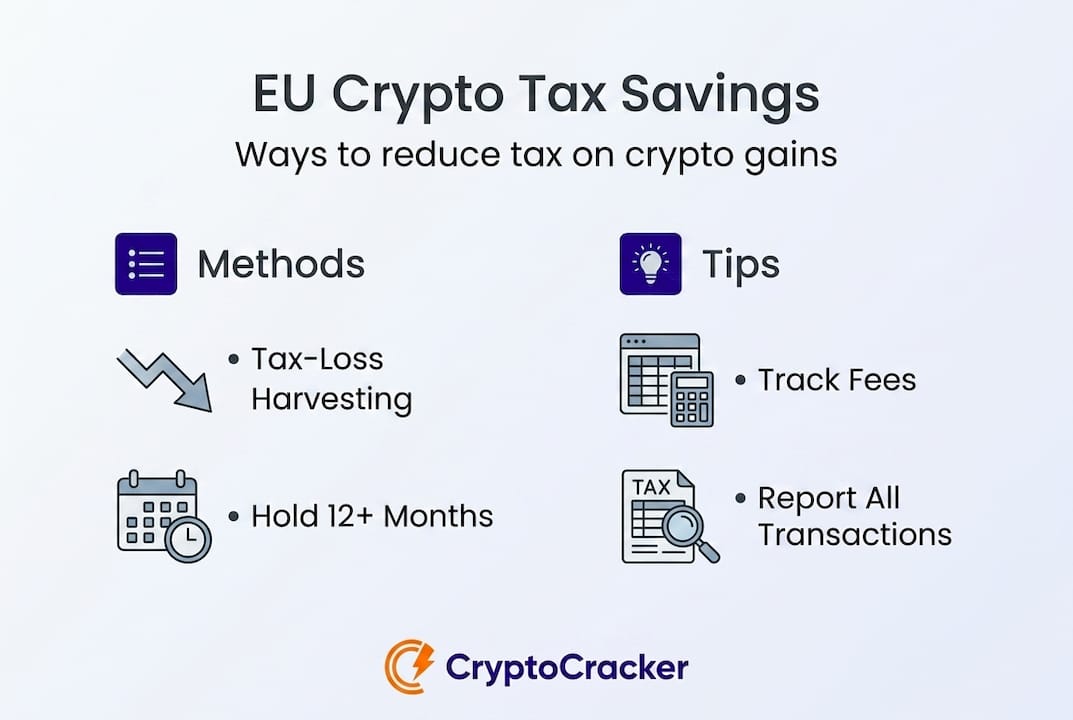
Germany’s 12-month exemption is arguably the most investor-friendly rule in the EU: if you hold crypto for more than 12 months before selling, your gains are completely tax-free. That single rule has made long-term holding an especially attractive strategy for German residents.
For other EU countries, here is how loss offset and carryforward rules compare:
| Country | Loss Offset (Same Year) | Carryforward Period |
|---|---|---|
| Germany | Yes | Indefinite |
| France | Yes (capital losses only) | Within tax year |
| Spain | Yes | Up to 4 years |
| Italy | Yes | Up to 4 years |
| Netherlands | Limited (Box 3) | Limited |
Loss carryforward rules vary widely across EU countries, with some allowing only in-year offsets and others extending up to four years or indefinitely. Knowing your country’s specific rules can shape your trading calendar in powerful ways.
Legal tax minimization strategies:
- Harvest losses before year-end to offset gains
- Avoid selling long-term holdings prematurely if you are near the exemption threshold
- Keep detailed records of every loss event for carryforward purposes
- Review country-specific crypto tax strategies applicable to your jurisdiction
- Use portfolio tax optimization tools to model the tax impact of trades before executing
Pro Tip: Never attempt wash-sale-style strategies where you sell an asset for a loss and immediately rebuy it to game your tax position. While the EU does not have a single universal wash sale rule like the US, national tax authorities are increasingly alert to artificial transactions, and DAC8 gives them the data to spot patterns. Stick to genuine, documented losses.
Why compliance-first beats optimization for crypto investors in 2026
Here is our honest take, and it might surprise you: in 2026, the biggest financial risk for most EU crypto investors is not missing a tax-saving strategy. It is getting caught underreporting.
DAC8 has changed the enforcement landscape fundamentally. Tax authorities now receive direct, structured data from every major crypto exchange operating in the EU. That means the era of “they can’t see it anyway” is genuinely over. Before you spend energy optimizing your tax position, you need to be certain your compliance foundation is solid.
We have seen the advice columns that lead with aggressive optimization strategies. But reporting transparency under DAC8 means optimization pursued without perfect documentation is now a liability, not a strategy. The ROI on clean, transparent, complete reporting is higher in 2026 than it has ever been.
Our recommendation: treat compliance as your first priority and optimization as a second-order benefit. Get your records straight, minimize crypto tax liabilities within documented rules, and only then explore advanced strategies. That order matters more now than it ever did before.
Crypto tax management made simple with CryptoCracker
Managing crypto taxes across an increasingly regulated EU landscape is a genuine challenge. But you don’t have to do it manually or alone.

CryptoCracker is built to support EU crypto investors at every stage of the tax and compliance process. From automated portfolio tracking and performance dashboards to crypto tax software options comparisons and EU-focused compliance resources, the platform puts clarity within reach. Whether you want to optimize your crypto portfolio for after-tax returns or simply stay audit-ready, CryptoCracker gives you the tools to manage your investments with confidence, without needing to be a tax expert yourself.
Frequently asked questions
What triggers a crypto taxable event in the EU?
Selling, swapping, and spending crypto, as well as receiving crypto income, are taxable in most EU countries. Simply holding tokens is generally not taxed, though some countries have specific exceptions.
Do I have to report all crypto transactions under the new DAC8 rules?
Yes. As of 2026, EU exchanges must report all client transaction data to tax authorities. Investors should ensure their own records match what exchanges report to avoid discrepancies.
How can I legally minimize my crypto taxes in the EU?
The most effective legal methods include tax-loss harvesting and, where eligible, holding period exemptions such as Germany’s 12-month rule that makes long-term gains fully tax-free.
What are common mistakes in crypto tax reporting?
Missing fees, misclassifying cost basis lots, and mishandling staking reward records are the most frequent errors. Keeping audit-ready records prevents all three.
Does every EU country allow loss carryforward for unsold crypto?
No. Loss carryforward rules vary widely: France limits offsets to within the reporting year, Germany allows indefinite carryforward, and Spain and Italy permit up to four years.