TL;DR:
- AI is now integrated into platforms accessible to everyday crypto investors for real-time signal generation and automated trading. Reinforcement learning enables AI systems to adapt to evolving market conditions and regime changes. Proper validation, risk controls, and layered strategies are essential for sustainable AI-driven crypto trading.
If you think AI-powered crypto trading is reserved for data scientists and quant firms, that assumption is already outdated. AI tools are no longer locked behind walls of code and expensive infrastructure. Today, they sit inside platforms that ordinary investors use every day, quietly filtering noise, generating signals, and managing risk in real time. We put this guide together to show you exactly what AI does in crypto trading, how the frameworks work, and how you can start applying these ideas without needing a computer science degree.
Table of Contents
- What does AI do in crypto trading?
- AI-powered trading frameworks: From signals to execution
- Reinforcement learning and adapting to crypto’s market cycles
- AI for risk management, portfolio control, and compliance
- A smarter trading edge: What most guides miss about AI in crypto
- Leverage AI for smarter crypto investing with CryptoCracker
- Frequently asked questions
Key Takeaways
| Point | Details |
|---|---|
| AI does the heavy lifting | Machine learning automates signal generation, trade execution, and risk controls for crypto investors. |
| Smart validation beats complexity | A simple, well-tested workflow will outperform relying on unproven black-box models. |
| AI adapts to markets | Reinforcement learning and adaptive frameworks help your strategies keep up with shifting crypto trends. |
| Integrated compliance matters | AI-driven compliance and fraud detection are critical to protecting portfolios in volatile crypto environments. |
What does AI do in crypto trading?
Now that you know why AI isn’t just hype, let’s clarify what it actually does in practical terms.
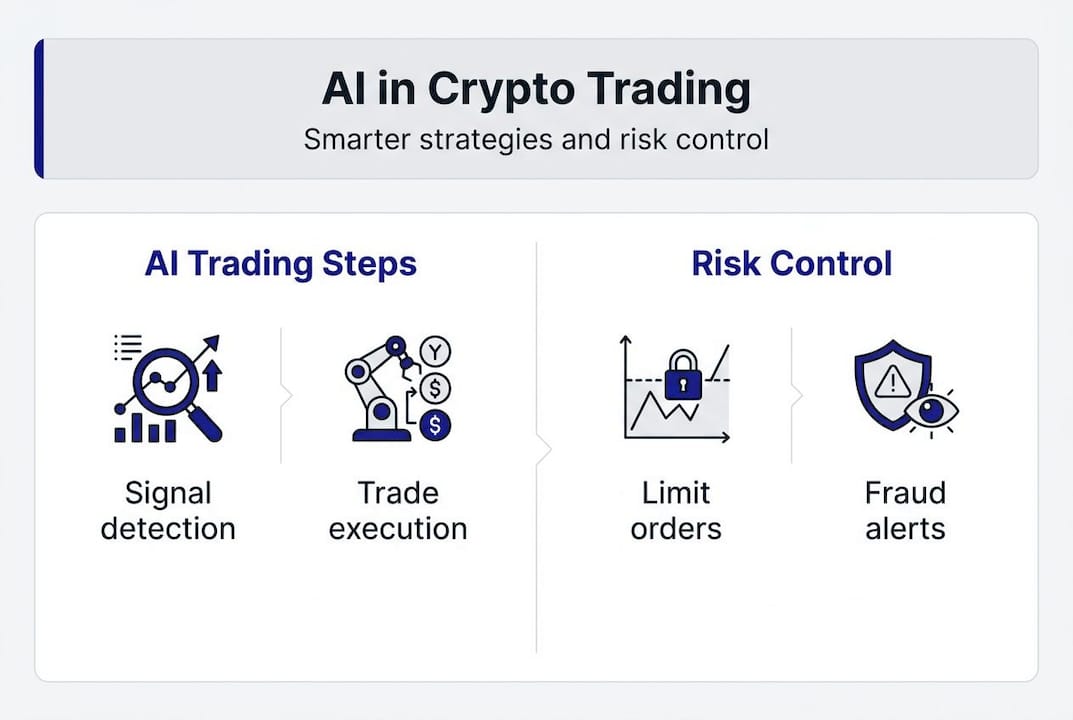
At its core, AI in crypto trading performs two distinct jobs. The first is generating signals: telling you when conditions suggest buying, selling, or holding based on patterns in price data, volume, and market sentiment. The second is executing decisions automatically, faster than any human could react, while applying risk rules in the background.
The most common model types you’ll encounter are:
- Supervised learning models: Trained on historical data to predict future price movements or classify market conditions
- Reinforcement learning (RL): An agent that learns by trial and error, rewarding profitable decisions and penalizing losses over time
- Ensemble methods and transformers: Newer architectures that combine multiple models or process long data sequences to spot complex patterns
AI/ML in crypto trading is commonly used as both a predictive layer for signals and price forecasts, and a decision layer for automated trading and risk and portfolio optimization, often via supervised models and reinforcement learning.
One underrated benefit: AI removes emotional bias from your decisions. It does not panic during a flash crash or get greedy during a bull run. It sticks to the rules you set or that the model has learned. That consistency is genuinely hard to replicate manually. You can read more about how AI trading signals work and why automation in trading is becoming the default for serious portfolio management.
Research spotlight: Recent studies highlight that transformer architectures and ensemble methods are increasingly powering real-time crypto market analysis, moving well beyond simple moving averages into adaptive, multi-variable systems.
AI-powered trading frameworks: From signals to execution
With a clear sense of AI’s role, let’s see how it actually fits into the workflow you’d use as a trader.

A well-built AI trading system is not a single black box. It has separate layers, each doing a specific job. Understanding those layers helps you evaluate any platform or tool you consider using.
| Stage | What it does | AI’s role |
|---|---|---|
| Signal generation | Identifies potential trade opportunities | Predictive models, pattern recognition |
| Order execution | Places trades at the right price and time | Automated order routing, latency optimization |
| Risk controls | Limits exposure and protects capital | Position sizing, stop-loss triggers, circuit breakers |
Here is how a typical AI-assisted trade flows from start to finish:
- Data ingestion: The system pulls in price data, order book depth, and sometimes on-chain metrics or news sentiment
- Signal generation: The AI model processes the data and outputs a directional signal, buy, sell, or hold
- Pre-trade risk check: Before execution, the system verifies that the trade fits within your position limits and risk budget
- Execution: The order is placed automatically, often split across time or price levels to minimize slippage
- Post-trade monitoring: The system tracks open positions against risk thresholds and adjusts or closes them as needed
For anyone building or evaluating AI-enabled systems, a practical AI trading workflow typically separates strategy logic, execution, and risk controls into distinct modules, making the system easier to test and improve.
Pro Tip: When backtesting any AI strategy, always include realistic slippage and trading fees in your simulation. Many backtests look great on paper but fail live because they ignore execution costs. If your model cannot stay profitable after accounting for fees, it needs more work before you risk real capital.
Backtesting is where most retail traders go wrong. A strategy that looks perfect on historical data may be exploiting patterns that no longer exist. Honest validation, using data the model never saw during training, is the only way to know if you have something real.
Reinforcement learning and adapting to crypto’s market cycles
While AI-powered frameworks are versatile, the real test comes when markets change. Here’s where reinforcement learning makes a difference.
Reinforcement learning is different from standard prediction models. Instead of learning a fixed mapping from input to output, an RL agent learns a policy: a set of rules for taking actions in a changing environment to maximize long-term reward. That makes it a natural fit for crypto, where conditions shift faster than most static models can handle.
| Feature | Reinforcement learning | Supervised learning |
|---|---|---|
| Learns from | Interaction and feedback | Labeled historical examples |
| Best for | Dynamic decisions, execution | Price prediction, classification |
| Main strength | Adapts to new regimes | Strong on stable patterns |
| Main weakness | Needs careful reward design | Struggles with sudden change |
RL is frequently positioned for dynamic decision-making tasks such as trade execution and asset allocation that adapt to evolving market conditions, including volatility and regime changes.
In experimental setups using BTC/USDT data, RL agents have outperformed static strategies during volatile periods. However, the results depend heavily on how the reward function is designed and whether the model was validated on data it has never seen. Crypto’s non-stationarity demands regime-aware frameworks and leakage-safe validation, meaning you cannot simply trust a backtest that uses the same data for training and testing.
Pro Tip: Always use walk-forward validation when testing RL strategies. This means training on one time window, testing on the next, then moving the window forward. It simulates how the model would actually perform in real time and is far more reliable than a single backtest run.
Robust validation is not optional, it is the foundation of any strategy worth trusting. Combining RL with sound reducing risk in crypto trading practices gives you a much better shot at sustainable results.
AI for risk management, portfolio control, and compliance
AI in crypto is not just about forecasting prices; it changes how you control risk and maintain trust, even behind the scenes.
Most investors focus on the signal side of AI, but the risk management side is equally powerful and arguably more impactful for long-term portfolio health. AI continuously monitors your exposure across assets and triggers predefined controls when thresholds are breached.
Common AI-driven risk controls include:
- Dynamic stop-losses: Adjusted automatically based on current volatility rather than fixed dollar amounts
- Position size limits: Scaled to your overall portfolio value so no single trade can do catastrophic damage
- Exposure monitoring: Real-time tracking of concentration risk across coins, sectors, or correlated assets
- Fraud detection and compliance flagging: AI scans transaction patterns to catch suspicious activity before it escalates
- Transaction monitoring: Automated checks that flag unusual flows for regulatory review
AI is also used beyond trading signals for crypto compliance and fraud detection, impacting venue integrity, operational risk, and ecosystem trust. This matters to you as an individual investor because the platforms and exchanges you use are relying on these systems to keep your funds safe.
Machine learning is increasingly used for automating risk controls and optimizing portfolios, which means the technology is not just about making money faster but about keeping losses small and portfolios balanced. Pairing smart risk reduction strategies with a solid crypto risk assessment process, alongside portfolio optimization with AI, creates a much more resilient investment approach.
Operational risk matters too. If a platform goes down during a volatile moment, or if a liquidity crunch hits a smaller exchange, AI systems that monitor ecosystem-level risk can help you exit positions before the situation worsens.
A smarter trading edge: What most guides miss about AI in crypto
Here is something we do not see discussed often enough: the single biggest mistake people make with AI trading tools is treating them like finished products. They run a backtest, see a strong result, and assume the model is ready. It usually is not.
The honest truth is that validating AI with out-of-sample tests and realistic performance metrics is the only way to avoid backtest overfitting, a situation where a model performs brilliantly on past data but fails completely on live markets. More complexity is not always better. A simple, well-validated model with clear rules often outperforms elaborate systems that were tuned to fit historical noise rather than capture real market dynamics.
We also see too much dependence on single-model predictions. Real edge comes from layering multiple signals, validating each one independently, and maintaining a disciplined crypto trading workflow that keeps testing and adaptation continuous. AI gives you a genuine edge only when paired with intellectual honesty about what your data is actually telling you.
Leverage AI for smarter crypto investing with CryptoCracker
If you want to put this knowledge into practice, here’s how specialized AI-powered tools can help you start smart.
CryptoCracker brings together the key capabilities we have covered in this guide, from signal generation to portfolio optimization and risk control, without requiring you to write a single line of code.

With CryptoCracker’s market analysis tool, you get real-time data-driven insights built for everyday investors. You can act on AI-based trading recommendations tailored to your portfolio, and take advantage of portfolio optimization features that keep your holdings balanced and risk-managed automatically. The platform integrates directly with Coinbase via API, so your data is live and your actions are secure, all within a clear, accessible dashboard designed to make AI your ally, not your obstacle.
Frequently asked questions
Is AI-based crypto trading profitable for individual investors?
Performance gains from AI are closely linked to validation quality and avoiding overfitting, so results depend on the strategy, market conditions, and how rigorously the model was tested, not just the technology itself.
Do you need programming skills to use AI in crypto trading?
AI and ML frameworks are increasingly accessible to non-experts, and many modern platforms now offer AI-driven features through intuitive interfaces that require no coding at all.
How does AI help manage crypto trading risk?
AI is used for compliance, fraud detection, and automated risk controls in crypto trading, meaning it can set stop-losses, flag suspicious activity, and monitor position limits without any manual input from you.
Can AI adapt to sudden market regime changes in crypto?
RL is well-suited for adapting to regime changes in crypto markets, unlike static models that rely on patterns from a specific historical period and often break down when conditions shift.
Recommended
- Why use fintech platforms for trading: smarter crypto strategies | CryptoCracker
- Simplified crypto trading explained: easy strategies in 2026 | CryptoCracker
- How crypto trading recommendations work: signals to portfolios | CryptoCracker
- Top crypto trading strategies to boost your portfolio | CryptoCracker