Cryptocurrency trading can feel overwhelming without a clear roadmap. Individual investors often struggle with account setup, choosing the right strategies, and managing risk effectively. This comprehensive guide walks you through a proven workflow designed for both novices seeking user-friendly approaches and experienced traders looking to refine their systems. You’ll discover step-by-step processes covering secure account creation, strategic trade execution, portfolio monitoring techniques, and common pitfalls to avoid. By following this structured approach, you’ll transform confusion into confidence and build a sustainable trading practice that aligns with your financial goals.
Table of Contents
- Preparing Your Crypto Trading Workflow: Accounts, Security, And Funding
- Executing Trades Effectively: From Simple Orders To Advanced Strategies
- Monitoring And Managing Risk For A Balanced Crypto Portfolio
- Common Pitfalls And Troubleshooting Your Crypto Trading Workflow
- Optimize Your Crypto Trading Workflow With Cryptocracker
- Frequently Asked Questions
Key takeaways
| Point | Details |
|---|---|
| Secure foundation matters | Setting up verified accounts with two-factor authentication and proper funding creates the essential base for successful crypto trading. |
| Strategy drives outcomes | Selecting appropriate trading pairs and matching strategies to your risk tolerance significantly impacts your portfolio performance. |
| Automation reduces errors | Using automated tools and clear risk management rules helps maintain discipline and protects capital during volatile market conditions. |
| Balance creates stability | Combining long-term core holdings with tactical active trading offers strategic flexibility while reducing emotional decision-making. |
Preparing your crypto trading workflow: accounts, security, and funding
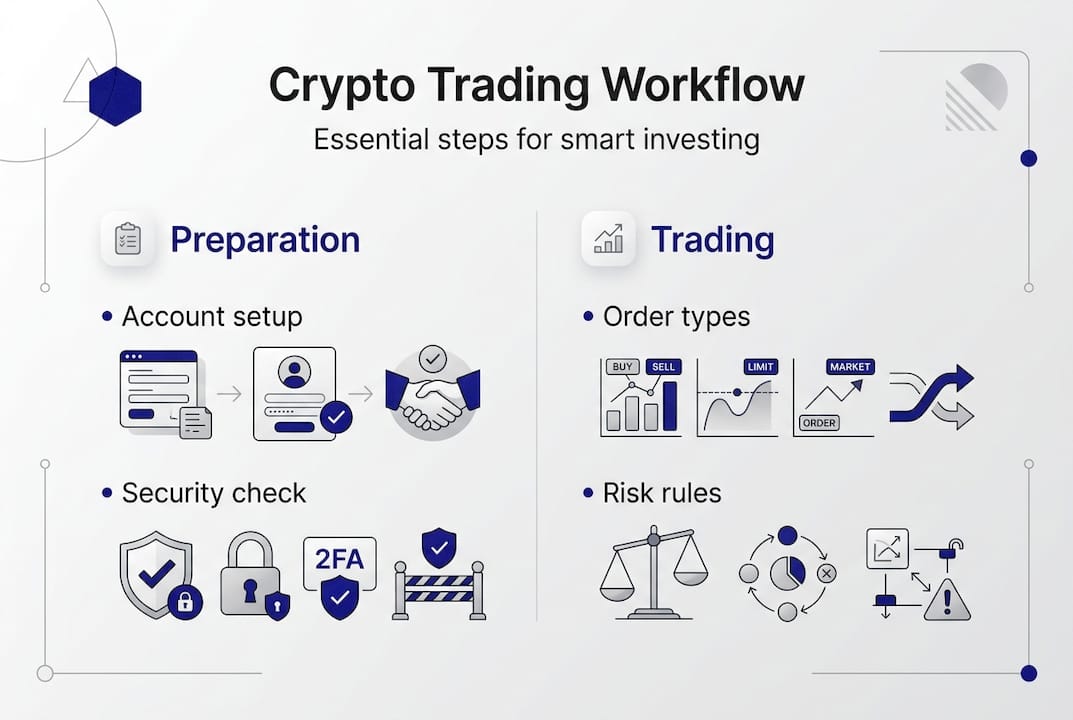
Your trading journey begins with selecting the right exchange platform. Reputable exchanges like Binance and Coinbase offer intuitive interfaces that simplify the learning curve for newcomers while providing advanced features for experienced traders. These platforms prioritize security and regulatory compliance, giving you peace of mind as you build your portfolio.
Completing Know Your Customer verification represents your first critical step. This process involves submitting identification documents and proof of address to comply with financial regulations. While it may seem tedious, KYC verification protects both you and the exchange from fraudulent activity and ensures you can access full platform features without restrictions.
Security measures extend beyond initial verification. Enable two-factor authentication immediately after creating your account to add an extra layer of protection against unauthorized access. This simple step dramatically reduces the risk of account compromise, even if someone obtains your password. Consider using authenticator apps rather than SMS-based codes for enhanced security.
Funding your account requires strategic thinking about your initial capital allocation. You can deposit fiat currency through bank transfers or credit cards, or transfer existing cryptocurrencies from external wallets. Each method carries different fees and processing times, so evaluate options based on your urgency and cost sensitivity.
Before executing your first trade, spend time exploring the exchange interface. Familiarize yourself with order types, chart tools, and portfolio tracking features. Most platforms offer demo modes or small test trades that let you practice without significant financial risk. This preparation phase builds confidence and reduces costly mistakes when real money enters the equation.
Pro Tip: Start with a small deposit to test the entire workflow from funding to trading to withdrawal. This hands-on experience reveals potential issues before you commit substantial capital.
Essential account setup checklist
- Choose an exchange with strong security reputation and user reviews
- Complete KYC verification with accurate, current documents
- Enable two-factor authentication using an authenticator app
- Set up withdrawal whitelists to restrict fund transfers to verified addresses
- Document your account credentials securely using a password manager
Funding method comparison
| Method | Processing Time | Typical Fees | Best For |
| — | — |
| Bank Transfer | 1-5 business days | Low (0.5-1%) | Large deposits, cost-conscious investors |
| Credit Card | Instant | High (3-5%) | Urgent trades, small amounts |
| Crypto Transfer | 10-60 minutes | Network fees only | Existing crypto holders |
| Wire Transfer | 1-3 business days | Moderate (1-2%) | International deposits |
Executing trades effectively: from simple orders to advanced strategies
Selecting the right trading pairs forms the foundation of successful execution. Liquid pairs like BTC/USDT offer tight spreads and quick order fills, making them ideal for beginners learning basic trading mechanics. These high-volume markets reduce slippage and provide consistent pricing, allowing you to enter and exit positions efficiently.
Market orders execute immediately at current prices, offering simplicity for straightforward trades. Limit orders give you price control, letting you specify exact entry and exit points. Beginners often start with market orders for small positions, then graduate to limit orders as they develop price awareness and strategic patience.
Advanced strategies open new possibilities for portfolio growth. Funding arbitrage and long/short positions have demonstrated stable returns with controlled drawdowns in recent market conditions. These approaches require deeper understanding but offer superior risk-adjusted performance compared to simple buy-and-hold tactics.
Automation tools transform complex strategies into manageable systems. Rather than manually monitoring markets 24/7, you can set parameters that execute trades based on predefined conditions. This approach removes emotional interference and ensures consistent application of your chosen methodology, whether you’re implementing proven trading strategies or developing custom rules.
Balancing simplicity with sophistication depends on your experience level and time commitment. New traders benefit from straightforward approaches that build foundational skills, while experienced investors can leverage automated trading systems to execute multi-layered strategies across numerous assets simultaneously.
Pro Tip: Paper trade new strategies for at least two weeks before risking real capital. This practice reveals flaws in your logic and builds confidence in your execution plan.
Step-by-step trade execution process
- Analyze market conditions using technical and fundamental tools
- Determine position size based on your risk management rules
- Select appropriate order type matching your strategy and urgency
- Set stop-loss and take-profit levels before entering the trade
- Execute the order and document your rationale for future review
- Monitor the position according to your predetermined schedule
- Close the trade when conditions meet your exit criteria
Trading approach comparison
| Approach | Complexity | Time Required | Risk Level | Potential Returns |
|---|---|---|---|---|
| Simple Market Orders | Low | Minimal | Moderate | Variable |
| Limit Order Strategies | Medium | Moderate | Moderate | Consistent |
| Funding Arbitrage | High | Low (automated) | Low | Stable, modest |
| Long/Short Trading | High | High | High | Potentially superior |
Monitoring and managing risk for a balanced crypto portfolio
Regular portfolio monitoring separates successful traders from those who abandon positions to chance. Establish a consistent review schedule that matches your trading timeframe. Day traders check positions hourly, while swing traders might review daily, and long-term investors weekly. This disciplined approach keeps you informed without triggering impulsive reactions to normal market fluctuations.

Risk management rules protect your capital during inevitable downturns. Implementing 1-2% stop-loss limits prevents single trades from devastating your portfolio. These predetermined exit points remove emotional decision-making when positions move against you, preserving capital for future opportunities.
The eternal debate between holding and trading often creates unnecessary stress. Research consistently shows that HODL strategies typically outperform retail trading attempts, yet active trading offers valuable learning experiences and potential tactical gains. The solution lies not in choosing one approach exclusively but in combining both intelligently.
A hybrid strategy allocates 80% of capital to core holdings in established cryptocurrencies while dedicating 20% to active trading opportunities. This structure provides stability through your long-term positions while allowing you to develop trading skills and capture short-term momentum. The majority holding reduces stress, knowing that trading mistakes won’t jeopardize your entire investment thesis.
Portfolio management tools automate much of the monitoring burden. Automatic trailing stop-loss features lock in profits as positions move favorably while protecting against sudden reversals. These systems work continuously, applying your risk rules even when you’re sleeping or away from screens.
Pro Tip: Review your worst-performing trades monthly to identify patterns in your decision-making. This reflection builds self-awareness and prevents repeated mistakes that erode returns.
Core risk management practices
- Never risk more than 2% of total portfolio value on a single trade
- Diversify across multiple cryptocurrencies to reduce concentration risk
- Maintain emergency reserves in stablecoins for buying opportunities
- Use position sizing calculators to determine appropriate trade amounts
- Document every trade decision to build accountability and learning
“Professional traders focus on process over outcomes. They know that following proven risk management principles consistently produces superior long-term results, even when individual trades fail.”
Balancing holding and trading
Successful investors recognize that long-term crypto investment provides the foundation for wealth building. Your core holdings should represent assets you believe will appreciate over years, not months. Bitcoin and Ethereum typically anchor these positions due to their established networks and adoption trajectories.
Your trading allocation serves different purposes. Use this portion to learn market dynamics, test new strategies, and capture shorter-term opportunities. Profits from successful trades can either compound within the trading allocation or migrate to your core holdings, creating a systematic wealth-building flywheel.
Common pitfalls and troubleshooting your crypto trading workflow
Fixed stop-loss levels represent one of the most common errors in crypto trading. Markets exhibit varying volatility across different conditions, yet many traders set rigid stops that don’t account for normal price fluctuations. This approach triggers unnecessary exits during temporary pullbacks, locking in losses that would have reversed. Instead, calculate stop distances based on recent volatility metrics, allowing positions room to breathe while still protecting against genuine trend reversals.
Chasing trades based on recent performance creates a dangerous cycle. A strategy showing high win rates over the past month might simply be experiencing favorable market conditions rather than demonstrating sustainable edge. Retail investors frequently fall victim to this recency bias, entering positions precisely when mean reversion becomes most likely. Evaluate strategies over complete market cycles, not cherry-picked timeframes.
Emotional trading destroys more portfolios than market crashes. Fear drives premature exits from winning positions, while greed encourages holding losers too long. The antidote involves systematic workflows that remove discretionary decisions during high-stress moments. When your predetermined rules signal an exit, execute immediately without second-guessing or hoping for better prices.
Fee impacts accumulate insidiously, especially for active traders. A strategy generating 15% annual returns might net only 8% after accounting for exchange fees, network costs, and slippage. Calculate your all-in costs before committing to high-frequency approaches. Sometimes a simpler strategy with fewer transactions produces superior after-fee performance.
Workflow optimization requires honest assessment of what’s working and what isn’t. Many traders continue ineffective practices simply because they invested time learning them. Be willing to abandon approaches that don’t produce results, regardless of sunk costs. Markets evolve constantly, demanding flexibility and continuous improvement from participants.
Pro Tip: Keep a trading journal documenting not just what you traded but how you felt during the decision. Emotional patterns often predict mistakes before they happen.
Avoiding common mistakes
- Adjust stop-loss distances based on current market volatility, not arbitrary percentages
- Evaluate strategies over 6-12 month periods, not recent hot streaks
- Follow your trading plan even when emotions suggest otherwise
- Calculate total fees before assuming a strategy is profitable
- Review and update your workflow quarterly based on results
Systematic workflow enhancement steps
- Document your current complete trading process in detail
- Identify specific pain points causing stress or errors
- Research solutions used by successful traders facing similar challenges
- Implement one improvement at a time to isolate effects
- Measure results objectively over meaningful timeframes
- Keep changes that improve outcomes, discard those that don’t
- Repeat the cycle continuously as markets and your skills evolve
Recognizing when you need help accelerates improvement. Retail investor challenges often stem from trying to solve every problem independently. Leveraging educational resources, community insights, and professional tools fills knowledge gaps faster than trial-and-error learning alone.
Optimize your crypto trading workflow with CryptoCracker
Transforming knowledge into results requires the right tools supporting your workflow. CryptoCracker eliminates the complexity that prevents many investors from implementing proven strategies consistently. The platform integrates seamlessly with your Coinbase account, providing real-time portfolio tracking and actionable insights without requiring technical expertise.

Advanced automation features let you implement sophisticated strategies with simple configuration. Whether you’re executing portfolio optimization techniques or building wealth through automated crypto savings, CryptoCracker handles the technical execution while you focus on strategic decisions. The platform’s automatic trailing stop-loss protection safeguards your gains even during volatile market swings, applying professional-grade risk management without constant monitoring. Clear visualizations and personalized recommendations guide your decisions, transforming raw data into actionable intelligence that improves outcomes.
Frequently asked questions
What is the basic crypto trading workflow for beginners?
A solid beginner workflow starts with creating a verified account on a reputable exchange, enabling security features like two-factor authentication, and funding the account with an amount you’re comfortable risking. Next, familiarize yourself with the platform interface and start with simple market or limit orders on liquid pairs like BTC/USDT. As you gain confidence, implement basic risk management rules such as position sizing limits and stop losses, then gradually explore more advanced strategies while maintaining detailed records of your trades and decisions.
How can I balance long-term holding and active trading?
The most effective approach allocates roughly 80% of your portfolio to core holdings in established cryptocurrencies you believe will appreciate over years, while dedicating 20% to active trading for learning and tactical opportunities. This structure provides stability through your long-term positions while allowing skill development and short-term profit capture. Profits from successful trades can either reinvest in the trading allocation or migrate to core holdings, creating a systematic wealth-building process that reduces overall portfolio stress.
What are common mistakes to avoid in a crypto trading workflow?
Avoid setting fixed stop-loss percentages that don’t account for varying market volatility, as this triggers unnecessary exits during normal price fluctuations. Don’t chase strategies showing recent high win rates without evaluating performance over complete market cycles. Resist emotional decision-making by following predetermined trading rules even when fear or greed suggest otherwise. Always calculate total fees before assuming a strategy is profitable, as transaction costs can eliminate gains from high-frequency approaches.
Why use automated tools in crypto trading workflow?
Automation ensures faster trade execution, eliminates human errors during high-stress moments, and maintains consistent application of your risk management rules without requiring constant monitoring. Automated systems work 24/7, capturing opportunities and protecting positions even when you’re sleeping or away from screens. These tools remove emotional interference from trading decisions, applying your predetermined strategy with discipline that’s difficult to maintain manually during volatile market conditions.