TL;DR:
- Most crypto investors lack structured tracking, risking unrecognized underperformance and unmanaged risks.
- Regular performance review using key metrics and benchmarks is essential for informed decision-making.
- Using the right tools and techniques, including DeFi dashboards and tax-aware trackers, enhances portfolio management.
Most crypto investors don’t actually know if they’re winning. They check prices, feel good during bull runs, and panic during dips — but without structured tracking, you’re essentially flying blind with real money on the line. The good news is that tracking your portfolio performance doesn’t require a finance degree or hours of spreadsheet work each week. Whether you’re just getting started or you’ve been in the market for years, we’ve put together the tools, metrics, and step-by-step strategies you need to measure what matters, cut through the noise, and make smarter decisions with your crypto.
Table of Contents
- Understanding crypto portfolio tracking: Why it matters and common challenges
- Essential metrics for measuring crypto portfolio performance
- Step-by-step: How to track your crypto portfolio performance
- Advanced tactics: Tax reporting, DeFi analytics, and privacy-first tracking
- Why most crypto investors don’t realize they’re underperforming the market
- Streamline your tracking with CryptoCracker’s solutions
- Frequently asked questions
Key Takeaways
| Point | Details |
|---|---|
| Know your tracking options | There’s a spectrum from spreadsheets to all-in-one trackers and DeFi dashboards—choose what fits your needs. |
| Choose the right metrics | Profit/loss, allocation, and benchmarking are crucial for understanding real portfolio health. |
| Automate and review | Set up regular reviews with user-friendly apps to catch issues and maximize returns. |
| Handle complex cases wisely | Use specialized tools for tax reporting and DeFi assets to avoid errors and stay compliant. |
| Balance privacy and convenience | Manual methods protect privacy, while dedicated apps offer automation—match the approach to your comfort level. |
Understanding crypto portfolio tracking: Why it matters and common challenges
Tracking your portfolio isn’t just about watching numbers go up or down. It’s about knowing why they move, which assets are pulling their weight, and where your capital is sitting idle. Investors who skip this step often discover too late that they’ve been holding underperformers while missing better opportunities. Done right, portfolio tracking gives you the clarity to act on data rather than emotion.
The challenge? Crypto is uniquely complicated to track. You might hold assets across three exchanges, two hardware wallets, and a couple of DeFi (decentralized finance) protocols. Each platform speaks a different language. Add in staking rewards, liquidity pool positions, and taxable events, and you’ve got a recipe for confusion. Keeping up with crypto market analysis tool can feel overwhelming, but the right approach makes it manageable.
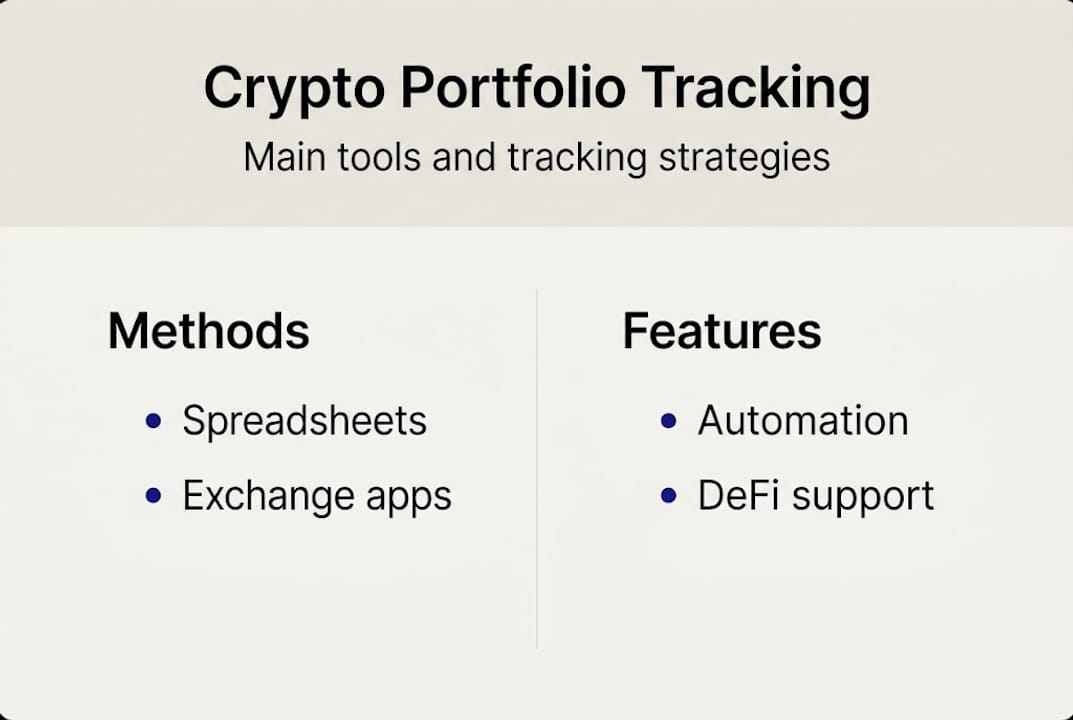
The tracking options overview shows that the main methods to track crypto portfolios include spreadsheets, exchange apps, dedicated trackers, and DeFi dashboards. Each comes with real tradeoffs.
| Method | Pros | Cons |
|---|---|---|
| Spreadsheets | Full privacy, customizable | Fully manual, error-prone |
| Exchange apps | Simple, auto-synced | Only covers one exchange |
| Dedicated trackers | Multi-exchange, analytics | Requires API setup, cost |
| DeFi dashboards | On-chain visibility | Limited to DeFi assets |
Before you pick a method, learn what mistakes to avoid. The most common tracking errors we see include:
- Tracking only one exchange while holding assets elsewhere
- Forgetting to log DeFi rewards or staking income
- Failing to account for gas fees and transaction costs
- Comparing performance without using a benchmark
- Reviewing performance inconsistently or only during volatility
If you want to monitor crypto markets effectively, consistent, structured tracking is your foundation. It’s also worth exploring cryptomanager alternatives to find the platform that fits your workflow.
A regular performance review, done weekly or monthly, is one of the highest-value habits an investor can build. Without it, even a well-constructed portfolio can drift into unrecognized risk.
Essential metrics for measuring crypto portfolio performance
Armed with an understanding of the tracking landscape, you’ll need to know which metrics matter most. Not all numbers are created equal in crypto. Some tell you what happened; others tell you what to do next.
Profit and loss (P&L) is the starting point. P&L simply measures how much you’ve gained or lost in dollar terms across a given time period. It sounds obvious, but many investors confuse unrealized gains (paper profits) with realized ones (cash in hand). Keeping these separate is critical for both decision-making and tax reporting.
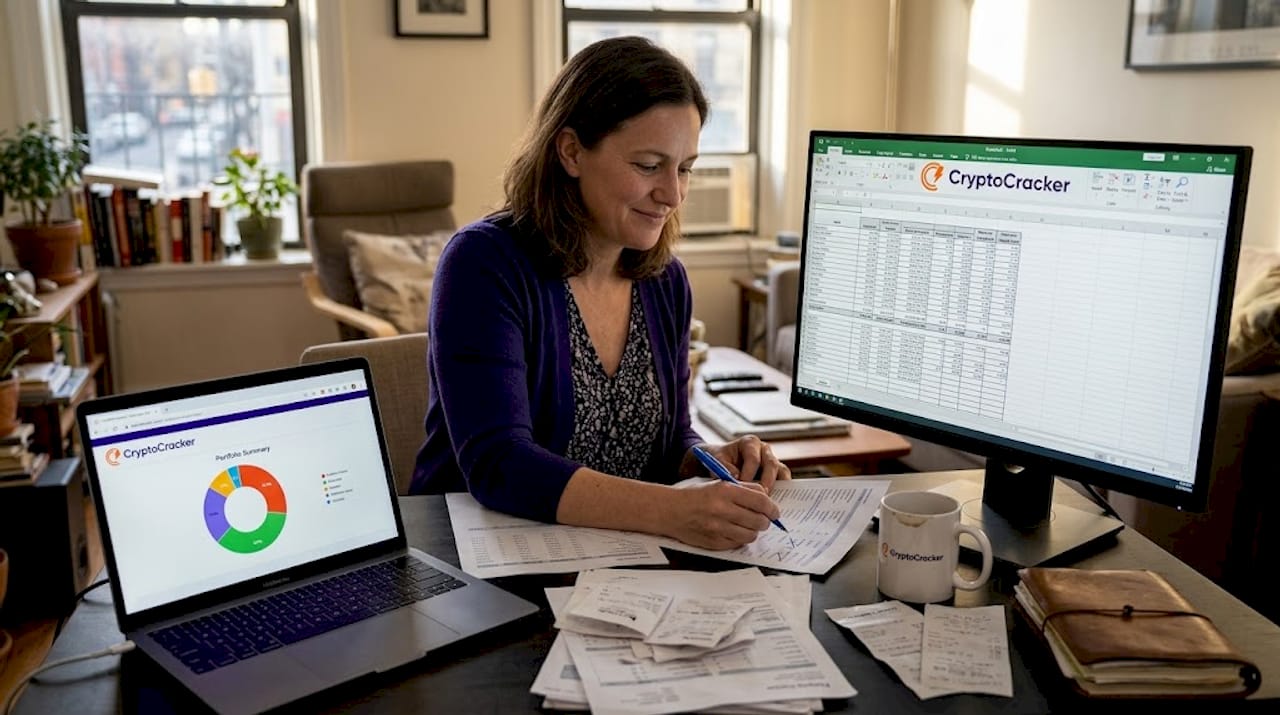
Allocation charts reveal hidden risk in a way raw numbers can’t. If one asset has grown to represent 60% of your portfolio, you may be far more exposed to a single point of failure than you realize. Visualizing your allocation regularly is one of the simplest risk checks you can do. Watching trend indicators in performance alongside allocation data gives you a much fuller picture.
Benchmarking is where most investors fall short. Knowing you’re up 20% feels great until you realize Bitcoin is up 40% over the same period. Key performance metrics tracked by serious investors include P&L, allocation charts, benchmarks, real-time net worth, and volatility. Empirical benchmarks worth using include Bitcoin dominance, the CMI, the CF Broad Cap Index, and the Sharpe ratio (a measure of return relative to risk).
Here’s a quick reference for the metrics that matter:
| Metric | Purpose | Difficulty | Best used |
|---|---|---|---|
| P&L | Track gains/losses | Easy | Daily/weekly |
| Allocation % | Reveal concentration risk | Easy | Weekly |
| Benchmark comparison | Measure relative performance | Moderate | Monthly |
| Sharpe ratio | Assess risk-adjusted return | Advanced | Quarterly |
| Volatility | Gauge portfolio stability | Moderate | Ongoing |
Key things to track consistently:
- Total portfolio value in both USD and BTC terms
- Per-asset performance against your entry price
- Benchmark performance over the same period
- Unrealized vs. realized gains
- Portfolio volatility relative to market volatility
Pro Tip: Set your benchmark before you invest, not after. Pick one index (such as Bitcoin or the total crypto market cap) and commit to comparing your performance against it every month. This removes the temptation to shift goalposts based on how things are going.
Step-by-step: How to track your crypto portfolio performance
Now that you know what to measure, here’s exactly how to set up and maintain effective tracking across all your crypto assets.
Step 1: Gather your account information. Before opening any tool, collect API keys or transaction histories from every exchange you use. Note the wallet addresses for any hardware or software wallets. List any DeFi platforms where you hold funds, including staking or liquidity positions.
Step 2: Choose your tracking method. Popular user-friendly tools for beginners include CoinMarketCap and CoinGecko, which offer simple manual entry and clean dashboards. More experienced users often prefer Koinly, Nansen, or CoinTracking for deeper analytics and tax reporting. Explore best portfolio tracker apps to compare options side by side.
Step 3: Set up read-only API connections. Most premium trackers let you connect exchanges via API (application programming interface) keys. Always use read-only keys. This means the tool can view your data but cannot make trades. It’s a simple but powerful privacy safeguard.
Step 4: Sync your full portfolio. Import or manually enter all assets, including tokens, NFTs (non-fungible tokens), staking positions, and cash. Note that top tools now support 100+ blockchains for aggregation, meaning you can consolidate positions from dozens of networks into one dashboard.
Step 5: Set your benchmarks. Within your tracker, define the benchmark you’ll compare against: Bitcoin, Ethereum, or the total market cap index.
Step 6: Review and adjust. Use your tool’s alerts and reporting features to schedule consistent check-ins. For in-depth insights, consider a dedicated crypto market analysis tool or explore portfolio optimization strategies alongside your tracking routine.
Pro Tip: Set a recurring weekly calendar reminder to open your tracker app and review P&L, allocation changes, and benchmark performance. Many apps let you configure push notifications for price thresholds. Use them to stay informed without obsessively checking every hour.
Advanced tactics: Tax reporting, DeFi analytics, and privacy-first tracking
Once your basic tracking is set, consider these advanced strategies to avoid common pitfalls and maximize accuracy.
Handling DeFi positions is where most trackers fall short. Liquidity pool (LP) tokens, staking rewards, and impermanent loss (the temporary value reduction that occurs in liquidity pools when asset prices diverge) need to be accounted for separately. DeFi positions such as LP tokens and staking are best handled by dedicated tools like Zapper, DeBank, or Nansen. These platforms can read your on-chain activity directly, giving you an honest view of what you actually hold.
Tax reporting gets complicated fast. Multiple trades per day, airdrops, cross-chain swaps, and hard forks can each trigger taxable events. Managing crypto tax tools becomes especially important as your portfolio grows. Tools like Koinly and CoinTracker are built to handle this complexity with automated categorization.
Common DeFi tracking challenges to plan for:
- LP token valuation changes daily and isn’t always visible in standard trackers
- Staking rewards may count as income at the time of receipt in many jurisdictions
- Cross-chain bridges can create gaps in transaction history
- Airdrops need to be logged at their fair market value on receipt date
| Approach | Privacy | Automation | Tax ready | DeFi support |
|---|---|---|---|---|
| Spreadsheet | High | None | Manual | Limited |
| Exchange app | Low | Yes | Partial | No |
| Dedicated tracker | Moderate | Yes | Yes | Partial |
| Self-hosted/open-source | High | Manual | Manual | Variable |
Spreadsheets offer privacy and manual control while dedicated apps automate data collection at the cost of some privacy. The right balance depends on your volume of trades, your tax situation, and how much manual work you’re willing to do. For those who want maximum control, open-source portfolio analysis frameworks offer a DIY solution. And if you’re thinking about crypto risk strategies, privacy-first tracking reduces data exposure without sacrificing insight.
Pro Tip: Use a tax-integrated tracker like Koinly throughout the year, not just at tax time. Running quarterly reports lets you identify tax-loss harvesting opportunities (selling losing positions to offset gains) before the year-end deadline closes the window.
Why most crypto investors don’t realize they’re underperforming the market
Here’s an uncomfortable truth: most crypto investors feel confident about their performance without ever actually measuring it. They see a higher dollar balance than six months ago and call it a win. But if the broader market is up 80% and their portfolio is up 25%, they’ve actually underperformed significantly relative to simply holding Bitcoin.
Emotional bias is the core problem. Bull markets make nearly everyone feel like a genius. Scattered tracking across multiple platforms reinforces that feeling because you never see the full, honest picture in one place. Regular reviews using P&L, allocation, and AI insights can genuinely optimize portfolio performance in ways that casual monitoring simply cannot.
The real turning point for most investors comes when they sit down and run an honest benchmark comparison. That moment of clarity, when you realize your altcoin-heavy portfolio underperformed a simple Bitcoin hold, is where real investment discipline begins. We think of eliminating guesswork as the first step toward investing like a professional rather than like a spectator. Review your performance honestly. The data won’t lie, even when our instincts do.
Streamline your tracking with CryptoCracker’s solutions
If all of this sounds like a lot to manage on your own, you don’t have to do it alone. CryptoCracker was built precisely for investors who want clarity without complexity.

Our crypto market analysis tool brings your market data into focus with real-time insights and visual dashboards designed to cut through the noise. If you’re ready to go further, portfolio optimization with CryptoCracker gives you personalized recommendations, automated tracking, and performance reporting across your connected accounts. One platform, one dashboard, and the clarity to invest with confidence.
Frequently asked questions
What is the easiest way for a beginner to track crypto portfolio performance?
For beginners, free tools like CoinGecko or CoinMarketCap offer simple manual tracking with easy setup and clear portfolio overviews. No API keys or technical knowledge are required to get started.
Which metric is most important when reviewing crypto portfolio performance?
P&L is foundational, but benchmarking against Bitcoin or the total market cap gives you the context needed to judge whether your strategy is actually working or simply riding a broad market wave.
How do I handle DeFi assets or staking rewards in tracking tools?
Use DeFi-native dashboards like Zapper or DeBank to transparently track LP tokens and staking positions, as these platforms read directly from the blockchain for accurate, up-to-date balances.
Is there a privacy-preserving way to track my crypto portfolio?
Spreadsheets or open-source self-hosted tools offer maximum privacy but require manual updates. Exchange apps and dedicated trackers are more automated but rely on read-only API keys, which keep your funds secure while sharing view-only data.
How often should I review and update my portfolio tracking?
A weekly or monthly review is the sweet spot for most investors. Regular reviews using P&L and allocation data allow for timely risk adjustments and keep your strategy aligned with your goals.