TL;DR:
- Effective crypto market monitoring involves tracking sentiment, social signals, on-chain metrics, macro news, and technical indicators.
- Consistent monitoring improves portfolio returns by enabling faster responses, reducing emotional bias, and generating higher risk-adjusted performance.
- Automation tools and machine learning models make monitoring more accessible, disciplined, and less prone to human error.
Many crypto investors believe that buying quality assets and holding through the noise is enough. It’s a reasonable instinct, but it leaves real money on the table. Markets don’t just move on fundamentals. They shift on sentiment, social momentum, and signals that flash briefly before prices react. Whether you’re managing a long-term portfolio or actively trading, missing those signals means making decisions with incomplete information. This article breaks down why market monitoring matters, which signals actually move prices, how consistent monitoring improves portfolio performance, and how automation is making the whole process more accessible than ever.
Table of Contents
- Why monitoring matters: Beyond price watching
- Key signals and strategies: Reading the crypto market
- How monitoring boosts your portfolio performance
- Tools, automation, and making market signals actionable
- The overlooked reality: Monitoring creates discipline, not just data
- Next steps: Level up your crypto market monitoring
- Frequently asked questions
Key Takeaways
| Point | Details |
|---|---|
| Sentiment moves markets | Investor sentiment changes can drive both upward and downward swings in crypto prices. |
| Monitoring boosts returns | Using trend signals and automation leads to higher Sharpe ratios and better portfolio results. |
| Discipline over reaction | Routine market checks build structure, helping you act on data instead of emotion. |
| Tools simplify success | Modern platforms make it easy to monitor, analyze, and react to market signals with minimal effort. |
Why monitoring matters: Beyond price watching
Having introduced why passive approaches miss key opportunities, let’s break down what market monitoring really involves. Most people think of monitoring as refreshing a price chart. But experienced investors know it’s much more than that. The crypto market is a living system where price is often the last thing to move, not the first.
Sentiment, trading volume, and social signals frequently shift before prices do. Research confirms that investor sentiment predicts crypto returns, with sentiment driving both booms and crashes in measurable ways. That means the mood of the market is not just noise. It’s data.
When you ignore these early signals, you’re essentially flying blind. You might hold through a crash that was telegraphed days in advance, or miss a rally that started building momentum in on-chain activity and social volume before it ever showed up on a price chart.
Here’s what effective monitoring actually covers:
- Price action and volume trends: Unusual volume spikes often precede significant price moves in either direction.
- Social sentiment: Spikes in mentions, fear-and-greed index shifts, and community activity on platforms like Reddit or X can signal incoming volatility.
- On-chain metrics: Wallet activity, exchange inflows and outflows, and miner behavior reveal what large holders are actually doing.
- Macro signals: Regulatory news, interest rate decisions, and institutional activity affect the entire crypto market.
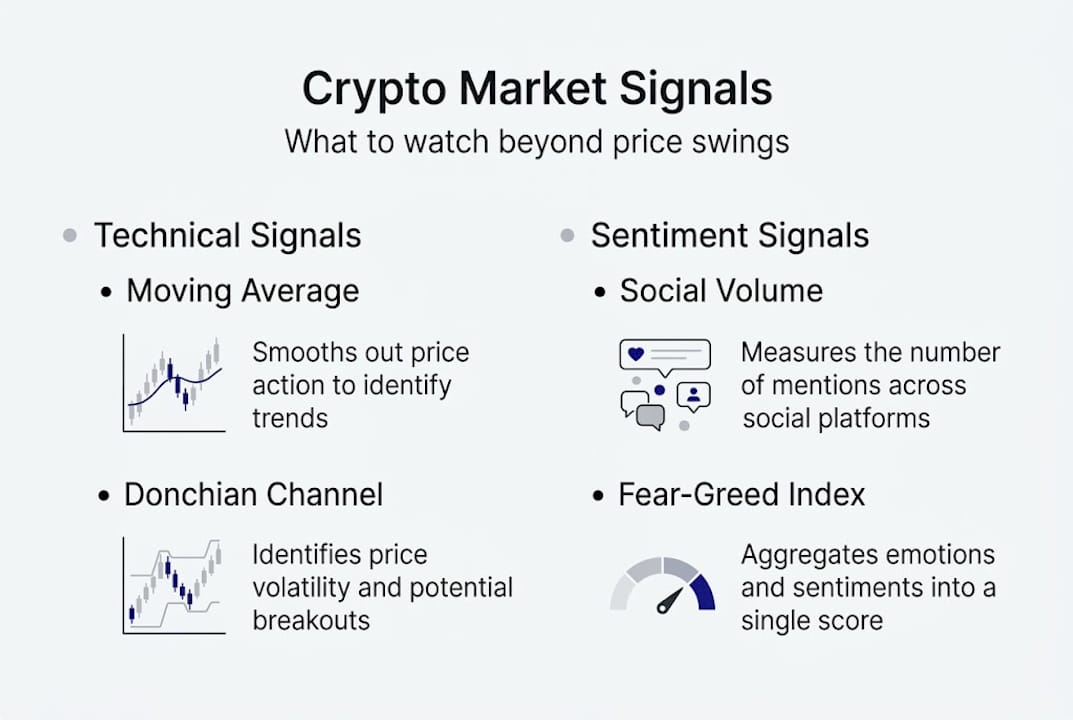
- Technical indicators: Moving averages, momentum signals, and channel breakouts help identify trend direction and strength.
“The market doesn’t reward those who watch prices. It rewards those who understand what’s driving them.”
The role of analytics in crypto investing is to turn this flood of signals into structured, actionable insight. Without that structure, even experienced traders fall into emotional decision-making, selling at the bottom out of fear or buying at the top out of excitement. Monitoring creates the guardrails that keep your strategy grounded in evidence, not emotion. For anyone still learning the basics, building this habit early is one of the most valuable things covered in crypto investment basics.
Key signals and strategies: Reading the crypto market
Now that you know why monitoring matters, the next step is understanding which signals to watch and how to use them effectively.
Not all signals are created equal. Some are noisy and unreliable. Others, when used correctly, offer a genuine edge. The key is knowing the difference.
Technical signals are the most widely used. Donchian channels, for example, define the highest high and lowest low over a set period. A breakout above the upper channel suggests bullish momentum. Research on trend-following using Donchian channels shows Sharpe ratios above 1.5 and annualized alpha of 10.8% on Bitcoin, especially when combined with volatility-based position sizing. That’s a meaningful edge over gut-feel trading.
Moving averages smooth out price noise and help you identify the underlying trend direction. When a short-term moving average crosses above a long-term one, it’s often an early signal of a new uptrend.

Sentiment metrics measure the emotional temperature of the market. The crypto fear-and-greed index, social volume scores, and funding rates on futures markets all give you a read on whether investors are euphoric or panicking.
Machine learning factors are newer but increasingly powerful. They process dozens of signals simultaneously to identify patterns that humans would miss.
Here’s a quick reference for the key signal types:
| Signal type | What it measures | How to track it |
|---|---|---|
| Donchian channels | Price breakouts and trend direction | Charting platforms like TradingView |
| Moving averages | Trend momentum and crossovers | Most crypto exchanges and dashboards |
| Fear-and-greed index | Overall market sentiment | Alternative.me or aggregator tools |
| Social volume | Community interest and buzz | LunarCrush, Santiment |
| On-chain flows | Exchange inflows and outflows | Glassnode, CryptoQuant |
Common pitfalls to avoid when reading signals:
- Chasing noise: Not every spike in volume or social mentions means a trend is forming. Wait for confirmation across multiple signals.
- Overfitting to patterns: A signal that worked perfectly in 2023 may not work in 2026. Markets evolve.
- Ignoring context: A bullish technical signal during a broad market downturn carries less weight than in a neutral or bullish environment.
Pro Tip: When analyzing crypto trends, always cross-reference at least two signal types before acting. A technical breakout confirmed by rising sentiment and volume is far more reliable than any single indicator alone. Tools built around predicting crypto trends can help you do this more efficiently.
How monitoring boosts your portfolio performance
But what difference does it actually make? Here’s why consistent market monitoring directly translates to better portfolio results.
The performance gap between monitored and unmonitored strategies is significant. Buy-and-hold works in sustained bull markets, but it leaves you fully exposed during corrections and trend reversals. Investors who monitor and respond to signals can reduce drawdowns, improve timing, and generate stronger risk-adjusted returns.
The evidence is compelling. The CTREND factor, which uses machine learning on 28 technical signals, robustly predicts returns across more than 3,000 crypto coins. That’s not a model built on a handful of assets. It’s a framework that holds across the breadth of the market.
| Strategy | Sharpe ratio | Emotional bias | Adaptability |
|---|---|---|---|
| Buy-and-hold only | Low to moderate | High | Low |
| Discretionary trading | Variable | Very high | Moderate |
| Monitored with signals | High | Low | High |
| ML-assisted monitoring | Very high | Very low | Very high |
Key benefits of consistent monitoring include:
- Higher Sharpe ratios: Signal-based strategies consistently produce better risk-adjusted returns than passive approaches.
- Improved alpha: Trend-following and ML-enhanced models generate returns above the market benchmark.
- Lower emotional bias: When you have a clear signal framework, you’re less likely to panic-sell or FOMO-buy.
- Faster reaction to trend changes: Markets can shift quickly. Monitoring shortens the gap between a signal appearing and your portfolio responding.
The ability to maximize crypto returns isn’t about predicting the future perfectly. It’s about being positioned to respond faster and more rationally than the average investor. Combining robust crypto market analysis tools with a consistent review routine is what separates structured investors from those who are always reacting too late.
Tools, automation, and making market signals actionable
Understanding the value of monitoring is one thing, but putting it into action is what closes the loop.
The good news is that you don’t have to do this manually. Modern monitoring tools and automation have made it possible for any investor, regardless of technical skill, to stay on top of market signals without spending hours in front of charts.
Automation removes two of the biggest obstacles: emotional bias and human error. When your alerts and responses are pre-configured, you’re not making split-second decisions under pressure. You’re executing a plan you built when your thinking was clear.
Ensemble machine learning models have taken this further. Gradient Boosting and XGBoost models have achieved R-squared values of approximately 0.98 in crypto price prediction and signal generation, outperforming simpler models by a wide margin. That level of accuracy, applied to real-time market data, is a genuine game-changer for retail investors.
Here’s what a practical, actionable monitoring setup looks like:
- Portfolio tracking dashboards: See all your holdings, performance, and exposure in one place without switching between platforms.
- Automated price and signal alerts: Get notified when a key level is breached or a trend signal fires, so you can act quickly without watching charts all day.
- ML-based signal providers: Platforms that process multiple indicators and surface the highest-confidence signals for you.
- Regular portfolio review routines: Set a weekly or bi-weekly review schedule where you assess signals and adjust positions if needed.
“Automation doesn’t replace your judgment. It protects it by removing the moments when emotion would otherwise take over.”
Pro Tip: Start simple. Set up alerts for your top holdings based on key support and resistance levels. Then add one sentiment indicator to your routine. Learning how to analyze crypto efficiently doesn’t require mastering everything at once. Build the habit first, then layer in complexity. A solid understanding of market analysis in crypto will help you choose the right tools for your specific strategy.
The overlooked reality: Monitoring creates discipline, not just data
With the practical ‘how’ explained, here’s a candid take you won’t hear in most trading guides.
Most articles about market monitoring focus on the data: which indicators to use, which tools to buy, which signals to follow. But the real value of monitoring isn’t the data itself. It’s the discipline that a structured monitoring routine forces on you.
When you commit to reviewing your portfolio against real signals on a regular schedule, you stop making impulsive decisions. You stop reacting to headlines. You stop second-guessing a position because of a tweet. The routine becomes a filter, and that filter is worth more than any single indicator.
The uncomfortable truth is that most traders don’t lose money because the market moved against them. They lose because they had no structure, overreacted to noise, and abandoned their strategy at exactly the wrong moment. Consistent trend analysis for smarter investing builds the habit of acting on evidence rather than anxiety.
Monitoring, done right, is not about watching every tick. It’s about building a repeatable process that keeps you grounded, informed, and ready to act when real signals emerge. That’s the edge most investors overlook entirely.
Next steps: Level up your crypto market monitoring
Ready to put disciplined monitoring into action?
At CryptoCracker, we’ve built a platform specifically designed to make this kind of structured monitoring accessible to every investor, not just the technically advanced ones. Our crypto market analysis tools surface the signals that matter, so you’re not drowning in data.

From portfolio tracking dashboards that give you a clear view of your holdings to a trend indicator tool that translates complex market dynamics into clear, actionable signals, we’ve designed every feature around one goal: helping you make smarter decisions with less effort. Explore how portfolio optimization with CryptoCracker can bring structure and confidence to your investment routine. The tools are ready when you are.
Frequently asked questions
What are the main benefits of monitoring crypto markets regularly?
Regular monitoring helps you react faster to market shifts, reduce emotional decision-making, and improve returns using evidence-based signals that anticipate booms and crashes before they fully develop.
Which signals should beginners focus on first?
Start with simple trend indicators and volume spikes. Trend-following with Donchian channels provides strong risk-adjusted returns and is a reliable foundation before adding more complex tools.
Can AI and machine learning really improve crypto market monitoring?
Yes. Ensemble ML models like Gradient Boosting and XGBoost achieve near-perfect prediction accuracy, outperforming manual analysis and delivering more consistent trade signals across market conditions.
Is monitoring only relevant for day traders?
Not at all. Even long-term holders benefit from monitoring because robust signal models improve rebalancing decisions and help you avoid major drawdowns regardless of your holding period.