Crypto trading recommendations have a reputation problem. Many investors assume they are a shortcut to guaranteed profits, a kind of magic button that tells you exactly when to buy and sell. The reality is more nuanced and, honestly, more interesting. Trading signals are actionable alerts built on statistical probabilities, not certainties. They are tools that help you make better-informed decisions, not promises of overnight wealth. This guide breaks down what recommendations really are, how they are generated, how bots execute them, and how you can use them wisely regardless of your experience level.
Table of Contents
- What are crypto trading recommendations?
- How are crypto trading recommendations generated?
- Automated execution: How bots turn recommendations into trades
- Limitations, risk, and best practices for using recommendations
- The real edge: Human-AI hybrid trading and why ‘DYOR’ still matters
- Take your crypto trading to the next level with CryptoCracker
- Frequently asked questions
Key Takeaways
| Point | Details |
|---|---|
| Trading signals demystified | Crypto trading recommendations help identify buy and sell opportunities but are not guarantees of profit. |
| Technology enhances accuracy | Modern trading recommendations use technical indicators and AI to improve signal reliability. |
| Automation boosts results | Bots can execute recommendations efficiently, removing emotional bias and boosting speed. |
| Risk management is vital | Even the best signals need careful risk controls like stop-loss and limited exposure. |
| Hybrid approach works best | Combining human oversight with AI-powered recommendations offers the most adaptable and resilient strategy. |
What are crypto trading recommendations?
With the myth-busting context set, let’s zero in on what crypto trading recommendations actually are and why they matter.
A trading recommendation, often called a signal, is an alert that tells you when and how to act on a specific cryptocurrency. Think of it like a weather forecast: it gives you the best available information to make a decision, but it cannot control what actually happens. The signal does not trade for you. It informs you.
Most quality signals include several key components:
- Asset: which coin or token to trade (e.g., BTC, ETH, SOL)
- Direction: whether to buy or sell
- Entry zone: the price range at which to open a position
- Stop-loss: the price at which to exit if the trade moves against you
- Take-profit: the target price at which to lock in gains
- Risk/reward ratio: how much you stand to gain relative to what you risk
As Business Insider notes, signals often specify coin, direction, entry price range, stop-loss, and take-profit levels, giving traders a structured framework rather than a vague hunch.
Signals come in two main forms. Manual signals are produced by experienced analysts who study charts and market conditions. Automated signals are generated by algorithms that process vast amounts of data in milliseconds. Neither type is inherently superior. Manual signals carry human insight; automated signals carry speed and consistency.
Here is the part most beginners overlook: even the best professional signal systems carry an accuracy range of roughly 55% to 70%. That means up to 45% of signals can be wrong. This is not a flaw; it is a reality of probabilistic trading. The goal is not perfection. It is to reduce crypto trading risk by making decisions that, over time, produce more winners than losers.
How are crypto trading recommendations generated?
Now that you know what a recommendation looks like, it is crucial to understand where these insights come from and why the process matters.
Most signals are generated through one or more of three core methodologies. Here is a structured look at each:
| Method | Strengths | Weaknesses | Typical accuracy |
|---|---|---|---|
| Technical Analysis (TA) | Fast, visual, widely used | Lagging indicators, noise | 55-65% |
| On-chain/Fundamental | Deep market insight | Slow to react, complex | 60-68% |
| AI/Machine Learning | Adaptive, pattern-rich | Requires large datasets | 65-75% |
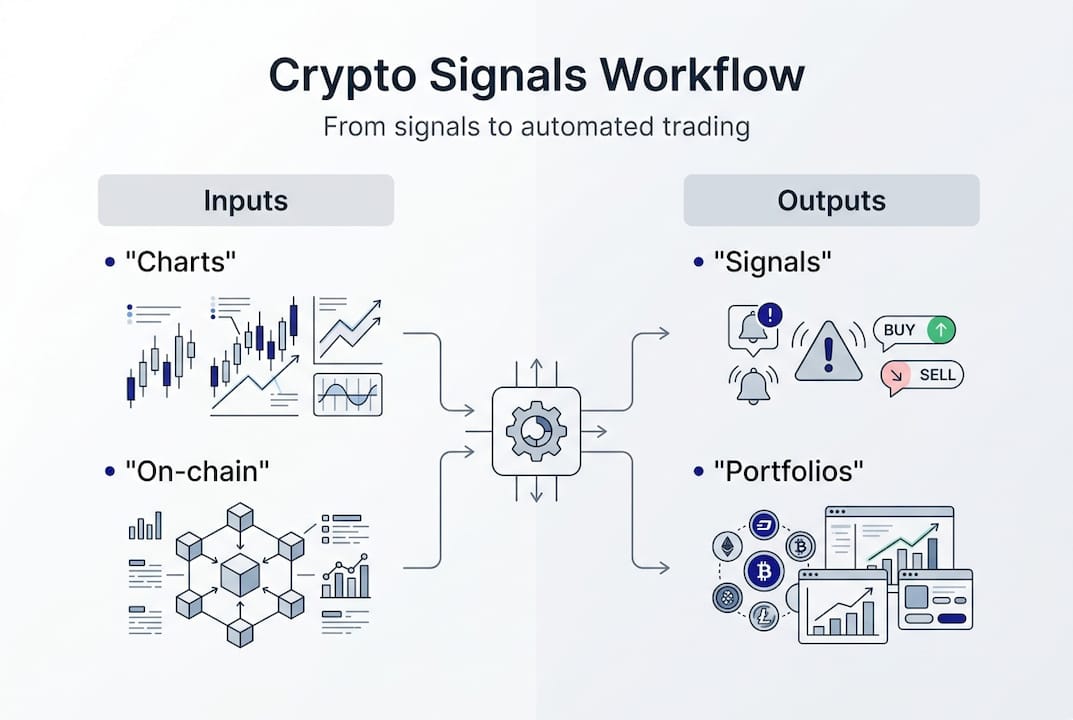
Technical analysis uses price charts and volume data. Indicators like RSI (Relative Strength Index), MACD (Moving Average Convergence Divergence), and Bollinger Bands help analysts spot potential reversals and momentum shifts. These tools analyze crypto trends by identifying repeating patterns in historical price behavior.

On-chain and fundamental analysis digs into blockchain data: wallet activity, exchange inflows, developer commits, and network growth. This approach helps you analyze crypto at a deeper level, looking beyond price to the actual health of a project.
AI and machine learning represent the frontier of signal generation. Models like LSTM (Long Short-Term Memory networks) and XGBoost process thousands of variables simultaneously. Research shows XGBoost models achieved R2 scores above 0.98 in crypto signal prediction, meaning they explained nearly all variance in the data during testing. Impressive, but backtesting performance does not always translate to live markets.
Here is how a typical AI-powered signal pipeline works:
- Raw data is collected: price, volume, order book depth, social sentiment, on-chain metrics
- Features are engineered and normalized for model input
- The model generates a probability-weighted prediction
- A signal is triggered when confidence exceeds a defined threshold
- The signal is validated against backtested historical data
- It is then delivered to traders or fed directly into a bot
As Investopedia highlights, signals often combine technical indicators, on-chain data, ML models, and backtested strategies for the most robust results. Understanding this process helps you evaluate market analysis crypto sources with a critical eye.
Automated execution: How bots turn recommendations into trades
A signal is only as good as your execution, which leads us to automation.
Once a signal is generated, you have two options: act on it manually or let a bot handle it. Over 80% of crypto volume is traded by bots, deploying strategies like Grid, DCA, arbitrage, and AI-driven models. That statistic alone tells you automation is not a niche tool. It is the standard.
Here is a quick comparison of common bot strategies:
| Bot type | Best market condition | Pros | Cons |
|---|---|---|---|
| Grid bot | Sideways/ranging | Consistent small gains | Struggles in trending markets |
| DCA bot | Long-term accumulation | Reduces timing risk | Slow capital deployment |
| Signal/trend-following | Trending markets | Captures big moves | Can whipsaw in choppy conditions |
| Arbitrage bot | Price discrepancies | Low-risk by design | Shrinking margins over time |
| AI-driven bot | Adaptive to all conditions | Self-optimizing | Complex, expensive to build |
Platforms like 3Commas, Pionex, and Cryptohopper connect to exchanges via API keys, enabling bots to execute trades automatically based on incoming signals or their own internal logic. The core benefits are clear: bots eliminate emotional decision-making, execute in milliseconds, and can run 24/7 without fatigue.
Bots can either follow external signals (acting as an executor) or generate their own signals internally (acting as a full strategy engine). Understanding this distinction matters when you choose trading strategies to boost your portfolio.
Pro Tip: Before committing real capital to any bot strategy, use paper trading mode. Most major platforms offer this feature, letting you simulate trades with fake money to validate performance without any financial risk. It is the single best way to reduce trading risk when starting out.
Limitations, risk, and best practices for using recommendations
To make recommendations truly work for you, here is what you need to know about their limits and how to stay safe.
No signal system is perfect. Markets are living systems that shift based on regulation, macro events, and human psychology. A strategy that worked brilliantly for six months can fail suddenly when market conditions change. This is called a regime shift, and it is one of the biggest threats to automated trading.
Other major risks include:
- Overfitting: a model trained too closely on historical data fails in live markets
- Black swan events: unexpected crashes or regulatory announcements that no model predicted
- Signal lag: by the time a signal reaches you, the opportunity may have passed
As research confirms, bots reduce emotional decisions by roughly 70%, but they remain vulnerable to overfitting and black swans, making risk management essential.
“Technology can remove emotion from trading, but it cannot remove uncertainty from markets. The traders who thrive long-term are those who treat every signal as a suggestion, not a command.”
Here is a practical checklist for using recommendations safely:
- Verify the track record: demand at least 3 to 6 months of audited performance data
- Always use a stop-loss: no exceptions, ever
- Limit risk per trade to 1-2% of your total portfolio
- Backtest any strategy before going live
- Avoid overleveraging: leverage amplifies losses as fast as gains
- Cross-check signals with your own crypto risk assessment
- Review your trading workflow regularly using a structured trading workflow guide
Pro Tip: Diversify across signal providers and strategies. Relying on a single source creates concentration risk. Treat your signal sources the same way you treat your portfolio: spread them out.
The real edge: Human-AI hybrid trading and why ‘DYOR’ still matters
Understanding the limits is only half the battle. The real advantage comes from how you combine technology with your own judgment.
Full automation sounds appealing. Set it up, walk away, collect profits. But in practice, 100% automated trading is rarely optimal for everyday investors. Markets evolve. Regulations change. A bot trained on 2024 data may be completely wrong-footed by a 2026 market structure shift.
The investors who consistently outperform are those who use hybrid systems: signals as inputs to bots, combined with human monitoring for regime changes, producing adaptive strategies that neither pure automation nor pure manual trading can match.
This is where “do your own research” (DYOR) becomes more than a meme. It is a practical discipline. When you understand why a signal was generated, you can decide whether the underlying conditions still hold. You become the quality filter that no algorithm can fully replace.
We believe the best approach is to use a crypto trade recommendation tool as a starting point, not an endpoint. Let the technology surface opportunities. Let your judgment evaluate them. That combination reduces risk, accelerates learning, and keeps you in control of your own financial future. Trading is ultimately a blend of technology and human wisdom, and the most successful investors we see treat it exactly that way.
Take your crypto trading to the next level with CryptoCracker
If you are ready to put your new knowledge to use, CryptoCracker is built for exactly this moment in your journey.

Our trade recommendation tool delivers personalized, data-driven signals without requiring you to be a data scientist. Whether you want to learn through our market analysis process or automate your strategy with our automated crypto savings features, we have tools for every experience level. We connect securely to Coinbase via API, keep your data safe, and give you clear visualizations so every recommendation makes sense before you act on it. Start smart, stay informed, and grow with confidence.
Frequently asked questions
Are crypto trading recommendations safe to use?
Signals can help identify trading opportunities, but they always carry risk. Never follow any signal blindly; always pair it with solid risk management and your own judgment, since real-world volatility and overfitting can affect outcomes significantly.
How accurate are automated crypto trading bots?
Professional bots show 12-18% average monthly ROI in backtesting, with platforms like 3Commas averaging around 15.3% monthly in historical tests, but actual live results vary widely and are never guaranteed.
Do I need to pay for quality trading signals?
Both free and paid signals exist across the market. The key is to verify any provider’s performance record carefully, since free and paid signals alike require thorough due diligence before you trust them with real capital.
What’s the best way for beginners to use trading recommendations?
Start with educational tools, practice with paper trading, and limit your risk to 1% per trade until you build confidence and understand how signals behave in different market conditions.