TL;DR:
- Trading recommendations provide data-driven guidance to improve investor decision-making across experience levels.
- They include signals for active trading and strategic suggestions for long-term portfolio balance.
- Success relies on personal evaluation, risk awareness, and adapting recommendations to individual goals.
Trading recommendations used to feel like insider knowledge reserved for Wall Street pros or full-time crypto traders. If you’ve ever stared at a price chart wondering whether to buy, sell, or simply hold, you already know the paralysis that comes with too much information and not enough direction. The good news is that trading recommendations are not just for experts. They’re practical, data-driven tools that any investor can use to cut through market noise, make clearer decisions, and build a strategy that actually fits their life. This article breaks down exactly what trading recommendations are, how they work, and how to put them to use.
Table of Contents
- What are trading recommendations?
- Types of trading recommendations and how they work
- Choosing the right trading recommendation for your strategy
- Applying trading recommendations: Practical tips for crypto investors
- What most crypto investors miss about trading recommendations
- Connect your strategy with CryptoCracker tools and resources
- Frequently asked questions
Key Takeaways
| Point | Details |
|---|---|
| Recommendations are tools | Trading recommendations simplify investment decisions by delivering actionable insights tailored to crypto investors. |
| Personalization matters | Adapting trading recommendations to your risk tolerance and style makes them far more effective and sustainable. |
| Hybrid approaches excel | Combining a core holding with a small trading allocation balances long-term growth with short-term opportunities. |
| Application is key | Thoughtful use of trading recommendations, combined with regular evaluation, leads to better portfolio results. |
What are trading recommendations?
At their core, trading recommendations are actionable suggestions that guide you toward specific investment decisions based on market analysis, signals, or strategic frameworks. Think of them as a knowledgeable friend who has already done the research and is telling you, “Here’s what the data is suggesting right now.” They don’t remove risk entirely, but they reduce guesswork and help you act with more confidence.
Trading recommendations generally fall into two main categories:
- Manual recommendations: These come from analysts, financial experts, or crypto strategists who review market conditions and publish their findings. They’re valuable for context and narrative but can be slower to update.
- Algorithmic recommendations: These are generated by automated systems that scan market data in real time, looking for patterns, volume shifts, price momentum, or other indicators. They’re fast, consistent, and increasingly accessible to everyday investors.
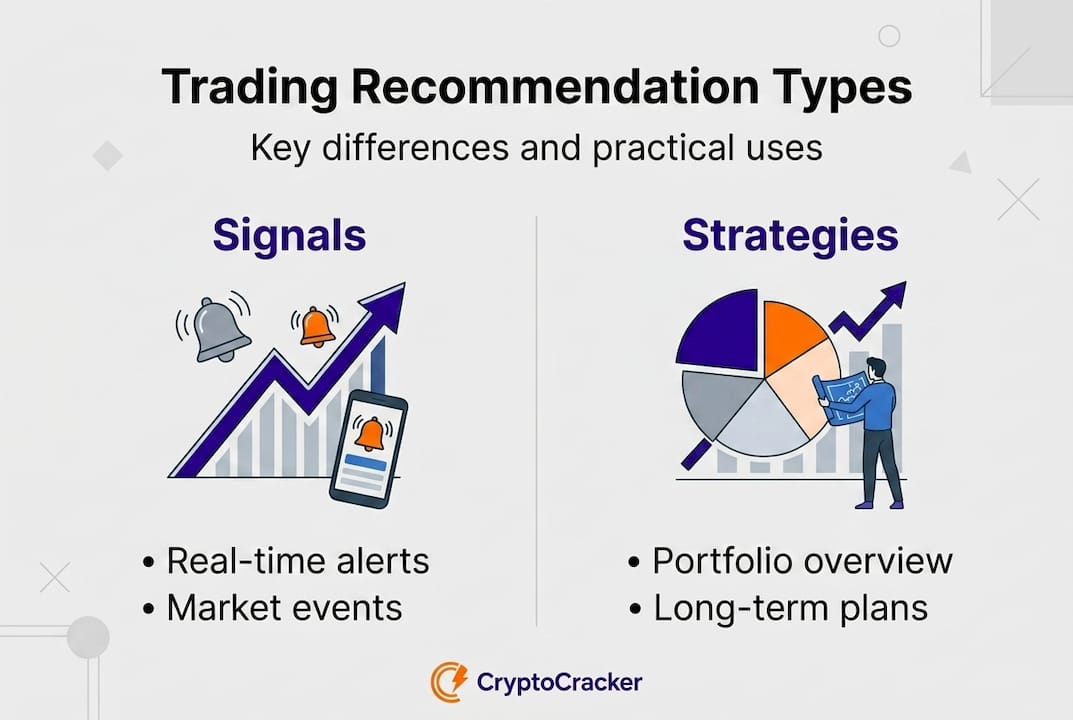
Within those two buckets, you’ll also encounter the distinction between signals and strategy suggestions. A signal is a specific, timely prompt: “Bitcoin is approaching a key resistance level; consider a small sell position.” A strategy suggestion is broader: “Given your risk profile, a 70/30 split between long-term holdings and short-term trades may serve you well this quarter.” Understanding trading recommendation signals helps you choose the format that fits how you invest.
Trading recommendations are genuinely useful for all investor types. Beginners benefit because they reduce analysis paralysis, giving clear next steps rather than a flood of raw data. Experienced investors use them to validate their own research or identify opportunities they might have missed. Both groups gain from having a structured framework instead of reacting emotionally to price swings.
One key reason recommendations matter so much in crypto specifically is the market’s volatility and 24/7 trading cycle. Unlike stock markets that close at 4 p.m., crypto never sleeps. Having a crypto recommendation tool that monitors conditions around the clock gives you an edge without requiring you to be glued to your screen.
A hybrid approach combining core holdings with a smaller trading allocation is widely recommended for many investors, balancing growth potential with manageable risk. This idea is central to how most good recommendation systems are designed.
Types of trading recommendations and how they work
Now that you know what trading recommendations are, let’s compare the main types and how they’re delivered. Not every recommendation format is right for every investor, and understanding the differences will help you avoid following advice that doesn’t match your situation.
| Recommendation type | How it’s generated | Best for | Key benefit |
|---|---|---|---|
| Signal-based alerts | Algorithmic models, technical analysis | Active traders | Real-time, timely prompts |
| Strategy suggestions | Expert analysis, risk profiling | Long-term investors | Personalized, big-picture guidance |
| Community-driven calls | Peer forums, social platforms | Engaged, social learners | Diverse perspectives |
| Automated portfolio advice | AI and machine learning models | Hands-off investors | Consistent, emotion-free decisions |
Signal-based alerts are the most immediate type. They trigger based on specific market events: a coin breaking above its 200-day moving average, trading volume spiking unexpectedly, or a large wallet making a significant move. These are excellent for active traders who want to capitalize on short-term momentum. The downside is that they require you to act quickly and confidently, which can be stressful if you’re newer to crypto markets.

Strategy suggestions work differently. Rather than reacting to a single market event, they take a wider view of your portfolio goals, risk appetite, and time horizon. Platforms using this model might recommend rebalancing your allocation between Bitcoin, Ethereum, and altcoins based on your stated objectives. If you want to explore top trading strategies that align with your goals, strategy-based suggestions are a great starting point.
Community-driven recommendations are more informal but can be surprisingly powerful. Platforms like Reddit or Discord host thousands of experienced traders sharing ideas and analysis. The risk is that quality varies enormously, and crowd sentiment can amplify bad decisions as easily as good ones. Use community input as a secondary layer, not your primary guide.
For investors who prefer a more hands-off approach, automated portfolio advice powered by AI models offers the cleanest experience. These systems continuously analyze market conditions and adjust recommendations without emotion or fatigue. If you’re just finding your footing, beginner trading strategies built around automated advice are a solid entry point. You can also deepen your knowledge by reviewing crypto trading concepts to understand the building blocks that drive these systems.
The hold vs. flip debate is shaped by risk tolerance, emotional comfort, and time commitment, meaning no single recommendation type wins universally.
Pro Tip: Never follow a recommendation blindly, no matter how reputable the source. Always run it through your personal filter: Does this fit my risk tolerance? Do I have the time to manage this trade? Does it align with my broader financial goals? A recommendation is a starting point, not a final answer.
Choosing the right trading recommendation for your strategy
With the main types covered, the next step is deciding which recommendation style matches your needs. This is where most investors either get it right or stumble. Picking the wrong format leads to frustration, overtrading, or holding positions you never should have entered in the first place.
Three factors matter most when choosing a recommendation style:
- Risk tolerance: How much of a loss can you absorb without panic-selling? If the answer is “not much,” signal-based alerts that encourage frequent trading are probably not for you.
- Emotional comfort: Some investors feel empowered receiving daily signals; others feel overwhelmed. Be honest about how you respond to information and uncertainty.
- Time availability: Following signal-based alerts requires daily attention and fast responses. Strategy suggestions need only periodic review, making them better for busy investors.
A practical approach many investors adopt is the hybrid model: a core portfolio of long-term holdings, typically 70-80% of your total allocation, and a smaller active portion where you apply short-term recommendations. This structure lets you benefit from both growth stability and trading opportunities without overexposing yourself to risk. Exploring asset allocation strategies designed for crypto can help you map this out clearly.
Here’s a simple checklist to guide your decision:
- Define your investment goal: long-term wealth building, income generation, or active growth?
- Assess how much time you realistically have each week for monitoring and decision-making.
- Be honest about your emotional responses to market volatility.
- Start with one recommendation type before adding complexity.
- Revisit your choice every three months to see whether it’s serving you well.
As Investopedia notes, “the best allocation depends on your risk tolerance and temperament.” This applies directly to recommendation formats too. There’s no universally superior system. There’s only the one that fits where you are right now. If you’re seeking a low-friction entry point, easy trading strategies can serve as a strong foundation before you scale up complexity.
Applying trading recommendations: Practical tips for crypto investors
Once you’ve chosen the right recommendation, it’s time to put it into action. And here’s where many investors make avoidable mistakes: they either ignore the recommendations they receive or follow them so rigidly that they abandon their own judgment entirely. The goal is a middle path.
Follow these steps to integrate recommendations into your investing routine effectively:
- Start with a test allocation. Before committing significant funds, test a recommendation with a small amount you can afford to lose. Observe how it performs over four to six weeks before scaling up.
- Log every trade. Keep a simple record of what you did, why you did it, and what the outcome was. This helps you identify patterns in what’s working and what isn’t.
- Set a review schedule. Check your recommendation tool weekly or biweekly, not daily. Constant checking leads to overtrading and emotional decisions.
- Define your exit before you enter. Before acting on any recommendation, decide your target exit price and your maximum acceptable loss. This removes emotion from the decision when the moment arrives.
- Adjust as your goals change. A recommendation format that suits you today may not suit you in six months. As your portfolio grows or your life circumstances shift, revisit your approach.
One of the most common traps is overtrading. When recommendations are flowing in regularly, it’s tempting to act on every one of them. But long-term holding aligns with growth and tax advantages, while frequent flipping raises risk and demands constant attention. More trades do not automatically mean more profit. In many cases, they mean more fees, more errors, and more stress.
Understanding crypto investing best practices can help you set realistic expectations. A solid trading strategies guide will also show you how professionals pace their decision-making. And if you want to sharpen your ability to evaluate recommendations before acting on them, learning about trading indicators gives you the analytical vocabulary to do that confidently.
Pro Tip: Start small, track outcomes consistently, and give each recommendation format at least 30 days before judging its effectiveness. Short-term results in crypto are often misleading. What looks like a failure in week one may prove to be sound strategy by week six.
What most crypto investors miss about trading recommendations
Here’s our honest take, and it’s something we rarely see stated plainly enough: trading recommendations are not a magic system that replaces your own thinking. They’re a structured input into a decision you still have to make.
We see this pattern repeatedly. A new investor discovers a well-regarded recommendation tool, follows every signal without question, and then blames the tool when a trade doesn’t work out. But no recommendation system accounts for your personal financial situation, your emotional responses to loss, or the unexpected life event that means you need liquidity next month.
Most newcomers assume there’s a universally “best” recommendation format. Experienced investors know better. They treat recommendations as one signal among several, combining them with their own market awareness, risk rules, and long-term goals. They also adapt their approach over time, something the set-and-forget mentality completely misses.
The real skill isn’t finding the perfect recommendation. It’s learning how to evaluate signals vs. strategies against your personal constraints and adjusting as those constraints evolve. Your risk tolerance at 25 is not your risk tolerance at 45. Your time availability changes. Your financial goals shift. A trading recommendation is a tool, and like any tool, its value depends entirely on how you use it.
Connect your strategy with CryptoCracker tools and resources
If you’re ready to put trading recommendations to work, we’ve built the tools to make that process simpler and smarter.

CryptoCracker offers personalized trading recommendations, portfolio tracking dashboards, and market analysis features designed to translate complex signals into clear, actionable steps. Whether you’re testing a hybrid strategy for the first time or fine-tuning an advanced allocation approach, our platform gives you the real-time data and visualizations you need without requiring a finance degree to interpret them. Explore our crypto recommendation tool to see how recommendations can be tailored to your goals, or browse our asset allocation strategies to build a structure that fits your risk profile. Simpler decisions, better outcomes.
Frequently asked questions
Are trading recommendations suitable for beginners in cryptocurrency?
Yes, trading recommendations can genuinely help beginners by simplifying complex decisions and offering a starting framework. A non-trading framework for new investors often begins with long-term holding before introducing more active strategies.
What should I consider before following a trading recommendation?
Always evaluate your risk tolerance, emotional comfort, and time commitment before acting. As noted by Investopedia, the best approach depends on your individual risk tolerance and temperament, not a generic formula.
How do trading recommendations differ from trading signals?
Trading signals are specific, real-time prompts tied to market events, while trading recommendations can include signals but also provide broader guidance on portfolio strategy and long-term asset management.
Can trading recommendations improve my portfolio performance?
When applied thoughtfully and customized to your personal goals, recommendations help you make more informed decisions and manage risk more consistently, which over time supports stronger portfolio outcomes.