TL;DR:
- Most crypto hacks target user accounts, not the blockchain itself.
- Security features like 2FA, withdrawal whitelisting, and strong habits are essential for protection.
- Most investors overlook the importance of consistent security practices over complex technology.
Most people assume crypto theft happens when hackers crack the blockchain itself. That assumption is wrong, and it’s costing investors real money. Most crypto hacks target user accounts, not the underlying technology. Whether you’re just starting out or managing a sizable portfolio, the way you set up, configure, and maintain your crypto accounts determines how safe your assets really are. In this guide, we walk through the critical decisions around custody, the features that matter most, the habits that protect you daily, and the emerging threats you need to know about.
Table of Contents
- Understanding custodial vs. non-custodial accounts
- Key features of a secure crypto account
- Essential habits for better account security
- Emerging threats and innovations in crypto account security
- Our take: Why most investors overlook the real dangers
- Level up your crypto security with expert tools
- Frequently asked questions
Key Takeaways
| Point | Details |
|---|---|
| Custody choices impact risk | Choosing between custodial and self-custody accounts profoundly affects your control and exposure to loss. |
| Security features matter | Features like two-factor authentication and withdrawals whitelists significantly improve account safety. |
| User habits are crucial | Daily practices, such as avoiding password reuse and being alert to phishing, are the strongest defense. |
| New threats require adaptation | Ongoing innovation like smart wallets combats new risks, while future threats like quantum computing are being anticipated. |
Understanding custodial vs. non-custodial accounts
Having set the stage for why account security matters, let’s start with the critical decision between who holds your crypto: the platform or you.
A custodial account is one where a third party, typically an exchange like Coinbase or Binance, holds your private keys on your behalf. Think of it like a bank holding your money. You log in, you see your balance, and you trust the institution to keep it safe. A non-custodial account means you hold your own private keys, giving you direct, unmediated control over your funds. No middleman, no counterparty.
The tradeoff is real. Custodial platforms offer convenience but create counterparty risk, while self-custody gives control but requires security discipline. If a custodial exchange gets hacked, freezes withdrawals, or goes bankrupt, your assets could be at risk. If you lose your private key in self-custody, there’s no customer support line to call.
| Feature | Custodial account | Non-custodial account |
|---|---|---|
| Who holds private keys | The platform | You |
| Recovery option | Yes (via platform) | Only if you saved seed phrase |
| Ease of use | High | Moderate to complex |
| Counterparty risk | Yes | No |
| Ideal for | Beginners, frequent traders | Long-term holders, advanced users |
Here’s a quick breakdown of when each approach makes sense:
- Custodial: You’re actively trading, new to crypto, or want a simple experience with customer support.
- Non-custodial: You’re holding large amounts long-term, want maximum control, or distrust centralized platforms.
“Not your keys, not your coins” is one of the oldest sayings in crypto, and it still holds. Self-custody is powerful, but it demands that you treat your seed phrase like the combination to a vault.
For those curious about the mechanics of both options, our crypto wallet guide covers the full landscape. If you’ve decided self-custody is right for you, learning how to transfer to a secure wallet is the logical next step.
Key features of a secure crypto account
Once you’ve chosen who holds your crypto, it’s crucial to understand the tools and protections that define a truly secure account.
Not all platforms are built the same. The security features an exchange or wallet offers can mean the difference between a minor scare and a total loss. Here’s what to look for and why each feature matters.
| Security feature | What it does | Risk it reduces |
|---|---|---|
| Two-factor authentication (2FA) | Requires a second verification step at login | Unauthorized access |
| Withdrawal address whitelisting | Limits withdrawals to pre-approved addresses | Theft via account takeover |
| Multi-signature (multi-sig) | Requires multiple approvals for transactions | Single point of failure |
| Session monitoring | Tracks and alerts on active login sessions | Unauthorized session use |
| Encrypted backup | Secures recovery phrases and account data | Data loss or theft |
Two-factor authentication, withdrawal whitelisting, and strong password management underpin secure crypto accounts. These aren’t optional extras; they’re the foundation.
Withdrawal address whitelisting is one of the most underused features available. When you whitelist an address, you’re telling the platform: only send funds to these destinations. Even if someone gains access to your account, they can’t redirect your crypto to their own wallet. That’s a powerful layer of protection most investors never activate.
Multi-sig wallets require two or more private keys to authorize a transaction. This is especially valuable for businesses or anyone storing large amounts, because a single compromised key isn’t enough to drain the account.
- Enable 2FA on every account, and use an authenticator app rather than SMS when possible.
- Activate withdrawal whitelisting immediately after setting up an account.
- Review active sessions regularly and log out of any you don’t recognize.
- Store your backup seed phrase offline, never in a cloud document or screenshot.
Pro Tip: SMS-based 2FA is better than nothing, but it’s vulnerable to SIM-swapping attacks. Switching to an app like Google Authenticator or Authy takes about five minutes and dramatically raises your security baseline.
For a deeper look at how these protections work in practice, check out our guide on crypto security best practices and how to evaluate the features of secure crypto platforms.
Essential habits for better account security
Beyond features, it’s your daily habits that make the real difference. Here are the essential actions every investor needs.
User mistakes like poor password reuse and falling for phishing scams remain top causes of crypto theft. The technology can only protect you so far. Your behavior fills the rest of the gap.
Here are the core habits every investor should build:
- Use a unique, complex password for every account. A password like “crypto2026!” shared across five platforms is a single point of failure. One breach exposes them all.
- Enable 2FA on every crypto account. This alone blocks the vast majority of automated account takeover attempts.
- Never click links in unsolicited emails or social messages. Phishing sites are designed to look identical to legitimate platforms. Always navigate directly to your exchange by typing the URL yourself.
- Check your account’s active sessions weekly. Most platforms show you where and when your account was last accessed. A session from an unfamiliar location is a red flag.
- Set conservative withdrawal limits. Many platforms let you cap daily withdrawal amounts. A lower limit means less exposure if your account is ever compromised.
- Review connected apps and API keys regularly. Third-party apps connected to your account can be a backdoor. Revoke access for anything you no longer use.
Phishing deserves special attention because it’s the most common attack vector. Scammers send emails mimicking Coinbase, Binance, or other platforms, urging you to “verify your account” or “claim a reward.” The goal is to get your login credentials. If an email creates urgency or asks for sensitive information, treat it as suspicious by default.
Pro Tip: A password manager like Bitwarden or 1Password generates and stores unique passwords for every account. You only need to remember one master password, and your security across all platforms improves dramatically overnight.
Building these habits connects directly to a safer overall strategy. Our resources on crypto security best practices and how to create a safe crypto wallet give you the full picture.
Emerging threats and innovations in crypto account security
Security is always evolving. Here’s what modern investors must watch for and how to position themselves for the future.
The security tools available to crypto investors in 2026 are genuinely impressive. But so are the threats. Staying ahead means knowing what’s new on both sides.
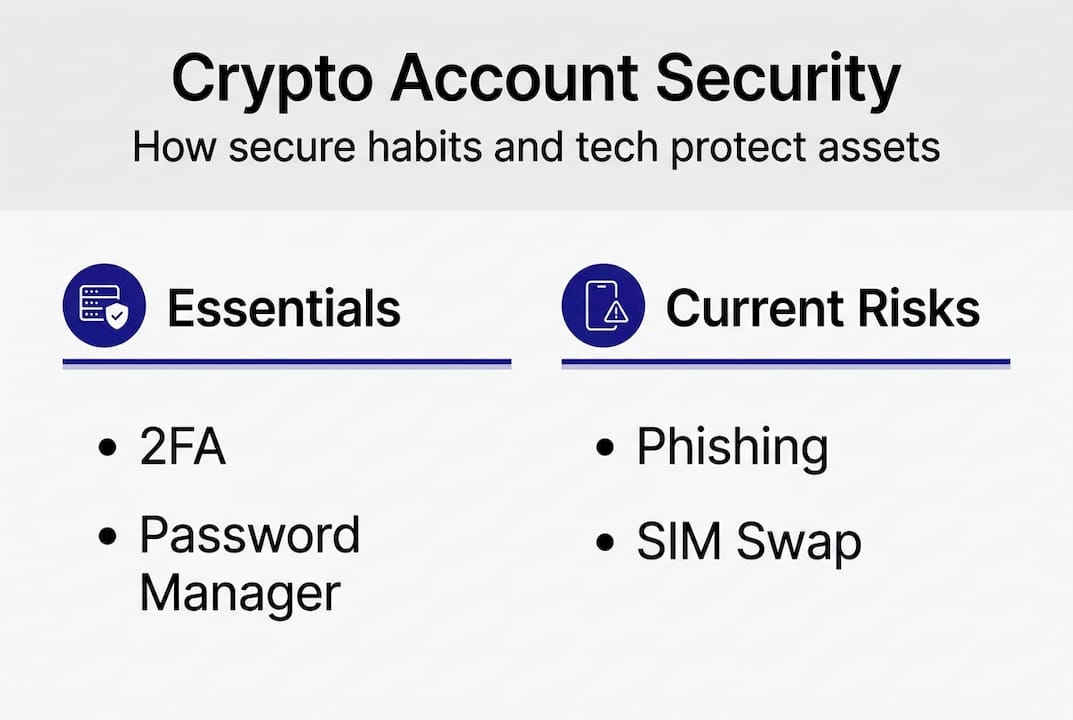
Session keys and smart wallets are two of the most exciting developments in account security right now. Session keys are temporary, limited-permission keys that allow specific actions (like a single trade) without exposing your main private key. Smart wallets, built on programmable blockchain accounts, can enforce rules automatically: spending caps, transaction limits, and time locks that prevent large transfers without a delay period. DeFi wallets now use session keys and spending caps to block total asset drain, a genuine leap forward in practical security.
Here’s a quick summary of emerging tools worth knowing:
- Session keys: Temporary permissions that limit what a single interaction can do to your wallet.
- Spending caps: Automatic limits on how much can leave your wallet in a given period.
- Multi-party computation (MPC): Splits your private key into fragments held by multiple parties, so no single breach exposes everything.
- Quantum-resistant algorithms: New cryptographic standards being developed to withstand future quantum computing attacks.
On the subject of quantum computing: quantum threats are real but not urgent for most users today. The computing power needed to crack current encryption doesn’t yet exist at scale. That said, the industry is actively developing quantum-resistant standards, and the platforms you choose should be ones that take this seriously and adapt over time.
“The biggest security gains in the next decade won’t come from better passwords. They’ll come from smarter wallet architecture that removes human error from the equation entirely.”
The practical takeaway: choose platforms and wallets that actively update their security infrastructure. A platform that hasn’t updated its security features in two years is a platform falling behind. For more on managing the full risk picture, see our guides on how to reduce crypto trading risk and the broader security in crypto investing.
Our take: Why most investors overlook the real dangers
With the landscape mapped out, here’s a candid perspective gained from years of observing where investors get tripped up.
We’ve seen a consistent pattern: investors spend hours researching which coin to buy and minutes thinking about how to protect it. That imbalance is where most losses happen. The biggest risk to your crypto isn’t a sophisticated hacker targeting the blockchain. It’s the shortcut you took when setting up your account because the setup felt tedious.
Convenience is a quiet threat. Reusing a password because it’s easier, skipping 2FA because it adds a step, leaving large balances on an exchange because moving them feels complicated. These small compromises stack up into real vulnerability.
The investors who stay secure aren’t necessarily the most technically advanced. They’re the most consistent. A monthly account review, a password manager, an authenticator app, and a whitelisted withdrawal address will protect most people from most threats. These aren’t exotic measures. They’re basic discipline applied consistently.
We recommend treating account security like a recurring calendar item, not a one-time setup. For a broader framework on building that discipline, our expert strategies for crypto investors is a strong starting point.
Level up your crypto security with expert tools
Armed with clear tactics, you can partner with platforms dedicated to your account security.
At CryptoCracker, we’ve built our platform around the idea that security and simplicity should go hand in hand. You shouldn’t have to choose between a safe account and an easy-to-use one.

Whether you’re just starting to explore wallet options or you’re ready to sharpen your approach with proven best security practices, we have the resources to guide you. Our crypto management platform integrates real-time portfolio tracking, security-conscious API management, and actionable insights, so you can invest with confidence, not anxiety. Security isn’t a feature we added as an afterthought. It’s the foundation we built everything on.
Frequently asked questions
What is the difference between custodial and non-custodial crypto accounts?
Custodial accounts are managed by exchanges or platforms that hold your private keys, while non-custodial accounts give you direct control of your keys and funds. The core tradeoff is convenience versus full ownership.
Which crypto security feature is most important?
Two-factor authentication is one of the most effective ways to protect your crypto accounts from unauthorized access. Pair it with withdrawal whitelisting for a significantly stronger defense.
How can I avoid phishing and scams targeting my crypto account?
Always type exchange URLs directly into your browser, never reuse passwords, and treat any unsolicited message asking for account details as suspicious. Phishing remains one of the top causes of account compromise.
Are quantum computers a threat to my crypto assets right now?
Quantum computing threats are emerging but not an immediate danger for most investors today. Prioritizing strong passwords, 2FA, and phishing awareness will protect you far more effectively right now.
Recommended
- Crypto security best practices: protect assets confidently | CryptoCracker
- Mastering the role of security in crypto for safer investing | CryptoCracker
- Key features that make crypto platforms secure and user-friendly | CryptoCracker
- Best practices for crypto investors: expert strategies | CryptoCracker