Connecting your cryptocurrency exchange to third-party portfolio tools can feel risky, especially when the service is unfamiliar. Many investors wonder whether apps like Crypto-Cracker expose their funds to theft or unauthorized access. The confusion often stems from not understanding how API connections work and what permissions these tools actually receive. This guide breaks down the technical mechanics of exchange integration, evaluates Crypto-Cracker’s security profile, and provides actionable steps to protect your assets while managing your portfolio efficiently.
Table of Contents
- Key takeaways
- Understanding how exchange connections and portfolio trackers work
- Evaluating Crypto-Cracker’s security and trustworthiness
- Balancing convenience and security: best practices for connecting exchanges
- Comparing Crypto-Cracker with established portfolio trackers
- Explore secure crypto portfolio management with CryptoCracker
- Frequently asked questions
Key Takeaways
| Point | Details |
|---|---|
| Crypto Cracker credibility | Crypto Cracker lacks a verified security record or broad public recognition, which raises investor concerns about trust and safety. |
| Read only keys safe | Read only API keys limit access to viewing balances and transaction history and cannot withdraw funds. |
| OAuth 2.0 protection | OAuth 2.0 deployments create temporary tokens that let apps fetch data without exposing login credentials. |
| Unverified services risk | Using unverified services risks data exposure, phishing attempts, and credential theft. |
Understanding how exchange connections and portfolio trackers work
Portfolio trackers connect to cryptocurrency exchanges through Application Programming Interfaces, commonly known as APIs. These interfaces allow software applications to communicate and exchange data without requiring direct human interaction. When you link your exchange account to a portfolio tool, you generate an API key that acts as a secure access token.
The critical security feature lies in API key permissions. Connecting exchanges uses read-only API keys that do not grant withdrawal or trading permissions, making it safe if the tracker is reputable. You control exactly what data the third-party application can access. Most exchanges let you create keys with specific scopes: view balances, check transaction history, or execute trades. For portfolio tracking, you only need read-only access.
Reputable portfolio applications use OAuth 2.0, an industry-standard authorization framework that enables secure data access without exposing your password. When you click “Sign in with Coinbase” or similar buttons, OAuth 2.0 creates a temporary authorization token. This token grants the portfolio app permission to fetch your balance data directly from the exchange’s servers. The app never sees your login credentials.
The technical restriction of API scopes means even if someone gains access to your read-only key, they cannot withdraw funds or place trades. The exchange’s backend systems enforce these permissions at the server level. Any withdrawal attempt using a read-only key gets rejected automatically.
“Properly configured read-only API keys represent one of the safest methods for third-party portfolio integration, as they create a clear separation between data visibility and fund control.”
Understanding exchange integration in crypto 2026 guide helps you recognize that the technology itself is secure when implemented correctly. The risk emerges when services request excessive permissions or when users accidentally grant full access instead of read-only capabilities.
Evaluating Crypto-Cracker’s security and trustworthiness
When assessing any portfolio tracker, verification matters more than promises. No credible evidence of Crypto-Cracker being a verified portfolio tracker with safe exchange integration exists in public security audits or independent reviews. This absence of validation creates legitimate concern for investors considering the platform.

The name itself raises questions within cryptocurrency communities. Terms like “cracker” typically associate with unauthorized system access or hacking in cybersecurity contexts. While the name might be coincidental, it contributes to skepticism among security-conscious traders who scrutinize every detail before connecting their exchange accounts.
Established portfolio tools like CoinTracker and CoinStats have published security practices, third-party audits, and thousands of verified user reviews. These platforms openly document their data encryption methods, server security protocols, and permission management systems. Transparency builds trust in an industry where one compromised API key could mean significant financial loss.
Risks for unknown services include data breaches, phishing attempts, and malicious applications designed to steal credentials. Some fraudulent services request full API permissions or even wallet seed phrases, which would grant complete control over your cryptocurrency holdings. Once someone has your seed phrase, they own your wallet contents permanently.
Critical warning signs include:
- Requests for full API access when read-only would suffice
- Asking for private keys or seed phrases under any circumstances
- Lack of published security documentation or audit reports
- Absence of verified user testimonials or community discussion
- Unclear data storage and encryption policies
“The cryptocurrency space attracts both innovative solutions and sophisticated scams. Due diligence before connecting any exchange account is not optional, it’s essential for asset protection.”
Before using any portfolio tracker, research its background thoroughly. Check cryptocurrency forums, Reddit discussions, and security-focused websites for independent reviews. If you cannot find substantial evidence of legitimate operation, consider that a significant red flag. Learning how CryptoCracker optimises your portfolio from official sources helps distinguish genuine platforms from questionable alternatives.
Balancing convenience and security: best practices for connecting exchanges
Protecting your cryptocurrency while enjoying portfolio tracking convenience requires following proven security protocols. These steps minimize exposure while maintaining functionality.
- Log into your exchange account and navigate to the API management section, typically found under account settings or security preferences.
- Select “Create New API Key” and carefully review the permission options presented.
- Enable only read-only permissions, specifically balance viewing and transaction history access.
- Disable all trading, withdrawal, and transfer permissions for portfolio tracking purposes.
- Save the API key and secret in a secure password manager, never in plain text files or emails.
- Copy the credentials into your portfolio tracker exactly once, then delete any temporary copies.
- Set up IP address restrictions if your exchange supports this feature, limiting API access to known locations.
- Enable two-factor authentication on both your exchange and portfolio tracker accounts.
Before connecting any tracker, verify its reputation through multiple sources. Search for security audits, read user experiences on independent forums, and check how long the service has operated. Even read-only API connections carry some risk if the tracker is hacked, so alternative strategies can reduce exposure.
Monitor your API key activity regularly through your exchange’s security logs. Most platforms show when and where each API key was used. Unusual access patterns or unexpected locations should trigger immediate key revocation. If you notice anything suspicious, delete the API key instantly and change your exchange password.
Pro Tip: Rotate your API keys every 90 days even if you notice no suspicious activity. This practice limits the window of opportunity if a key somehow becomes compromised without your knowledge.
Alternative tracking methods offer enhanced security at the cost of convenience. Manual portfolio tracking through spreadsheets eliminates third-party access entirely. Non-custodial wallets like MetaMask or hardware wallets like Ledger provide complete control without exchange dependencies. These options require more effort but maximize security for high-value holdings.
For comprehensive guidance on secure practices, explore crypto management for Irish investors 2026 and crypto management tools and tax 2026 to understand regional compliance alongside security considerations.
Comparing Crypto-Cracker with established portfolio trackers
Evaluating portfolio trackers requires examining specific security and transparency criteria. This comparison highlights the differences between verified platforms and unknown services.
| Feature | CoinTracker | CoinStats | Crypto-Cracker |
|---|---|---|---|
| Third-party security audit | Yes, annual | Yes, published | No evidence found |
| Read-only API default | Yes | Yes | Unknown |
| Data encryption standard | AES-256 | AES-256 | Not disclosed |
| User review count | 10,000+ | 15,000+ | Minimal |
| Password storage | Never stored | Never stored | Not disclosed |
| Community validation | Extensive | Extensive | Limited |
Established trackers emphasize audited security, read-only keys, and do not store passwords. They publish detailed security whitepapers explaining their encryption methods, server infrastructure, and data handling practices. This transparency allows independent security researchers to verify claims and identify potential vulnerabilities.
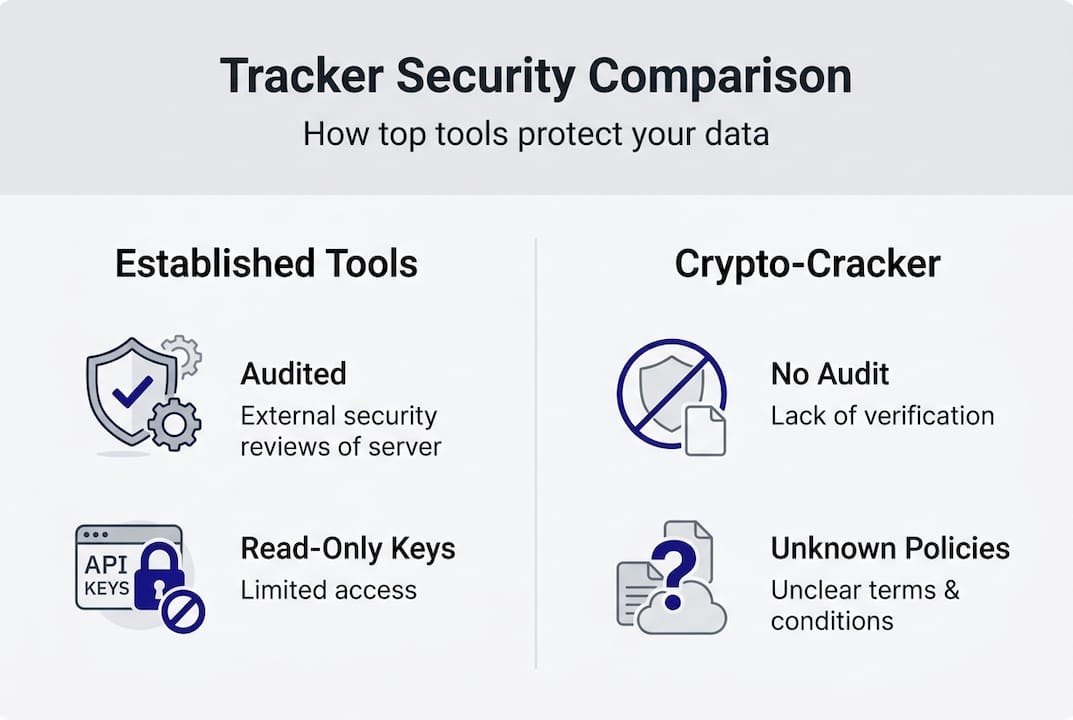
Data storage policies matter significantly. Reputable services encrypt your API keys using industry-standard AES-256 encryption before storing them on secure servers. They implement strict access controls, ensuring only authorized systems can decrypt and use your credentials. Many platforms also offer optional client-side encryption, where your data gets encrypted on your device before transmission.
Community trust develops over years of consistent operation without major security incidents. Platforms with extensive user bases benefit from collective scrutiny. Thousands of active users means security researchers, ethical hackers, and vigilant traders constantly monitor for vulnerabilities. This crowd-sourced security layer provides protection that new or unknown services lack.
Critical differences indicating safer options:
- Published security audits from recognized cybersecurity firms
- Transparent disclosure of data handling and storage practices
- Active community forums with responsive support teams
- Clear documentation of API permission requirements
- Regular security updates and vulnerability patch notifications
The absence of these elements in Crypto-Cracker’s public information suggests caution. Without third-party validation or community consensus about safety, connecting your exchange carries elevated risk compared to proven alternatives. Understanding CryptoCracker optimises your portfolio through official channels helps clarify the platform’s actual capabilities versus assumptions.
Explore secure crypto portfolio management with CryptoCracker
If you’re seeking a verified portfolio management solution with transparent security practices, CryptoCracker’s official platform offers comprehensive tools designed for investors at all experience levels. The platform integrates with major exchanges using OAuth 2.0 authentication, ensuring your login credentials never pass through third-party systems.

CryptoCracker emphasizes read-only API connections by default, preventing unauthorized withdrawals while providing real-time portfolio analytics. The platform encrypts all data using bank-level AES-256 encryption and never stores exchange passwords. Features include automated portfolio rebalancing suggestions, tax reporting tools, and performance tracking across multiple exchanges and wallets.
The Crypto Management Platform provides detailed insights into market trends, helping you optimize holdings based on data-driven analysis. Whether you’re managing a small portfolio or substantial holdings, CryptoCracker portfolio optimisation adapts to your investment strategy. Transparent Crypto-Cracker pricing plans ensure you understand costs upfront, with options suitable for beginners and active traders alike.
Frequently asked questions
Do read-only API keys allow fund withdrawals?
No, read-only API keys only permit viewing balances and transaction history. The exchange’s backend systems enforce these restrictions at the server level, automatically rejecting any withdrawal or trading attempts made with read-only credentials.
What are the risks of using unknown portfolio trackers?
Unknown trackers may expose your data through breaches, enable phishing attacks by collecting credentials, or misuse API permissions if granted excessive access. Without security audits or community validation, you cannot verify their data handling practices or server security measures.
How can I verify if a crypto portfolio app is safe?
Look for published security audits from recognized cybersecurity firms, read independent user reviews on cryptocurrency forums, and confirm the service never requests private keys or seed phrases. Established platforms typically have extensive documentation about their encryption methods and data storage policies.
Should I give wallet seed phrases to portfolio tools?
Never provide seed phrases to any portfolio tracker or third-party service. Seed phrases grant complete control over wallet contents, and legitimate portfolio tools never require them. Anyone requesting your seed phrase is attempting to steal your cryptocurrency.
What alternative tracking methods exist besides exchange integration?
Manual tracking through spreadsheets eliminates third-party access entirely. Non-custodial wallets like MetaMask provide portfolio visibility without exchange connections. Hardware wallets like Ledger offer maximum security by keeping private keys offline while still allowing balance monitoring through public addresses.
How does OAuth 2.0 protect my exchange credentials?
OAuth 2.0 creates temporary authorization tokens that grant specific permissions without exposing your password. When you authorize a portfolio app through OAuth, the exchange generates a token that allows data access while your actual login credentials remain private. The app never sees or stores your password.