TL;DR:
- Most crypto investors fail because they lack a structured research system rather than because of the coins they choose.
- A layered approach involving macro analysis, fundamentals, on-chain behavior, sentiment, and technical signals enables quick, confident project evaluation and better portfolio management.
Most crypto investors don’t fail because they pick the wrong coins. They fail because they never had a real system for picking in the first place. With thousands of active projects, conflicting data everywhere, and new narratives emerging weekly, even experienced investors get lost in the noise. A structured cryptocurrency research process cuts through that confusion. It gives you a repeatable, clear framework to evaluate any project quickly and confidently, whether you’re just getting started or refining a portfolio you’ve already built.
Table of Contents
- Understanding the key components of the cryptocurrency research process
- Preparing your toolkit: essential data points and metrics to collect
- Step-by-step cryptocurrency research process: from broad screening to entry timing
- Navigating legal and regulatory considerations in crypto research
- Applying your research: building and optimizing your crypto portfolio
- Why most crypto research approaches miss the mark — and what really works
- How CryptoCracker makes cryptocurrency research easy and effective
- Frequently asked questions
Key Takeaways
| Point | Details |
|---|---|
| Multi-method approach | Combine technical, fundamental, on-chain, sentiment, and regulatory research for effective crypto analysis. |
| Key valuation metrics | Use market cap relative to fees and TVL with growth projections to assess smart contract platforms. |
| Layered filtering | Start with macro analysis to narrow projects, then confirm with on-chain and fundamental data. |
| Regulatory diligence | Research marketing promises and whitepapers to avoid investing in securities accidentally. |
| Practical portfolio strategies | Apply research insights using position sizing, staged entries, and planned exits for risk control. |
Understanding the key components of the cryptocurrency research process
To start your journey, let’s explore the essential research areas that professional investors use to dissect cryptocurrencies.
The biggest mistake most investors make is treating crypto research as one thing. It isn’t. It’s actually five distinct crypto market analysis methods working together, and each one answers a different question about a project.
Professional crypto research uses five core methods, and an experienced analyst can complete an initial screening in just 10 to 15 minutes per project. That speed comes from knowing exactly what to look for in each layer. Here’s what those five methods cover:
- Technical analysis: Examines price charts, trading volume, support and resistance levels, and momentum indicators like RSI to identify entry and exit timing.
- Fundamental analysis: Evaluates the team, whitepaper, tokenomics (how tokens are distributed and incentivized), development activity, and real-world use case.
- On-chain analysis: Reads data recorded directly on the blockchain, including wallet activity, whale movements (large holders buying or selling), and exchange inflows and outflows.
- Sentiment analysis: Measures market mood through tools like the Fear and Greed Index, social media volume, and community engagement trends.
- Macro and regulatory research: Tracks interest rate environments, dollar strength (the DXY index), and legal developments that shape the broader crypto market.
Used together, these methods let you eliminate 80 to 90 percent of projects quickly during initial screening. That’s the real value: not just knowing what to look for, but knowing what disqualifies a project fast so you can focus your energy where it actually matters.
Preparing your toolkit: essential data points and metrics to collect
Before analyzing projects, you must collect and understand the key data points investors prioritize.
Think of this as setting up your workbench before you start building. Going into research without the right metrics in hand wastes time and leads to shallow conclusions. The core numbers every investor should track are market capitalization (the total value of all circulating tokens), transaction fees generated by the network, Total Value Locked (TVL, which reflects the amount of assets secured in a protocol’s smart contracts), and forward growth projections.

Smart contract platforms are commonly valued using market cap to fees ratios or market cap to TVL ratios, often adjusted for growth expectations similar to how equity investors use PEG ratios. That forward-looking angle matters enormously. A project trading at a high market cap to fees ratio might still be undervalued if its fee growth is accelerating. Context is everything.
Here’s a simplified comparison of how these metrics might look across major asset types:
| Asset | Market cap to fees ratio | Market cap to TVL | Growth outlook |
|---|---|---|---|
| Bitcoin | Very high (store of value) | Not applicable | Moderate, driven by adoption |
| Ethereum | Moderate | ~1x to 2x | Strong, driven by ecosystem growth |
| Emerging L1 platform | Low to moderate | Below 1x | High potential, higher risk |
| Mature DeFi protocol | Low | Near 1x | Stable, income-generating |
Useful data sources for gathering these metrics include blockchain explorers, DeFi analytics sites, project GitHub repositories for development activity, and token terminal dashboards for financial metrics.
Pro Tip: Always check when data was last updated on any analytics platform. Stale TVL or fee data can make a project look healthier than it currently is. Fresh data is non-negotiable before any investment decision.
You can also use dedicated crypto valuation metrics tools that aggregate this data automatically, saving you significant manual research time.
Step-by-step cryptocurrency research process: from broad screening to entry timing
With your data toolkit ready, here is how to execute a layered and systematic crypto research process.
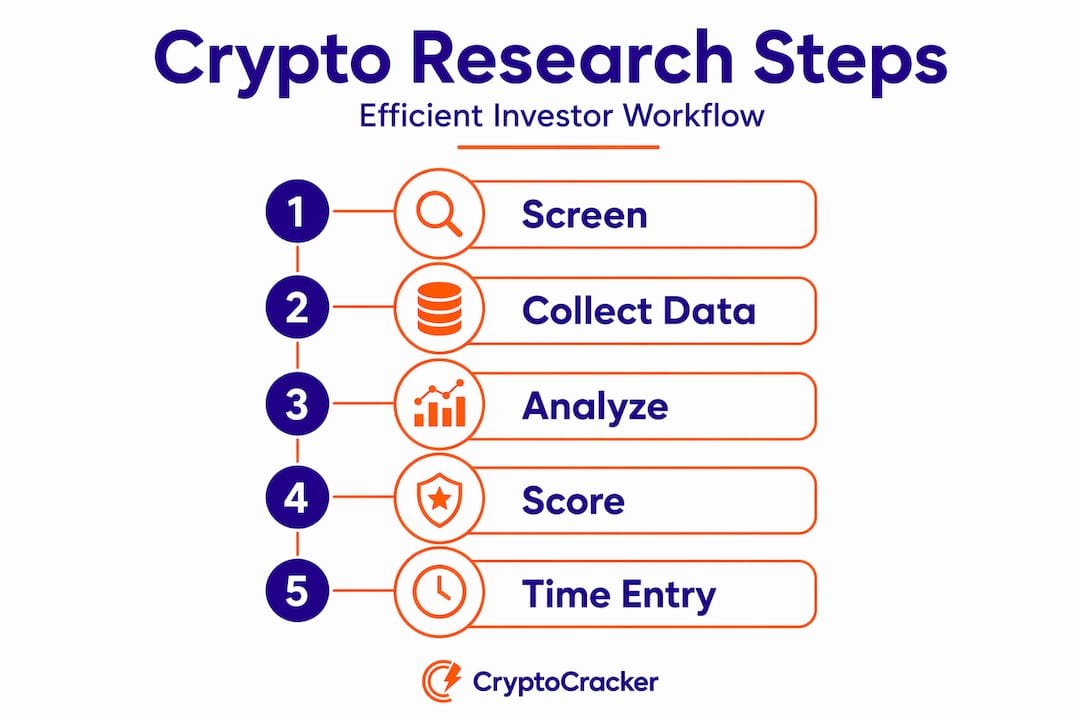
Insiders rely on a layered analysis approach that begins with macro filters, moves through on-chain confirmation, and only then uses technical analysis for precise entry timing. This process rejects roughly 85 percent of candidates before reaching the technical stage. Here’s the full sequence:
-
Macro and regulatory overview. Start with the big picture. Are interest rates rising or falling? A rising dollar (strong DXY) historically pressures crypto prices. Are there upcoming regulatory decisions that could affect the sector? This step sets the investment climate before you analyze any individual project.
-
Fundamental screening. Evaluate the team’s track record, the whitepaper’s clarity and originality, token supply structure, vesting schedules (when early investors can sell), and real-world demand for the protocol. Look at crypto project screening steps to build a consistent checklist.
-
On-chain confirmation. Check whether large wallets (whales) are accumulating or distributing. Monitor exchange inflows; when tokens flow onto exchanges in large quantities, selling pressure usually follows. Declining exchange reserves alongside rising prices signal genuine demand, not just speculation.
-
Sentiment timing. Use the Fear and Greed Index as a contrarian signal. Extreme fear often aligns with buying opportunities. Extreme greed often signals overheated conditions. Cross-reference with social media sentiment trends on X and Reddit to gauge retail mood.
-
Technical analysis for entry. Only at this final stage do you look at charts. Identify key support levels where price has historically held, check RSI for overbought or oversold conditions, and confirm entry signals with volume. Technical analysis answers when to buy, not whether to buy.
“The investors who consistently outperform don’t have better information. They have a better process for filtering information.”
This layered approach also pairs naturally with crypto trend analysis steps to help you track emerging opportunities without getting caught in short-term noise.
Pro Tip: Build a simple scoring sheet. Rate each project from 1 to 5 across all five research layers. Any project scoring below 3 in macro, fundamental, or on-chain analysis should be eliminated before you even open a price chart.
Navigating legal and regulatory considerations in crypto research
Researching projects also means understanding the legal landscape you invest in, so you can avoid pitfalls and regulatory traps.
This is the part of the cryptocurrency research process that most investors skip entirely, and it’s where some of the biggest losses originate. A technically impressive project can still be a legal liability if it’s structured in a way that puts it squarely under securities law.
The U.S. Securities and Exchange Commission classifies crypto assets into five categories, and the key trigger for registration requirements is often marketing language, not technology. When a project’s promoters make promises about profit derived from the efforts of others, that language alone can bring a token under securities law. Researching a project’s marketing materials and public communications is not optional — it’s essential due diligence.
On the European side, the EU’s Markets in Crypto-Assets regulation, known as MiCA, requires whitepapers that clearly disclose risks and environmental impact, along with capital requirements for Crypto-Asset Service Providers (CASPs) that took full effect in 2026. For investors in Ireland and across the EU, this means projects operating without a compliant whitepaper or unlicensed CASPs carry regulatory risk that directly affects your investment’s safety and liquidity.
Key legal checkpoints to include in your research:
- Does the project have a current, compliant whitepaper?
- Is the issuer or exchange you’re using licensed under MiCA (for EU investors)?
- Does marketing language make explicit profit promises tied to team efforts?
- Is the token listed on exchanges that maintain crypto regulations overview compliance?
Understanding these factors won’t make you a lawyer, but it will help you avoid projects that carry hidden legal risk beneath impressive-looking technology.
Applying your research: building and optimizing your crypto portfolio
Once you’ve researched effectively, you need to apply those insights into optimizing your portfolio for better results.
Research without action is just reading. The goal of a solid cryptocurrency analysis process is to translate findings into a portfolio structure that reflects your conviction and protects your downside. Professional investors use position sizing based on conviction level and risk tolerance, staged entries to reduce timing risk, and clear exit strategies to protect gains or limit losses.
Here’s how to put that into practice:
- Conviction-weighted sizing. Allocate more capital to projects that scored highest across your five research layers. A project you rate 4.5 out of 5 across all dimensions deserves a larger position than one that scraped through at 3.0.
- Staged entries. Rather than buying your full position at once, split it into two or three tranches. Enter the first when fundamentals confirm the thesis, and the second after on-chain data supports accumulation. This naturally lowers your average entry price over time.
- Predefined exit levels. Set your profit target and your stop-loss before you enter a trade. This removes emotion from the decision when markets move fast in either direction.
- Regular portfolio reviews. Markets change. A project that scored well three months ago may have weakened fundamentals or a changed regulatory picture today.
Pro Tip: Track portfolio performance against your original research thesis, not just against price. If a token is up 40 percent but the fundamentals have deteriorated, that’s still a sell signal. Your thesis is the benchmark, not the price chart alone.
Use a dedicated crypto portfolio tracking tool to monitor how each position evolves relative to your entry thesis over time.
Why most crypto research approaches miss the mark — and what really works
Here is the uncomfortable truth we’ve seen play out again and again: most investors approach crypto research backwards. They find a token they like (often through social media), then search for information that confirms their excitement. That’s not research. That’s storytelling with data decoration.
The investors who get burned most often are not the ones who avoided technical analysis. They’re the ones who only used technical analysis, treating price patterns as a substitute for understanding what a project actually does, who built it, and whether the economics make sense. Charts tell you what the crowd is doing. They don’t tell you whether the crowd is right.
The other common failure is treating regulatory signals as bureaucratic noise. Marketing representations trigger securities classification far more than the underlying technology does, which means a project can be technically groundbreaking and legally compromised at the same time. We’ve seen investors watch assets frozen or delisted not because the protocol failed, but because the legal structure around it collapsed.
What genuinely works is the layered approach outlined in this article, paired with brutal simplicity in execution. The best research frameworks we’ve encountered are not the most complex ones. They are the ones that any investor can consistently apply, project after project, without requiring a finance degree or a Bloomberg terminal. Complexity creates decision fatigue. Simplicity creates discipline.
We also believe that analytics in crypto investing should serve your decision-making, not overwhelm it. One solid data point applied consistently beats twenty metrics used occasionally. Build your process around the five layers, stick to it, and refine it as you learn. That’s the approach that actually compounds over time.
How CryptoCracker makes cryptocurrency research easy and effective
If you want to put these research methods into practice with simplicity and confidence, CryptoCracker offers the tools to empower your investing journey.
Pulling together macro data, on-chain signals, fundamentals, and sentiment across dozens of projects is genuinely hard work when you’re doing it manually. CryptoCracker was built to remove that friction. Our platform automatically aggregates the key data points you need across technical, fundamental, and market dimensions, giving you clear visualizations and actionable signals without requiring you to jump between twelve different websites.

Whether you’re analyzing your first project or managing a multi-asset portfolio, our crypto market analysis tool brings the layered research process into a single, easy-to-navigate dashboard. You can monitor portfolio performance, track how each position evolves against your original thesis, and benefit from personalized recommendations built around your risk profile. For investors in Ireland and across the EU, CryptoCracker is designed with MiCA compliance in mind, so the regulatory piece of your research is already supported. Explore how portfolio optimization with CryptoCracker can help you invest smarter, not harder.
Frequently asked questions
What are the most important factors in the cryptocurrency research process?
A solid cryptocurrency research process covers five core areas: technical analysis, fundamental evaluation, on-chain data, sentiment assessment, and macro and regulatory context. Each method takes 10 to 15 minutes at the screening stage and together they build a complete picture of any project’s investment potential.
How do regulations like the SEC rules and EU MiCA impact crypto investment research?
Regulations directly shape which projects are legally safe to hold and trade. SEC guidance focuses on whether marketing language triggers securities classification, while MiCA requires whitepapers with risk and environmental disclosures and sets capital standards for licensed CASPs operating in EU markets.
Can technical analysis alone reliably identify promising cryptocurrencies?
No. Technical analysis tells you when to enter or exit, but not whether a project is worth investing in. Identifying real growth potential requires evaluating fundamentals, on-chain behavior, sentiment, and regulatory standing alongside price chart signals.
How can I apply cryptocurrency research outcomes to manage my portfolio effectively?
Start by sizing positions based on how strongly your research supports each project, then use staged entries to reduce timing risk. Professional investors also set predefined exit levels for both profit-taking and loss protection before entering any trade, keeping emotion out of the equation.