TL;DR:
- Crypto security mainly hinges on protecting private keys, not transaction privacy.
- Using appropriate custody models like hardware wallets or multisig enhances asset security.
- Human error and procedural lapses often pose greater risks than cryptographic failures.
Most crypto investors assume security means hiding transactions or keeping blockchain data private. It doesn’t. The ledger is public by design, and that’s actually fine. What truly puts your assets at risk is losing control of your private keys, falling for a phishing scam, or neglecting the operational habits that keep your crypto where it belongs. In this guide, we’ll break down what data security really means in the crypto world, explore the most common threats, walk through custody models, and give you a practical framework to protect your investments without needing a cybersecurity degree.
Table of Contents
- Defining data security in crypto: What matters most
- Types of crypto custody: Methods for securing your assets
- Defense-in-depth: Layers of security beyond the tech
- Security trade-offs: Balancing risk, control, and usability
- Practical steps to secure your investments
- What most investors miss about data security in crypto
- How CryptoCracker helps you secure and manage crypto assets
- Frequently asked questions
Key Takeaways
| Point | Details |
|---|---|
| Keys control everything | Protecting your private keys is the core principle of crypto security since anyone with them can access your funds. |
| Layer your protection | Combining secure storage, operational controls, and good personal habits is far more effective than relying on technology alone. |
| There’s no perfect solution | Every custody method has trade-offs, so balance convenience and security based on your needs and risk profile. |
| Stay vigilant | Regularly review your setup and stay alert for phishing, scams, or procedural lapses since most losses are operational, not technical. |
Defining data security in crypto: What matters most
The blockchain is a public ledger. Anyone can view transactions, wallet balances, and transfer histories. That’s not a flaw; it’s a feature. The system is designed for transparency and verifiability. So when we talk about data security in crypto, we’re not talking about making transactions invisible. We’re talking about protecting the keys that give you control over your assets.
As security in crypto experts put it: “In crypto, ‘data security’ is mainly about protecting cryptographic keys and the systems/processes that use them.”
Think of your private key like the master key to a safety deposit box. The box itself is visible to everyone walking through the bank, but only the person with the key can open it. Losing that key, or handing it to the wrong person, means losing your funds. Permanently. There’s no customer support line to call, no password reset email.
This distinction matters because many investors focus their energy in the wrong place. They worry about blockchain privacy when the real risk lives elsewhere. Most crypto losses are caused by poor key management, not by cryptographic failures. The good news is that understanding where the actual risk sits gives you a real path to reducing it.
Here are the three core pillars of crypto data security:
- Key custody: How and where your private keys are stored.
- Signing authorization: Who or what is permitted to approve transactions.
- Credential and seed phrase protection: How you safeguard the recovery information that can regenerate your keys.
Neglect any one of these, and the other two don’t matter as much. Learning the crypto security basics around these pillars is the most important step any investor can take. Most experienced investors will also tell you that reviewing your security best practices regularly is just as important as setting them up in the first place.
With the basics established, the next step is to understand the different storage and custody models used to enhance data security.
Types of crypto custody: Methods for securing your assets
Not all wallets are created equal, and choosing the right custody model depends on your risk tolerance, how actively you trade, and how much crypto you’re holding. Let’s break down the main options.
Secure crypto custody reduces risk “by isolating key material (e.g., cold storage), using dedicated infrastructure (HSMs), splitting approvals (multisig), and/or distributing key-signing operations (MPC).”

| Custody type | Security level | Usability | Best for |
|---|---|---|---|
| Hot wallet | Medium | High | Active traders, small amounts |
| Cold storage | High | Low | Long-term holders, large amounts |
| Hardware wallet | High | Medium | Most individual investors |
| Multisig | Very high | Medium-low | Shared accounts, larger holdings |
| MPC (Multi-party computation) | Very high | Medium | Institutional or advanced users |
Here’s a quick breakdown of what each model means in practice:
- Hot wallets are connected to the internet and easy to use, but that connection creates exposure. Great for small, everyday amounts.
- Cold storage keeps keys completely offline, making them nearly impossible to hack remotely. The trade-off is slower access.
- Hardware wallets are physical devices that store keys offline while still allowing you to sign transactions when needed. A solid middle ground.
- Multisig wallets require multiple private keys to authorize a transaction. Even if one key is compromised, funds can’t move without the others.
- MPC (Multi-party computation) splits the signing process across multiple parties without any single party holding a complete key.
Operationally, no matter which method you choose, good discipline matters. That means separating duties if multiple people manage funds, scheduling regular audits, and having a clear emergency access process in place. Understanding security’s role in investing helps you see that custody isn’t just a technical choice; it shapes your entire investing process. Pairing the right custody type with secure transaction methods gives you a much stronger overall posture.
Pro Tip: Don’t keep your main investment in a single wallet type. Use a hardware wallet for long-term holdings and a hot wallet only for amounts you actively trade. Splitting reduces your exposure significantly.
After learning about the available storage methods, it’s important to consider how defense-in-depth covers not just technology, but also human and procedural risks.
Defense-in-depth: Layers of security beyond the tech
Here’s something that surprises most investors: the biggest security failures in crypto rarely involve breaking cryptographic code. They involve people making mistakes, getting tricked, or skipping a simple process step. Security in crypto is “defense-in-depth (keys + systems + people + procedures).”
Phishing attacks, social engineering scams, and procedural lapses are responsible for an enormous share of crypto losses. Someone clicks a fake wallet link. Another person shares their seed phrase with a “support agent.” A third forgets to revoke access after an employee leaves. These aren’t exotic hacks. They’re everyday mistakes.
Here’s what a layered defense looks like in practice:
- Access controls: Limit who can initiate or approve transactions. Use multi-factor authentication everywhere.
- Monitoring and logging: Keep records of all wallet activity. Set up alerts for unusual transaction sizes or new device logins.
- Approval workflows: For larger amounts, require multiple confirmations before funds move.
- Recovery planning: Know exactly how you’ll regain access if a device is lost or a key is compromised.
| Layer | What it protects against | Example action |
|---|---|---|
| Keys | Unauthorized signing | Hardware wallet, strong passphrase |
| Systems | Software vulnerabilities | Regular updates, vetted software |
| People | Social engineering | Training, verification habits |
| Procedures | Operational lapses | Checklists, audits, access reviews |
Consider a real-world scenario: an investor stores crypto in a hardware wallet (strong key layer) but reuses passwords across accounts (weak people layer). A data breach on an unrelated site exposes that password, and suddenly their exchange account is drained. The hardware wallet did its job, but the procedure didn’t. Regular crypto risk assessment helps you spot these gaps before they cost you. It also pays to know how to reduce crypto risk across all layers, not just the technical ones.
Now, let’s dig deeper into the trade-offs involved in these security decisions, so you can tailor your approach to your specific needs and risks.
Security trade-offs: Balancing risk, control, and usability
More security doesn’t always mean better outcomes. It means different trade-offs. As crypto custody guidance explains, “more security depends on your threat model and operational trade-offs — cold storage lowers exposure but adds usability frictions; multisig increases on-chain transparency/auditability but can be more operationally complex, while MPC can reduce exposure on-chain but increases reliance on signer infrastructure.”
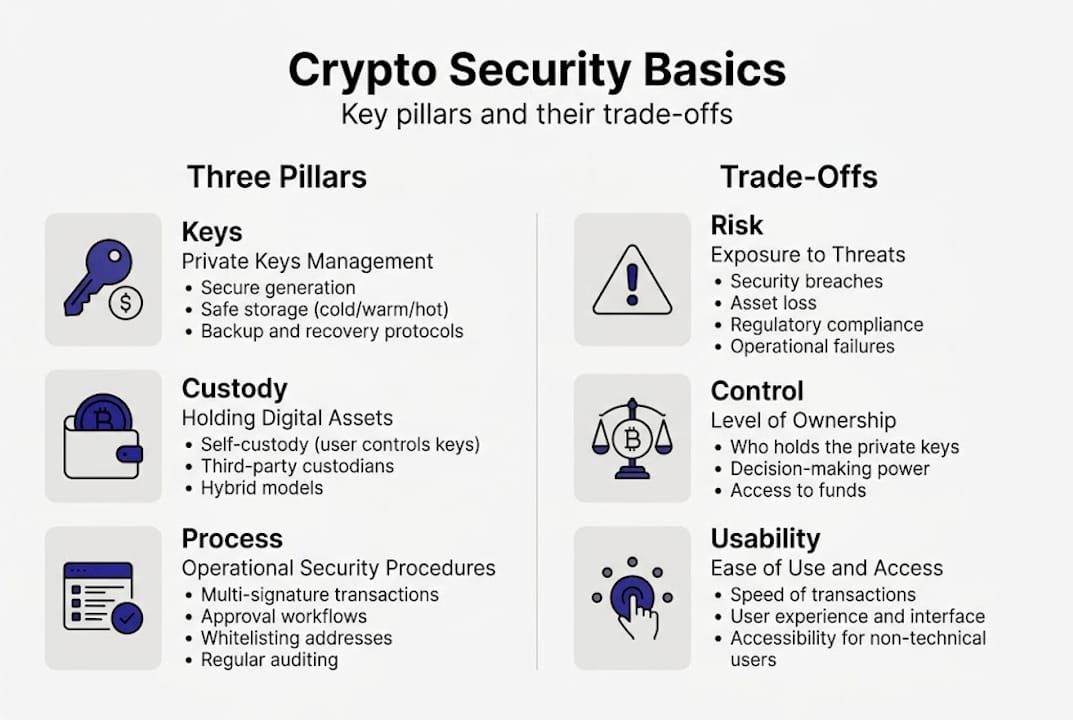
Your “threat model” is simply a realistic picture of what risks you face. A long-term holder with $500 in a single wallet has a very different threat model than someone managing $50,000 across multiple tokens. Your security setup should match your actual situation, not someone else’s.
Here’s a checklist to help you think through your own approach:
- What is the total value of your crypto holdings?
- How often do you need to access or trade your assets?
- Do multiple people manage your crypto, or is it just you?
- Have you stored your seed phrase somewhere secure and offline?
- Are you using unique, strong passwords and multi-factor authentication?
- Do you have an emergency access plan if your device is lost?
- When did you last review and update your security setup?
Balancing these questions honestly helps you find the right level of security without adding unnecessary friction. Following expert crypto investor strategies is a great starting point, and evaluating secure platform features helps you identify which tools actually match your needs.
Pro Tip: Revisit your security setup whenever your portfolio grows significantly or your habits change. What worked at $1,000 may not be enough at $20,000.
With these frameworks, you can now focus on simple, actionable steps for strengthening your own crypto data security.
Practical steps to secure your investments
Knowing the theory is one thing. Putting it into practice is where it counts. Your practical data-security decisions center on “key custody, signing authorization, and how you prevent credential/seed-phrase compromise, not about making blockchain data ‘secret’.” Here’s a straightforward checklist to get your security foundations solid:
- Generate your seed phrase securely. Use a reputable wallet to generate it. Never do this on a shared or public device.
- Write your seed phrase down on paper. Store it in a physically secure location, not in a screenshot, email, or cloud note.
- Never share your seed phrase with anyone. No legitimate platform or support team will ever ask for it.
- Use a hardware wallet for significant holdings. Keep only small amounts in a hot wallet for day-to-day activity.
- Enable multi-factor authentication on every exchange account and email address linked to your crypto.
- Bookmark legitimate wallet and exchange URLs. Never click links in emails, DMs, or ads claiming to be from your wallet provider.
- Monitor your wallet activity regularly. Check for any transactions you don’t recognize and set up alerts where possible.
- Review your access credentials every few months. Update passwords, check connected apps, and remove anything you no longer use.
- Tell someone you trust where your seed phrase is stored, in case of emergency. This is part of your recovery plan.
- Reassess your setup any time your portfolio value jumps, or you start using a new platform.
Following the top crypto security practices built into each of these steps keeps you well ahead of the majority of investors who skip the basics entirely.
With all these pieces in mind, let’s examine what most people get wrong about crypto data security and what you can do differently.
What most investors miss about data security in crypto
We’ve seen this pattern repeat itself many times: investors spend hours researching the most sophisticated custody solution, then store their seed phrase in a notes app on their phone. The technical product was excellent. The habit was the weak link.
The uncomfortable truth is that it’s almost never the cryptography that fails. Private keys and blockchain protocols are extraordinarily robust. What fails is access management, human behavior, and the small process gaps that get ignored when things feel fine. A strong password manager and a paper backup stored somewhere safe will protect more people than a premium hardware wallet used carelessly.
The real crypto security mindset is about consistency and discipline, not just buying the right tools. Process matters more than products. Reviewing your setup regularly matters more than setting it up once. Doing the basics exceptionally well will protect you better than any single fancy feature.
How CryptoCracker helps you secure and manage crypto assets
Understanding data security is powerful, but having the right tools and guidance alongside you makes applying that knowledge far easier.

At CryptoCracker, we’ve built our platform with security and simplicity in mind, so you don’t have to trade one for the other. Our cryptocurrency wallet guide walks you through safe storage choices in plain language, and our portfolio tools let you monitor your assets in real time without adding unnecessary complexity. If you’re ready to take a more structured approach to optimizing your portfolio while keeping security front and center, we’re here to help you do exactly that.
Frequently asked questions
Why are private keys so critical for crypto data security?
Whoever controls your private keys controls your funds. As security in crypto makes clear, protecting cryptographic keys is the central concern of all crypto data security, because there is no way to recover funds if keys are lost or stolen.
Is storing my crypto on an exchange safe?
Exchanges are frequent targets for large-scale attacks, so for significant holdings, cold storage or a hardware wallet is generally a safer option since you control the keys yourself.
How do I protect my wallet from phishing and social engineering?
Always verify website URLs manually, never share your seed phrase with anyone, and enable multi-factor authentication. Most operational failures happen because attackers exploit trust, not technology.
What is ‘multisig’ and why does it matter?
Multisig wallets require more than one key to authorize a transaction, so if one key is lost or exposed, your funds still can’t move without the others. Splitting approvals this way adds a meaningful layer of protection for larger holdings.
Recommended
- Crypto security best practices: protect assets confidently | CryptoCracker
- Mastering the role of security in crypto for safer investing | CryptoCracker
- Secure crypto transactions: practical examples and methods | CryptoCracker
- Key features that make crypto platforms secure and user-friendly | CryptoCracker