TL;DR:
- Bitcoin may move in tandem with risky assets during crises, undermining its role as a safe haven.
- True crypto diversification involves spreading across different sectors, use cases, and ecosystems for better risk management.
- Regular rebalancing and understanding asset correlations are crucial for effective and resilient crypto portfolio strategies.
Most investors assume that owning Bitcoin automatically means owning safety. It feels logical: Bitcoin is the biggest, most established crypto asset in the world, so surely it cushions the blow when markets turn. The reality is more complicated. Correlation spikes in crises like COVID-19 and the Ukraine conflict show that Bitcoin can actually move in lockstep with riskier assets during the worst moments. That is precisely when you need protection most. This guide breaks down why genuine diversification matters, what it actually looks like, and how you can build a smarter crypto portfolio today.
Table of Contents
- The risk reality: Why crypto portfolios can’t rely on Bitcoin alone
- What does crypto diversification really mean?
- Comparing diversification: Crypto vs. traditional finance
- Practical strategies: How to diversify your crypto holdings today
- Why most investors get crypto diversification wrong
- Level up your portfolio diversification with CryptoCracker
- Frequently asked questions
Key Takeaways
| Point | Details |
|---|---|
| Bitcoin isn’t enough | Relying on a single coin exposes you to market swings, especially during crises. |
| True diversification is strategic | Hold assets from different sectors, chains, and use cases to dampen risk. |
| Correlation matters | Crypto assets can spike in correlation during market stress—adjust accordingly. |
| Practical steps make a difference | Follow a clear, step-by-step plan to diversify, monitor, and rebalance regularly. |
The risk reality: Why crypto portfolios can’t rely on Bitcoin alone
There is a comforting story many new investors tell themselves: Bitcoin is digital gold, a store of value that holds steady while everything else crumbles. We understand the appeal. But the data challenges this narrative in a meaningful way.
“Bitcoin can be a poor hedge in some stock portfolios, and correlation between crypto assets rises sharply during market crises, undermining assumed diversification benefits.”
Research on network-based portfolio diversification confirms that during major stress events, crypto assets tend to move together rather than independently. When panic spreads, investors sell across the board. The result is a portfolio that feels diversified on paper but behaves like a single concentrated bet in practice.
So what specific risks does a non-diversified crypto portfolio carry?
- Concentration risk: One bad event affecting Bitcoin or your primary holding can wipe out a significant portion of your portfolio overnight.
- Sector blindness: Holding one coin means missing the entirely different risk and growth profiles of DeFi tokens, layer-2 networks, stablecoins, and utility tokens.
- No cushion during drawdowns: Without assets that respond differently to market forces, there is nothing to absorb losses when your main coin falls 40% in a week.
- Missed opportunities: Crypto markets move in cycles. Different sectors often lead at different times, and a single-coin portfolio can miss entire waves of growth.
Understanding the key benefits of crypto trading starts with recognizing that managing risk is just as important as chasing gains. And reducing crypto trading risk requires a deliberate approach, not just picking the most popular coin.
With the myth of Bitcoin-as-ultimate-hedge addressed, let’s explore how diversification truly works.
What does crypto diversification really mean?
Diversification sounds simple: own more than one thing. But in crypto, real diversification goes several layers deeper than just buying five or ten different coins.
True crypto diversification means spreading your holdings across different use cases, blockchain ecosystems, sectors, and even geographic exposure of the development teams behind projects. A portfolio holding Bitcoin, Ethereum, and three Ethereum-based tokens is not genuinely diversified. All four of the last assets would likely suffer if the Ethereum network faced a major problem or regulatory action.

| Factor | Single-coin portfolio | Diversified portfolio |
|---|---|---|
| Volatility exposure | Extremely high | Moderate to lower |
| Sector risk | Total exposure | Distributed |
| Growth opportunity | Limited to one asset | Access to multiple sectors |
| Drawdown cushion | None | Partial |
| Complexity to manage | Low | Moderate |
A practical, diversified portfolio might look something like this: 40% in large-cap assets like Bitcoin and Ethereum, 25% in mid-cap tokens across DeFi and infrastructure, 20% in stablecoins for liquidity and safety, and 15% in higher-risk, smaller-cap projects with different use cases. The exact split depends on your goals and risk tolerance, but the principle is clear: variety with purpose.
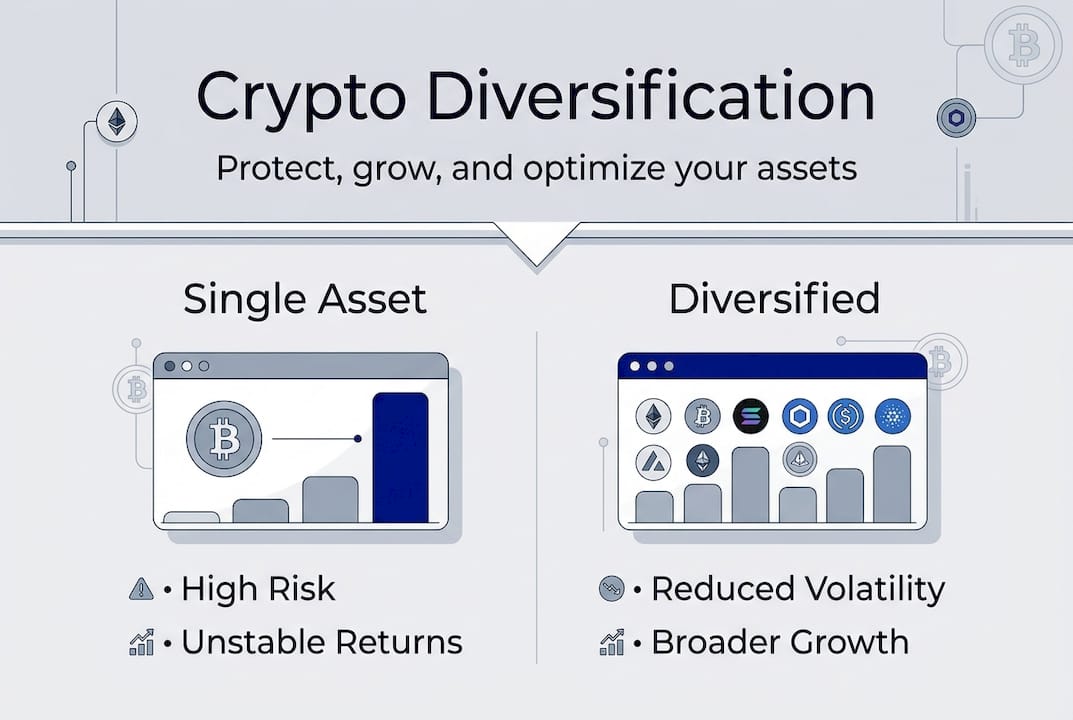
Research supports this approach, finding that network-based strategies that measure actual relationships between assets can outperform simple random diversification. In other words, picking coins intelligently based on how they interact matters more than just picking many coins.
For a deeper foundation, explore crypto asset allocation strategies and brush up on crypto investment basics if you want a structured starting point.
Pro Tip: Don’t just diversify by coin name. Ask whether each asset operates on a different blockchain, serves a different purpose, and responds differently to market events. If your whole portfolio would suffer from a single regulatory change or network outage, it is not truly diversified.
Comparing diversification: Crypto vs. traditional finance
Diversification is a concept that has worked in traditional finance for decades. The classic model: mix stocks, bonds, real estate, and commodities so that when one dips, others hold steady. It is time-tested. But crypto plays by different rules.
In traditional markets, correlations between asset classes tend to stay relatively stable. Government bonds often rise when equities fall. Gold holds value during uncertainty. These relationships are predictable enough to build long-term strategies around. Traditional diversification principles are genuinely disrupted in crypto due to the market’s unique volatility and behavior patterns.
| Asset class | Typical volatility | Crisis behavior | Diversification reliability |
|---|---|---|---|
| Government bonds | Low | Often stabilize | High |
| Blue-chip stocks | Moderate | Mixed | Moderate to high |
| Bitcoin | Very high | Can fall sharply | Low to moderate |
| Altcoins | Extremely high | Often fall harder than BTC | Low |
| Stablecoins | Near zero | Typically stable | High (as cash equivalent) |
How does building a diversified portfolio compare across both worlds?
- Identify your risk tolerance before picking assets, whether stocks or crypto.
- Choose across categories in stocks (sectors like tech, healthcare, energy) and in crypto (layer-1 chains, DeFi, infrastructure, stablecoins).
- Rebalance regularly since crypto markets shift faster than stock markets, requiring more frequent adjustments.
- Monitor correlations, not just individual performance. In crypto especially, assets that look different can behave identically during stress.
Learn how crypto investing is becoming mainstream and why applying crypto investing best practices from traditional finance, adapted for crypto’s unique behavior, gives you a real edge.
Practical strategies: How to diversify your crypto holdings today
Having seen how crypto and finance differ, here is how to put true diversification into action right now.
A 5-step plan for diversifying your crypto portfolio:
- Audit what you currently hold. List every asset, its percentage of your total portfolio, and what blockchain or sector it belongs to. Most people discover they are far less diversified than they thought.
- Define your target allocation. Decide how much risk you can absorb. A conservative investor might keep 60% in large-caps and stablecoins, while an aggressive investor might hold more mid and small-cap tokens.
- Introduce assets from different sectors. Add at least one asset each from DeFi, infrastructure, and a non-Ethereum ecosystem. This reduces your exposure to any single platform’s fate.
- Set rebalancing triggers. Decide in advance that if any single asset grows beyond a certain percentage of your portfolio, you will rebalance. Quarterly reviews work well for most investors.
- Use data and analysis tools. Network-based portfolio approaches consistently outperform random diversification. Tools that visualize asset correlations help you make smarter choices.
Pro Tip: Use a portfolio tracker that shows correlation data, not just price. If two assets in your portfolio move together 90% of the time, owning both adds almost no real protection.
Red flags: What not to do when diversifying:
- Adding 20 coins without understanding how they interact
- Treating stablecoins as “not real” portfolio holdings
- Ignoring rebalancing until losses force your hand
- Confusing low price per coin with low risk
- Overlooking crypto risk assessment strategies for each new asset you add
For a full view of how to optimize your approach, check our guide on crypto portfolio optimization tips and never underestimate the importance of crypto security fundamentals as you expand your holdings.
Why most investors get crypto diversification wrong
Here is an uncomfortable truth: most crypto investors who think they are diversified are not. They have added altcoins, perhaps a dozen of them, and assumed that breadth equals protection. It does not.
The deeper issue is that many of these coins share hidden connections. During normal market conditions, they look independent. But when fear takes hold, crypto correlations spike, and nearly every asset falls together. The illusion of diversification evaporates at exactly the moment it should deliver.
We believe the real mistake is treating diversification as a one-time setup rather than an ongoing discipline. Crypto markets evolve fast. An asset that was uncorrelated with Bitcoin six months ago might be deeply tied to it today. That is why understanding network-level relationships between assets matters far more than simply counting how many coins you own.
The one move most investors skip? Regular rebalancing. Markets drift, allocations shift, and what starts as a balanced portfolio becomes top-heavy without anyone noticing. Expert crypto strategies consistently point to rebalancing as one of the highest-impact habits you can build. Diversification is about depth, not breadth.
Level up your portfolio diversification with CryptoCracker
Ready to put real diversification to work? CryptoCracker gives you the tools to move beyond guesswork and manage your portfolio with clarity and confidence.

With CryptoCracker, you can optimize your crypto portfolio using data-driven insights and performance dashboards that show you exactly where your risk is concentrated. Our crypto market analysis tools help you identify correlations and spot opportunities across sectors before the market moves. And with automated crypto savings features, you can build consistent exposure over time without having to time every decision perfectly. Whether you are just starting to diversify or refining an existing strategy, CryptoCracker makes the next step clear, accessible, and actionable.
Frequently asked questions
What is the main benefit of diversifying my crypto holdings?
Diversification helps protect your portfolio from major losses if one coin underperforms by spreading risk across various assets. Even so, correlations can rise in crises, which is why smart, evidence-based allocation matters more than simply owning many coins.
Is diversification in crypto really different from stocks?
Yes, because crypto assets often become highly correlated during market stress, requiring smarter strategies than traditional diversification. Research shows BTC can be a poor hedge in some portfolio configurations, making it unreliable as a standalone safety net.
How many cryptocurrencies should I hold for real diversification?
There is no magic number, but holding coins with different use cases, platforms, and risk profiles improves diversification for most portfolios. Quality and strategic contrast between holdings matters far more than quantity.
How often should I rebalance my crypto portfolio?
Rebalancing quarterly or when allocations shift significantly helps maintain strategic diversification and mitigate risk. Fast-moving crypto markets often demand more frequent reviews than traditional investment accounts.
What are common mistakes when diversifying crypto?
Common errors include adding too many similar coins and ignoring how assets react during downturns. Since not all assets protect equally during crises, understanding correlation patterns is essential to building real resilience.