Most investors assume crypto risk is just about price swings. Buy low, sell high, brace for volatility. But that framing misses the bigger picture entirely. Real crypto risk spans technical failures, regulatory shifts, liquidity traps, and catastrophic black swan events that can erase a portfolio overnight. The good news? There are structured, proven frameworks that help you identify, measure, and manage these risks before they become costly mistakes. In this guide, we walk through the key concepts, professional methodologies, and practical steps that both new and experienced investors can apply right now.
Table of Contents
- What is crypto risk assessment? Key concepts for investors
- Frameworks and methodologies: From due diligence to risk scoring
- Quantitative risk tools: Modern Portfolio Theory and beyond
- Advanced risks: Black swans, correlation traps, and leverage
- Practical steps for different investor levels
- Take your crypto risk management to the next level
- Frequently asked questions
Key Takeaways
| Point | Details |
|---|---|
| Structured risk approach | Effective crypto risk assessment goes well beyond price swings and requires a multi-layered, evidence-based strategy. |
| Use both frameworks and tools | Combine due diligence frameworks with quantitative analytics for a comprehensive risk picture. |
| Protect against tail events | Adopt CVaR, correlation monitoring, and stress-testing to safeguard portfolios from black swan scenarios. |
| Level up your process | Novices should focus on diversification and stop-loss, while experienced investors can unlock deeper insights with MPT, CVaR, and on-chain analytics. |
What is crypto risk assessment? Key concepts for investors
Crypto risk assessment is not guesswork. It is a structured process that helps investors identify and respond to threats across multiple dimensions. As EY outlines, crypto risk assessment involves identifying, measuring, and mitigating risks such as volatility, liquidity, regulatory, technical, financial, and compliance risks through structured frameworks. That is a much broader scope than most retail investors realize.
Here are the six core risk categories every investor should understand:
- Price volatility risk: Rapid, unpredictable price swings that can trigger large losses in hours
- Liquidity risk: The inability to buy or sell an asset quickly without significantly moving its price
- Regulatory risk: Changing laws or government actions that restrict or ban crypto activity
- Technical risk: Smart contract bugs, protocol failures, or network vulnerabilities
- Financial risk: Overexposure, poor position sizing, or leverage misuse
- Compliance risk: Failing to meet legal obligations around reporting, taxation, or custody
Both qualitative analysis (reading whitepapers, evaluating teams) and quantitative analysis (volatility metrics, correlation data) are essential. Neither alone is enough. Think of it like a health checkup: you need both the doctor’s judgment and the lab results to get the full picture.
“Risk management in crypto is not about avoiding risk entirely. It is about understanding which risks you are taking and whether you are being compensated for them.”
If you want to reduce crypto trading risk effectively, starting with this foundational map of risk types is the most important first step.
| Risk category | Primary concern | Example |
|---|---|---|
| Price volatility | Sudden price collapse | Bitcoin dropping 50% in weeks |
| Liquidity | Can’t exit position | Low-cap altcoin with thin order books |
| Regulatory | Legal restrictions | Exchange shutdowns or asset bans |
| Technical | Protocol failure | Smart contract exploit or hack |
| Financial | Overexposure | Putting 80% of savings into one token |
| Compliance | Legal penalties | Unreported crypto gains at tax time |
Frameworks and methodologies: From due diligence to risk scoring
With the main risk categories in mind, let’s dig into the leading frameworks and protocols the experts use to analyze risk. Professional risk assessment borrows heavily from traditional finance but adapts it for the unique nature of digital assets.

According to EY’s token due diligence framework, key methodologies include risk scoring and a six-pillar due diligence structure covering reputational, technical, financial, legal, cybersecurity, and auditability dimensions. Each pillar surfaces a different layer of hidden risk.
Here is how to apply the six pillars in practice:
- Reputational and strategic: Research the founding team, partnerships, and project roadmap. Anonymous teams with no track record are a red flag.
- Technical: Review the codebase, audit history, and consensus mechanism. Has the protocol been independently audited?
- Financial: Analyze tokenomics, treasury reserves, and revenue model. Is the project financially sustainable?
- Legal and compliance: Check jurisdiction, regulatory filings, and any ongoing legal disputes.
- Cybersecurity: Assess past hacks, bug bounty programs, and infrastructure security practices.
- Auditability: Can you verify on-chain data independently? Transparent projects are far easier to trust.
Risk scoring takes this further by assigning numerical values to each pillar, allowing you to compare assets side by side. This is especially useful when evaluating new tokens or DeFi protocols. For a broader view of crypto risk management, combining scoring with qualitative judgment gives you the most complete picture.
If you are new to this space, brushing up on crypto investment basics before applying these frameworks will make the process much smoother. And do not underestimate crypto security essentials as part of your due diligence routine.
Pro Tip: Build a simple scoring spreadsheet with the six pillars. Rate each from 1 to 5 before investing in any new asset. A total score below 20 out of 30 should prompt serious caution.
Quantitative risk tools: Modern Portfolio Theory and beyond
Now that we have covered frameworks, let’s turn to the quantitative tools that help investors manage volatility and unpredictable crypto swings. Numbers tell a story that intuition alone cannot.
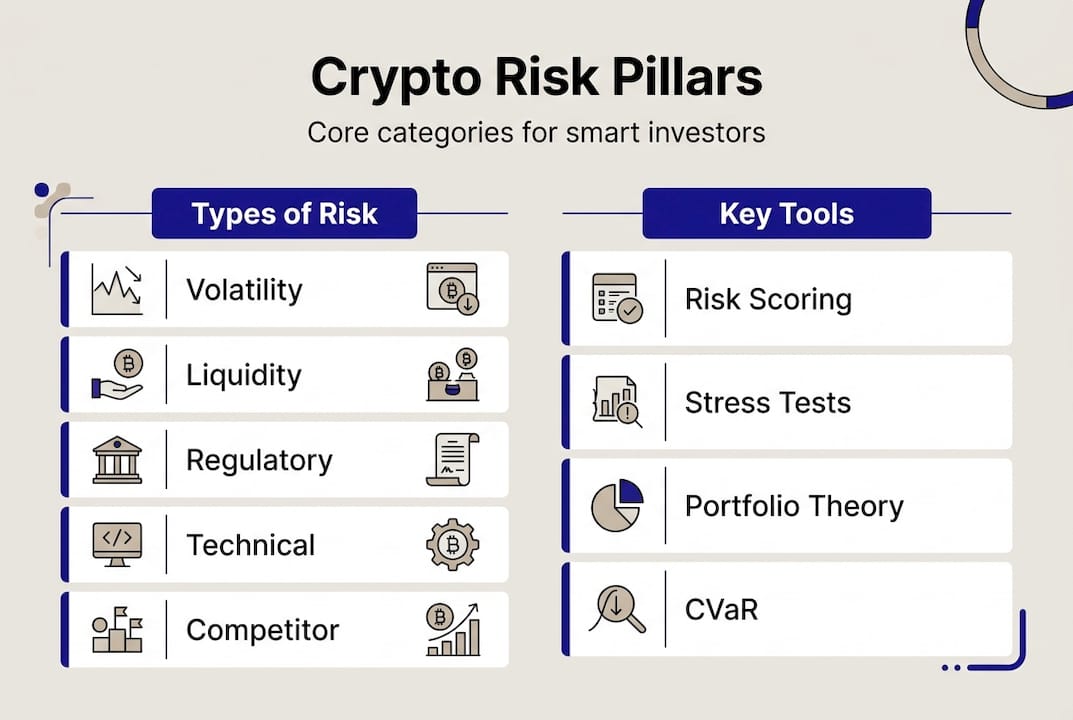
Modern Portfolio Theory (MPT), originally developed for traditional markets, has been adapted for crypto. The core idea is constructing a portfolio that maximizes expected return for a given level of risk. In practice, this means using mean-variance optimization to find the most efficient mix of assets, often called the “efficient frontier.”
Here are the key quantitative tools every serious crypto investor should know:
- CVaR (Conditional Value at Risk): Measures expected losses beyond a defined threshold. Because crypto has “fat tails” (extreme events happen more often than normal distributions predict), CVaR outperforms VaR for capturing real downside risk.
- Position sizing: Limiting each trade to 1 to 2% of total portfolio value caps your maximum loss on any single bet.
- Diversification: Spreading exposure across uncorrelated assets reduces overall portfolio volatility.
- Stress testing: Simulating historical crash scenarios (like the 2022 crypto winter) reveals how your portfolio would have performed under extreme conditions.
- Correlation monitoring: Tracking how assets move relative to each other helps you avoid false diversification.
“In crypto, the question is not whether extreme events will happen. It is whether your portfolio is sized to survive them.”
For deeper insight into managing extreme risks, combining CVaR with stress testing is the gold standard. Pair this with regular crypto trend analysis to stay ahead of shifting market conditions. And if you want to put it all together, exploring proven crypto trading strategies will show you how professionals integrate these tools into daily decisions.
Pro Tip: Run a quarterly stress test by asking: “If the market dropped 60% tomorrow, what percentage of my portfolio would I lose?” If the answer makes you uncomfortable, rebalance now, not later.
Advanced risks: Black swans, correlation traps, and leverage
Beyond numbers, it is crucial to understand the hidden pitfalls that can wipe out gains, or entire portfolios, overnight. These are the risks that most frameworks underestimate until it is too late.
Black swan events are rare but devastating. Hacks, exchange collapses, quantum computing threats, and mass liquidation cascades all qualify. Research on extreme crypto portfolio events shows that during market crashes, asset correlations can surge above 0.85 to 0.9, effectively erasing the diversification benefit you thought you had. When everything falls together, no amount of asset variety saves you.
Here are the advanced risk factors you need to monitor:
- Correlation traps: Assets that appear uncorrelated in calm markets often move together during crashes. Set a portfolio correlation limit of around 60% maximum exposure to highly correlated assets.
- Slippage and stop hunting: In low-liquidity markets, large orders move prices against you. Stop-loss orders can be triggered by brief price spikes engineered by larger players.
- Leverage amplification: Using borrowed capital multiplies both gains and losses. Even moderate leverage can trigger forced liquidations during sharp drawdowns.
- Regime-switching: Markets shift between trending and ranging conditions. Static strategies that work in one regime often fail in another.
- Dynamic rebalancing: Experts recommend rebalancing at least quarterly to maintain your intended risk profile as market conditions evolve.
For investors focused on mitigating extreme crypto risks, understanding these dynamics is non-negotiable. Combine this with strong security for crypto investors practices to protect against technical and custodial threats as well.
Practical steps for different investor levels
Finally, let’s translate the theory into specific actions, whether you are just starting out or looking to upgrade your toolkit. Risk management is not a one-size-fits-all exercise.
For novice investors, the 1% rule and stop-losses are your best friends. Experts recommend limiting crypto to 10 to 30% of your overall portfolio, doing your own research (DYOR) before every purchase, and diversifying across at least three to five assets. Simple rules, consistently applied, beat complex strategies poorly executed.
Here is a level-specific action plan:
- Novice: Apply the 1% risk rule per trade. Use stop-loss orders on every position. Keep total crypto exposure under 30% of your portfolio. Start with large-cap assets like Bitcoin and Ethereum before exploring altcoins.
- Intermediate: Begin tracking portfolio-level volatility and cross-asset correlation. Use a risk scoring spreadsheet for new investments. Review your portfolio monthly and rebalance when allocations drift more than 5%.
- Advanced: Integrate CVaR and MPT-based optimization into your portfolio construction. Use on-chain metrics like MVRV (Market Value to Realized Value) and Reserve Risk to time entries and exits. Run quarterly stress tests simulating historical crashes like 2018 and 2022.
- All levels: Stay current on regulatory developments in your jurisdiction. Maintain a written investment policy statement that defines your risk tolerance, position limits, and exit criteria.
For a practical look at optimizing crypto portfolios, the tools available today make this process far more accessible than it was even two years ago. Pairing your strategy with a reliable crypto trend indicator adds another layer of informed decision-making to your routine.
Pro Tip: Write down your exit strategy before you enter any position. Knowing in advance at what price or condition you will sell removes emotion from the equation when markets get turbulent.
Take your crypto risk management to the next level
Understanding risk frameworks is one thing. Applying them consistently, with the right tools, is where real portfolio protection happens. We built CryptoCracker specifically to make that step as simple as possible for every type of investor.

Whether you are working through a beginner-friendly crypto guide or ready to implement advanced analytics, CryptoCracker gives you the dashboards, trend indicators, and portfolio tracking tools to put these strategies into action. Our platform connects directly to your Coinbase account via API, giving you real-time data without the complexity. Explore our reduce trading risk strategies and crypto investing strategies to see how structured risk management fits into a smarter, more confident investing routine.
Frequently asked questions
What is the first step in assessing crypto risk?
Start by mapping the key risk categories for each asset you hold: volatility, liquidity, regulatory, technical, and compliance. This structured inventory, as outlined in EY’s due diligence framework, gives you a clear starting point before applying any scoring or quantitative tools.
What metrics matter most for advanced crypto risk management?
Focus on portfolio volatility, cross-asset correlation, and CVaR for tail risks, alongside on-chain analytics like MVRV and Reserve Risk. These key methodologies give you both a macro and micro view of your exposure.
How can I protect my crypto investments from black swan events?
Use stop-losses, maintain diversification, apply CVaR-based position sizing, and run stress tests modeled on historical crashes. Research on extreme portfolio events confirms that preparation before a crisis is far more effective than reacting during one.
How much of my portfolio should I allocate to crypto for risk control?
Experts recommend keeping crypto between 10% and 30% of your total investment portfolio, adjusted based on your personal risk tolerance and investment timeline.
What is the difference between CVaR and VaR in crypto portfolio risk?
VaR (Value at Risk) estimates the maximum expected loss under normal conditions, while CVaR measures the average loss in the worst-case scenarios beyond that threshold. Because crypto has fat-tail risk, CVaR gives a more realistic picture of true downside exposure.