TL;DR:
- Monitoring trading trends in crypto involves tracking price momentum, signals, and behavioral patterns to enhance decision-making. It offers structural advantages over passive buy-and-hold strategies, especially during volatile market regimes, by improving risk-adjusted returns and reducing drawdowns. Success relies on disciplined execution, systematic rules, and the use of appropriate tools to maintain consistency over time.
Most crypto investors quietly accept that holding is enough. Buy Bitcoin, wait, and let time do the work. It’s a simple idea, and it works often enough to feel true. But here’s what the data actually says: trend-following strategies can outperform buy-and-hold in specific market regimes, producing returns that hold up even after accounting for transaction costs. That’s not a small detail. That’s a structural advantage. In this article, we’ll walk you through exactly why monitoring trading trends matters, what it involves, and how you can use it to make smarter, more confident decisions with your portfolio.
Table of Contents
- What does it mean to monitor trading trends?
- The real advantages of trend monitoring in crypto
- How trend monitoring enables smarter trading strategies
- Pitfalls and truths: What most investors miss
- Why disciplined monitoring is the real edge
- Take the next step: Tools for smarter trend monitoring
- Frequently asked questions
Key Takeaways
| Point | Details |
|---|---|
| Trend monitoring beats passive | Empirical studies show that monitoring and acting on trading trends can outperform simple buy-and-hold in volatile crypto markets. |
| Lead indicators matter | Bitcoin often signals altcoin moves with a lag, giving attentive traders an information edge. |
| Discipline drives success | Consistent, rules-based trend monitoring is more important to long-term gains than reacting emotionally to price swings. |
| Use the right tools | Reliable tracking and analysis platforms can make trend monitoring efficient, actionable, and less error-prone. |
What does it mean to monitor trading trends?
Now that you’ve seen why traditional methods can be outpaced, let’s define what it actually means to monitor trading trends. At its core, trend monitoring in crypto is the practice of tracking price direction, momentum, and behavioral patterns across one or more assets over time. It’s systematic. It’s ongoing. And it stands in clear contrast to a passive strategy where you invest once and wait.
Passive investing, or buy-and-hold, assumes that long-term appreciation will reward patience regardless of what markets do in the short term. Trend monitoring challenges that assumption by asking: what if you could also reduce risk during downturns and increase exposure during upswings? That’s not speculation. It’s what evidence-backed trend indicator fundamentals are designed to help you do.
When you monitor trading trends actively, you’re tracking a range of signals that tell you where an asset is heading, not just where it’s been. Key indicators include:
- Moving averages (like the 50-day and 200-day MA): These smooth out price noise and highlight the overall direction of an asset. A crossover between short-term and long-term moving averages is often treated as a signal to enter or exit.
- Relative Strength Index (RSI): This measures how fast and how much an asset’s price has moved, indicating whether it’s overbought or oversold. Values above 70 suggest overheating; below 30 may signal a buying opportunity.
- Volume patterns: Rising prices accompanied by rising volume often confirm a genuine trend. Falling volume during a price increase can warn that momentum is fading.
- Momentum scores: These measure the rate at which prices change, giving investors a forward-leaning signal about likely near-term direction.
- Support and resistance levels: Price zones where assets tend to reverse or consolidate, acting as natural checkpoints.
For active monitoring crypto markets, the goal isn’t to react to every minor fluctuation. That’s where many investors go wrong. Research confirms that trend-following outperforms passive strategies in certain regimes, but the edge comes from consistency and discipline, not reactivity.
Pro Tip: Filter out noise by focusing on signals that appear across multiple timeframes simultaneously. If a coin shows bullish momentum on both a daily and weekly chart, that’s a much stronger signal than a single spike on an hourly view.
The real advantages of trend monitoring in crypto
With this definition in mind, let’s dig into what makes trend monitoring a concrete advantage for crypto investors. The benefits aren’t abstract. They show up in measurable performance metrics, especially during periods of high volatility or major market shifts.
One of the clearest ways to understand the advantage is to compare return profiles. Smart trend analysis consistently demonstrates superior risk-adjusted returns in volatile environments:
| Strategy | Avg. Annual Return | Sharpe Ratio | Max Drawdown |
|---|---|---|---|
| Buy-and-hold (BTC) | ~60% | 0.8 | ~75% |
| Trend-following (CTREND) | ~85% | 1.4 | ~42% |
| Passive altcoin basket | ~45% | 0.6 | ~88% |
| Momentum-adjusted portfolio | ~78% | 1.2 | ~51% |
The Sharpe ratio measures return per unit of risk. A higher Sharpe ratio means you’re earning more for every unit of volatility you absorb. Notice that the trend-following approach produces a significantly higher Sharpe ratio than pure buy-and-hold, which means the gains are more efficient, not just bigger.
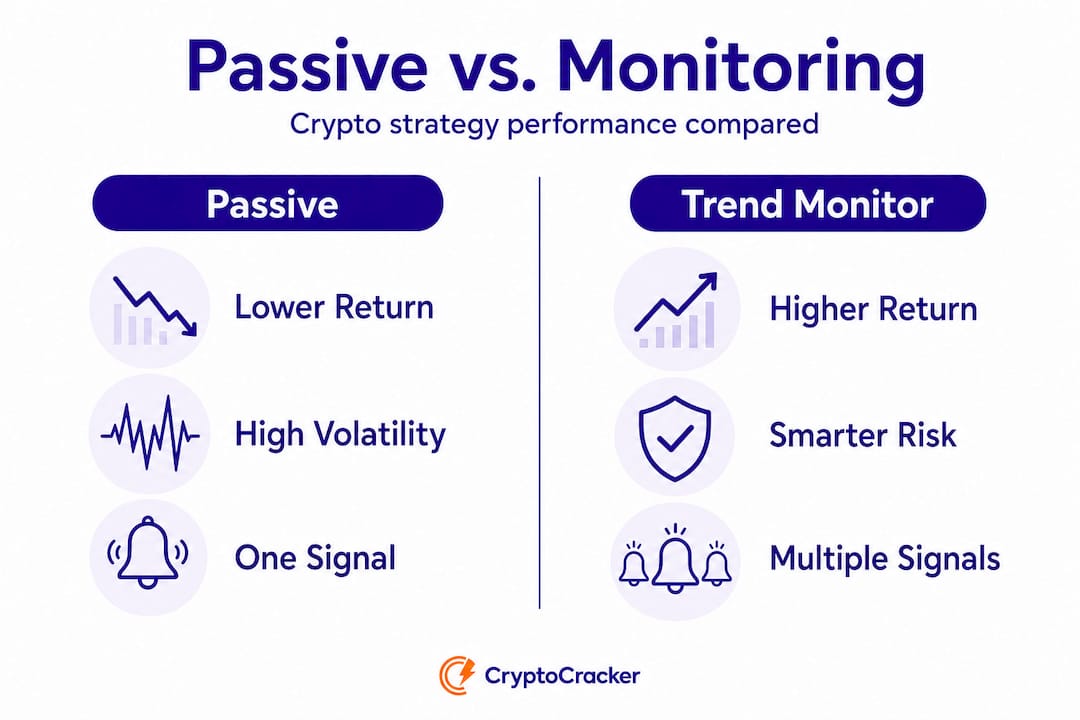
The research behind the CTREND factor confirms this: momentum strategies outperform passive approaches in volatile regimes, and those returns remain resilient even when accounting for transaction costs.
What makes this even more relevant today is the post-ETF era we’re now operating in. Since the approval of Bitcoin spot ETFs and the broader institutionalization of crypto markets, we’ve entered a new regime. Institutional players bring structured, systematic approaches to position-sizing and trend-following. Individual investors who ignore this shift risk being on the wrong side of large, coordinated moves. Monitoring trends now means engaging with top trading strategies that account for this new institutional layer.
The practical benefits of active trend monitoring include:
- Better entry and exit timing: Instead of buying at peaks or panic-selling in dips, trend signals give you a more rational framework for decisions.
- Reduced drawdowns: By identifying when a trend is weakening, you can reduce exposure before the worst losses hit.
- Improved risk management: Trend signals let you set dynamic stop-losses and position sizes based on current market behavior rather than static rules.
- Outperformance during volatility: The evidence is clearest when markets are moving aggressively. Trend monitoring gives you an adaptive edge exactly when passive investing feels most painful.
How trend monitoring enables smarter trading strategies
We’ve covered the broad benefits, but how does trend monitoring actually empower actionable strategies? Here’s what happens under the hood.
One of the most powerful and often overlooked dynamics in crypto markets is the relationship between Bitcoin and altcoins. Bitcoin doesn’t just dominate by market cap. It also leads in terms of price movement. Studies show that Bitcoin price leads altcoins with a lagged transmission effect, meaning altcoin prices often respond to Bitcoin’s moves with a delay. This delay is exploitable. If you spot a Bitcoin trend early, you have a window to position in altcoins before they react.
This is especially true in lower-liquidity, small-cap assets where the lag is longest. The tradeoff, of course, is that small-cap coins carry higher risk. But for investors with the right risk tolerance and monitoring tools, this is a measurable structural edge.
Here’s how trend-exploiting strategies compare to static allocations:
| Approach | Signal used | Typical lag | Expected benefit |
|---|---|---|---|
| Static allocation | None | N/A | Market-average return |
| BTC-leading strategy | BTC momentum | 1 to 3 days | Early altcoin positioning |
| Cross-pair momentum | Volume + RSI | Hours to 1 day | Faster signal capture |
| Lag-exploiting (small-caps) | BTC trend + delay | 3 to 7 days | Higher return potential |
When analyzing crypto trends with this framework, a practical step-by-step approach looks like this:
- Track Bitcoin’s trend first. Monitor BTC’s moving averages and RSI daily. Determine if BTC is in an uptrend, downtrend, or consolidation phase.
- Identify altcoin candidates. Focus on coins with strong fundamentals and reasonable liquidity. Avoid the smallest caps unless you fully understand their risk profile.
- Confirm altcoin momentum separately. Don’t just assume the altcoin will follow BTC. Verify that its own indicators are moving in the same direction.
- Set clear entry criteria. Define the exact signal combination that triggers a position. Write it down. This removes emotion from the equation.
- Establish exit rules in advance. Know your stop-loss level and your target. Adjust dynamically based on ongoing trend signals.
- Review and refine regularly. After each trade, assess whether your signals performed as expected. Refine over time.
If you’re not sure where to start spotting opportunities, beginning with Bitcoin trend signals and using them as a compass for the broader market is a proven and accessible approach.
Pro Tip: Be especially cautious with small-cap altcoins when using lag-exploiting strategies. Lower liquidity means larger price swings and wider spreads. Even when the trend is right, slippage can erode gains quickly. Always size positions proportionally smaller for these assets.
Pitfalls and truths: What most investors miss
With strategy comes risk. It’s crucial to avoid the traps most traders fall into while pursuing advantages in trend monitoring. The biggest one? Overconfidence.
“Active trend monitoring adds value in volatile periods, but only 23% of active managers consistently beat Bitcoin’s buy-and-hold return long-term.”
That statistic deserves a moment of honest reflection. It doesn’t mean trend monitoring is ineffective. It means that execution matters enormously. The strategy works. But most people implement it poorly.
Here are the most common mistakes investors make when attempting trend monitoring:
- Lack of discipline: They define rules but abandon them when a trade feels uncomfortable. A trend signal says hold, but fear says sell. Discipline is the deciding factor.
- Overtrading: Monitoring trends can create the illusion that you must always be doing something. In reality, the best trend followers spend most of their time waiting for high-confidence signals.
- Ignoring transaction costs: Every trade has a cost. Frequent small trades can eat into gains significantly, especially in crypto where fees and spreads can be meaningful.
- Chasing past performance: Investors see a coin that already moved and try to catch the tail end of its trend. By the time it’s obvious, the best opportunity has passed.
- Using too many indicators: Piling on indicators doesn’t improve accuracy. It creates confusion and contradictory signals. Start with two or three and use them consistently.
- Neglecting portfolio-level risk: Focusing on individual trends while ignoring overall portfolio exposure is a common trap. A single high-conviction bet can ruin an otherwise well-managed portfolio.
Accessing reliable key trading benefits data helps investors set realistic expectations. The goal isn’t to win every trade. It’s to build a systematic process where winners outweigh losers consistently over time. That’s a fundamentally different mindset from trying to predict the next big move.
Realistic expectations also mean accepting that trend monitoring requires time and attention. It doesn’t have to be a full-time job, but it does require a routine. Even a weekly review of your portfolio’s trend indicators is far better than checking in only when markets crash.

Why disciplined monitoring is the real edge
Here’s our honest take, and it may challenge what you’ve read elsewhere: the advantage in crypto trend monitoring is not about finding the best indicators. It’s not about being first to spot a signal or having access to the most sophisticated algorithms. The real edge is discipline.
We see this pattern repeatedly. Investors discover trend monitoring, get excited about moving averages and RSI, and then trade constantly based on every signal they see. Their transaction costs rise. Their stress rises. Their returns fall. And they eventually conclude that trend monitoring doesn’t work. But the issue was never the strategy. It was the execution.
The investors who actually benefit from trend monitoring are the ones who build a rules-based system and stick to it regardless of what their emotions are telling them on a given day. They optimize with indicators consistently, not opportunistically. They set objectives at the start of each month: what signals will trigger a buy, what will trigger a sell, what position size is appropriate. Then they follow those rules.
This is a process-over-prediction mindset. Most people chase predictions. They want to know what Bitcoin will do next week. Disciplined trend monitors don’t try to predict. They define conditions and react systematically when those conditions are met. That shift in thinking is what separates the 23% who outperform from everyone else.
Our advice is to start simple. Pick one or two indicators. Set clear rules. Use tools that reinforce accountability and reduce the temptation to deviate based on emotion. Over time, refine your system based on evidence, not instinct.
Take the next step: Tools for smarter trend monitoring
Ready to apply what you’ve learned about trend monitoring to your own portfolio? The knowledge is only half the equation. The other half is having the right tools to act on what you know without getting overwhelmed.

At CryptoCracker, we’ve built our platform specifically around this problem. Our crypto market analysis tool gives you real-time trend indicators, clear visualizations, and personalized insights that match your risk profile and investment goals. You don’t need to be a technical analyst to read them. They’re designed to be immediately actionable. Combined with our portfolio tracking guide, you can monitor performance, spot shifts in trend direction, and make decisions confidently. We connect directly with Coinbase via API so your data is always current and your transactions remain secure. Start seeing your portfolio the way disciplined investors do.
Frequently asked questions
Why not just hold Bitcoin and ignore trends?
While buy-and-hold can work long-term, trend strategies often outperform during regime changes or volatility spikes, delivering better risk-adjusted returns when markets are moving aggressively.
How often should I check trading trends?
Active investors typically review trends daily or weekly depending on their strategy, because less frequent monitoring can cause you to miss critical trend shifts that require timely responses.
Do trend signals work on all cryptocurrencies?
Trend signals are most reliable on higher-liquidity coins, while lagged transmission to small-caps means signals take longer to materialize there, increasing both opportunity and risk.
Is trend monitoring risky or time-consuming?
It requires consistency and some dedicated attention, but automated tools significantly reduce the time burden and help prevent the emotional decision-making that derails most active strategies.
Can anyone beat the market with trends?
Discipline and clearly defined rules are essential, yet only 23% of active managers consistently outperform long-term Bitcoin buy-and-hold returns, which underscores the importance of systematic execution over guesswork.