TL;DR:
- Trading fees can account for 10-20% of annual crypto returns if not managed properly.
- Effective fee reduction strategies include using limit orders, native tokens, and VIP tiers.
- Total trading costs include spreads, slippage, and withdrawal fees, which often surpass published rates.
Trading fees are one of the most overlooked drains on crypto profits. If you’re an active trader, fees can consume 10-20% of your annual returns without you even noticing. A single poorly timed withdrawal can wipe out an entire month of careful gains. In this guide, we walk you through every major fee type, show you how to calculate your true trading costs, and share proven strategies to minimize what you pay. Whether you’re just getting started or you’ve been trading for years, understanding fees is one of the highest-leverage moves you can make.
Table of Contents
- What you need to know about crypto trading fees
- Step-by-step: How to calculate your trading costs
- Advanced tips for minimizing trading fees
- Beyond fees: The real cost of crypto trading
- Our perspective: Why fee mastery defines successful crypto trading
- Take control: Tools and resources to optimize your trading fees
- Frequently asked questions
Key Takeaways
| Point | Details |
|---|---|
| Hidden costs matter | Even low advertised fees can hide extra costs from spreads, slippage, and withdrawal charges. |
| Fee optimization pays | Strategic choices can save you up to 60 percent in cumulative trading fees each year. |
| Track real trading costs | Always review your actual fee outflows, not just the published rates, for the clearest picture. |
| Automate for efficiency | Using automation and batching trades reduces manual errors and optimizes timing for lower costs. |
What you need to know about crypto trading fees
Now that you understand the stakes, let’s break down exactly what types of fees you’ll face and how they’re structured. Not all fees look the same, and knowing the difference between them is the first step toward protecting your returns.
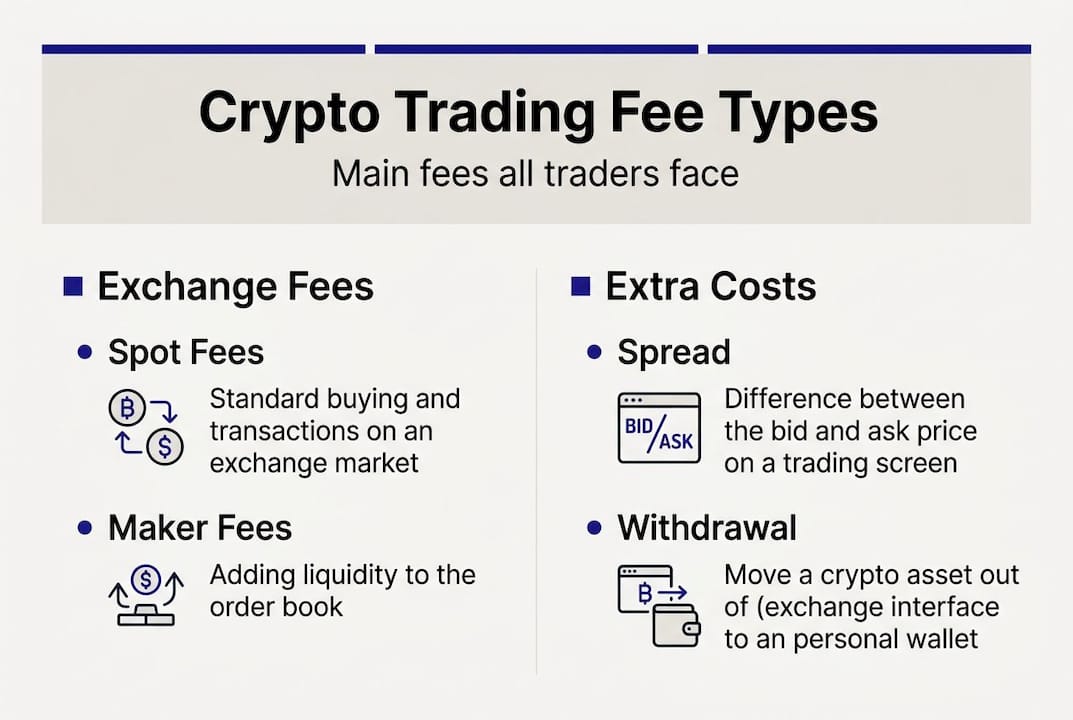
Spot fees are charged when you buy or sell crypto on an exchange. Maker fees apply when you place a limit order that sits on the order book, adding liquidity to the market. Taker fees apply when you execute a market order that fills immediately, removing liquidity. Taker fees are almost always higher. Withdrawal fees are charged when you move crypto off an exchange to a wallet. Funding fees apply to futures and perpetual contracts, paid periodically between long and short traders.
Here’s how major exchanges compare at their 2026 base tiers:
| Exchange | Maker fee | Taker fee | Notes |
|---|---|---|---|
| MEXC | 0.00% | 0.05% | Lowest spot fees |
| Bitget | 0.01% | 0.01% | Very competitive |
| OKX | 0.08% | 0.10% | Low withdrawals |
| Binance | 0.10% | 0.10% | Low withdrawals |
| Coinbase | ~0.40% | ~0.40% | Higher base tier |
Source: Best Crypto Exchange with Lowest Fees
Beyond listed fees, there are hidden costs worth watching:
- Spreads: The gap between buy and sell prices, often larger on less liquid pairs
- Slippage: When your order fills at a worse price than expected, especially on large trades
- Funding rates: On futures, these can exceed commissions long-term in volatile markets
- Minimum order sizes: Can force inefficient trade sizing
For occasional traders, spot fees matter most. For high-frequency traders, every basis point compounds fast. Understanding crypto fee transparency is critical before choosing where to trade. It’s also worth learning how exchanges, brokers, and bots each structure their costs differently.
Pro Tip: Always check the fee schedule for your specific trading pair. Some exchanges charge different rates for BTC/USDT versus altcoin pairs, and the difference can be significant.
Step-by-step: How to calculate your trading costs
With the major fee types clarified, we’ll walk through the exact steps to total up your trading costs. This process works for any exchange and any trade size.
- List every fee type that applies to your trade. For a standard spot trade, that’s the entry fee, exit fee, and withdrawal fee if you move funds afterward.
- Pull your trade history from the exchange. Most platforms let you export a CSV file with all fees itemized.
- Cross-reference with the exchange’s published fee table. Verify the rate you were charged matches your account tier.
- Add hidden costs. Estimate slippage by comparing your expected fill price to your actual fill price.
- Project annual costs. Multiply your average monthly trading volume by your effective fee rate.
Let’s make this concrete. On a $10,000 spot trade, MEXC charges roughly $0.25 to $2.50 in fees, while Binance charges $1 to $10. That gap seems small per trade, but scale it up. If you’re trading $100,000 per month, MEXC costs around $300 per year versus $1,200 on Binance. That’s $900 back in your pocket for doing nothing different except choosing the right platform.
“Retail roundtrip costs range from 0.53% on Bitvavo to 6.45% on some platforms.” This means the platform you choose can make your effective cost more than twelve times higher for the exact same trade.
To decode trading fee schedules accurately, always calculate the full roundtrip cost: entry fee plus exit fee plus withdrawal fee plus estimated slippage. Published fees only tell part of the story. The full picture only emerges when you track your actual trade data over time.
Advanced tips for minimizing trading fees
Once you know your cost structure, it’s time to get proactive with proven fee reduction strategies. These aren’t theoretical. Professionals use these methods consistently to reduce fees by 40-60%.
- Use limit orders whenever possible. Placing limit orders means you pay maker fees, which are almost always lower than taker fees. On many platforms, maker fees are zero.
- Hold native exchange tokens. Platforms like Binance (BNB) and Bitget (BGB) offer 20-80% fee discounts when you pay fees using their native token. Just track the token’s own price risk separately.
- Qualify for VIP tiers. Most major exchanges reduce fees as your 30-day trading volume increases. If you’re close to a threshold, consolidating trades on one platform can push you into a lower fee bracket.
- Time your withdrawals. Network congestion drives up withdrawal fees, especially for Ethereum-based assets. Early mornings on weekdays tend to have lower gas costs.
- Batch and automate trades. Frequent small trades multiply your fee exposure. Automating and batching orders reduces the number of individual transactions. You can automate trading to lower costs using tools designed for exactly this purpose.
- Watch for fee rebates and promotions. Exchanges regularly run limited-time zero-fee promotions on specific pairs. These are worth tracking.
Pro Tip: Before holding a native exchange token for fee discounts, check its 90-day price performance. A token that drops 30% erases any fee savings quickly. The discount only makes sense if the token is stable or appreciating.
Building these habits into your regular routine, alongside a clean optimized workflow, is what separates traders who grow their portfolios from those who wonder where their gains went.
Beyond fees: The real cost of crypto trading
Cutting trading fees is just one part of protecting returns. Don’t overlook other stealthy costs that never show up labeled as a “fee” but hit your bottom line just as hard.

Spreads are the silent killer. On a thinly traded altcoin, the spread between the best buy and sell price can be 1-3%, which instantly dwarfs a 0.1% trading fee. Retail roundtrip costs can reach 6.45% on some platforms once spreads and slippage are included. Chasing the lowest published fee while ignoring spreads is like saving on gas while driving twice the distance.
Slippage is another underestimated cost. When you place a large market order, it eats through multiple price levels in the order book. A $50,000 trade on a low-liquidity pair can slip 0.5-2% on execution alone. Deep liquidity on major pairs mitigates slippage significantly, which is why sticking to high-volume trading pairs matters.
Other hidden costs to watch:
- DEX gas fees: On decentralized exchanges, every transaction pays Ethereum or Solana network gas. During peak congestion, gas can exceed the value of a small trade entirely.
- MEV (Maximal Extractable Value): Bots on DEXs can front-run your transactions, effectively adding an invisible tax to your trade.
- Regulatory and compliance costs: As crypto regulation tightens, some platforms pass compliance costs on to users through higher fees or restricted features.
- Minimum order sizes: Forcing you into larger positions than intended increases your risk exposure.
The takeaway is simple: the lowest published fee is not always the lowest real cost. Evaluating platforms on total execution cost, including spreads, slippage, and withdrawal fees, is the only honest comparison. Learning to reduce trading risk means accounting for all of these factors together.
Our perspective: Why fee mastery defines successful crypto trading
Understanding all cost dynamics sets you up for smarter strategy, but what truly separates top traders is the way they approach fee mastery over time. Most traders check fees once when they sign up for an exchange and never look again. That’s a costly habit.
Exchanges change their fee schedules. Volume tiers shift. New platforms emerge with more competitive structures. Empirical data shows MEXC, Bitunix, and OKX are optimal for most traders in 2026, but that ranking will evolve. The traders who consistently outperform are the ones who treat fee analysis as a monthly review, not a one-time setup.
The biggest mistake we see is traders who obsess over finding the lowest listed fee while ignoring their actual cost per roundtrip. A platform with a 0% maker fee but wide spreads and high withdrawal fees can cost you far more than a platform charging 0.10% across the board. True fee mastery means tracking what you actually paid, not what the fee schedule says you should have paid.
We encourage you to decode crypto fees regularly and make a cost review part of your monthly portfolio check-in. Build the habit early, and it compounds just like your returns.
Take control: Tools and resources to optimize your trading fees
Ready to use these insights? Here’s how CryptoCracker’s resources can help you put them into action.
Knowing your fee structure is one thing. Tracking it automatically across every trade is another. CryptoCracker gives you the tools to do both without needing a spreadsheet or a finance degree.

Our platform connects to your Coinbase account via API, pulling real-time trade data so you can see your actual fees, not just the published rates. You can explore trading fee management alternatives and understand how CryptoCracker compares. Use our portfolio optimization tools to identify where fees are eating into your returns and get actionable suggestions to fix it. Our crypto market analysis tool adds context so every decision is backed by data, not guesswork.
Frequently asked questions
What is the difference between maker and taker fees?
Maker fees apply when you add liquidity by placing limit orders that sit on the order book. Taker fees are charged when you execute market orders that fill immediately, and they are typically higher than maker fees because you’re consuming existing liquidity.
Why do withdrawal fees vary so much between exchanges?
Withdrawal fees depend on network congestion, each platform’s internal cost structure, and their policies. OKX and Binance charge the lowest withdrawal fees among major exchanges, while some smaller platforms charge flat fees that can outweigh your trading fee savings entirely.
How much can trading fees reduce my annual returns?
Active crypto traders can see fees consume 10-20% of their annual returns if they don’t actively manage their cost structure, exchange choice, and trading habits.
How do I find the lowest total cost platform?
Compare published fees alongside live spreads, liquidity depth, and withdrawal policies for your typical trade size. Low fees don’t equal low total cost once spreads and slippage are factored in, so always calculate the full roundtrip cost for your most common trades.