TL;DR:
- Crypto trading psychology involves managing emotions amplified by high volatility and 24/7 markets.
- Building disciplined systems, like pre-defined rules and automation, reduces emotional trading mistakes.
- Effective strategies focus on environment design and process adherence over relying on willpower alone.
Most traders blame a bad indicator or a poorly timed entry when a trade goes wrong. Rarely do they look inward. Yet trading psychology is the study and management of thoughts, emotions, and habits that shape every trade decision you make, and in crypto, those emotions are turned up to full volume. The volatility is extreme, the market never closes, and social media keeps the noise constant. If you’ve ever panic-sold at the bottom or chased a pump you knew was risky, this article is for you. We’ll walk through what crypto trading psychology actually means, the traps it sets, and the frameworks that help you trade with a clearer head.
Table of Contents
- What is crypto trading psychology?
- Core psychological challenges crypto traders face
- Proven strategies to master crypto trading psychology
- Adapting psychological techniques for novice and expert traders
- A fresh take: What most crypto traders get wrong about psychology
- Start mastering crypto trading psychology with CryptoCracker
- Frequently asked questions
Key Takeaways
| Point | Details |
|---|---|
| Emotions drive crypto trades | Recognizing your emotional triggers is essential to avoid costly mistakes, especially in fast-moving markets. |
| Structured rules beat impulse | Using stop-losses, daily limits, and automation protects from erratic decisions and builds consistent trading habits. |
| Tools and environment matter | Alerts, automation, and journaling help create a disciplined ecosystem for both novice and experienced traders. |
| Tailor strategies to experience | Beginner and advanced traders need different psychological tools, so adapt your approach as you gain expertise. |
What is crypto trading psychology?
Crypto trading psychology is more than just “staying calm.” According to the trading psychology overview from CoinBureau, it covers the full scope of thoughts, emotions, and habits influencing trade entry, management, and exit decisions, all amplified by crypto’s high volatility, 24/7 markets, leverage, and social media. That’s a wide net, and rightly so. Every decision you make in the market is filtered through your mental state at that moment.
What makes crypto uniquely challenging is the combination of factors that don’t exist in traditional markets. Stock markets close on weekends. Crypto doesn’t. That constant availability means your brain never fully disconnects. Add leverage to the mix, and small price swings carry enormous emotional weight. A 5% move in a leveraged position can feel like a life-or-death situation, even when it isn’t.
“Crypto trading psychology is the study and management of thoughts, emotions, and habits influencing trade entry, management, and exit decisions, amplified by crypto’s high volatility, 24/7 markets, leverage, and social media.” — CoinBureau
Social media adds another layer. Twitter threads, Reddit posts, and Telegram groups create a constant stream of opinions that can override your own analysis in seconds. One viral post about a coin “going to the moon” can undo hours of careful research. This is why understanding crypto trading indicators alone isn’t enough. You need to understand yourself too.
| Emotion | Common trigger | Typical outcome |
|---|---|---|
| Fear | Sharp price drop | Panic selling at a loss |
| Greed | Rapid price surge | Overtrading or overleveraging |
| FOMO | Social media hype | Buying tops impulsively |
| Regret | Missing a move | Chasing late entries |
| Overconfidence | Recent winning streak | Ignoring risk management |
Recognizing which emotion is driving you at any given moment is the first real skill in trading psychology. Without that awareness, every other strategy falls apart.
Core psychological challenges crypto traders face
Knowing what trading psychology is and actually managing it in the heat of the moment are two very different things. The most common emotional traps show up repeatedly across all experience levels, and they cost traders real money.
Fear and greed are the most talked about, but regret and FOMO (fear of missing out) are just as destructive. FOMO pushes you into trades you haven’t analyzed. Regret keeps you holding a losing position too long because selling feels like admitting failure. These aren’t character flaws. They’re predictable human responses to uncertainty and financial risk.

Social media and news cycles make these emotions worse. When a coin trends on Twitter, the psychological pressure to act is immediate. The trader mindset expert advice from CoinBureau is clear: for novice traders especially, recognizing that emotions don’t reflect market reality is a foundational skill. Your anxiety about a price drop doesn’t mean the asset is worthless. Your excitement about a surge doesn’t mean it will continue.
The 24/7 nature of crypto markets also creates chronic stress. There’s no closing bell to signal that it’s safe to step away. This constant availability leads to compulsive chart-checking, sleep disruption, and reactive decision-making. All of these erode the quality of your trades over time.
Top five mistakes caused by trading psychology:
- Buying at the top due to FOMO after seeing social media hype
- Panic selling during a temporary dip instead of holding to plan
- Overtrading after a win, driven by overconfidence
- Ignoring stop-losses because “it will come back”
- Abandoning a strategy mid-trade based on a news headline
Pro Tip: After every trade, ask yourself: “Was this decision based on my plan or my emotions?” Keeping a trading journal to track this question builds self-awareness faster than any book on psychology.
Building better trading habits starts with recognizing your own patterns. Once you can spot an emotion-driven trade before you make it, you’ve already made significant progress.
Proven strategies to master crypto trading psychology
Awareness alone doesn’t fix the problem. You need systems. The most effective strategies for managing trading psychology aren’t about becoming emotionless. They’re about designing your environment and process so that emotions have less room to interfere.
The most powerful starting point is pre-defining your risk before you enter any trade. That means setting a stop-loss, knowing your maximum loss for the day, and deciding in advance what will trigger an exit. When you make these decisions before the market moves, you’re thinking clearly. When you try to make them during a price swing, you’re not.
Volatility management research shows that 59% of crypto investors use dollar-cost averaging (DCA) to reduce emotion-driven decisions. DCA means investing a fixed amount at regular intervals regardless of price. It removes the pressure of trying to time the market perfectly, which is one of the biggest sources of emotional stress.
Step-by-step mental discipline framework:
- Define your entry, exit, and stop-loss before placing any trade
- Set a daily loss limit and stop trading when you hit it
- Take a mandatory cooldown period after any significant loss
- Review your journal weekly to identify emotional patterns
- Use automation for routine trades to remove impulsive decisions
- Focus on fewer, higher-quality trades rather than constant activity
| Factor | Automation | Manual trading |
|---|---|---|
| Emotional exposure | Very low | High |
| Consistency | High | Variable |
| Reaction to volatility | Rule-based | Emotion-driven |
| Ideal for | Routine strategies | Active, monitored setups |
Exploring risk reduction strategies and pairing them with solid risk assessment tips gives you a structured foundation. And if you’re ready to remove emotion from routine trades entirely, automated trading is worth serious consideration.
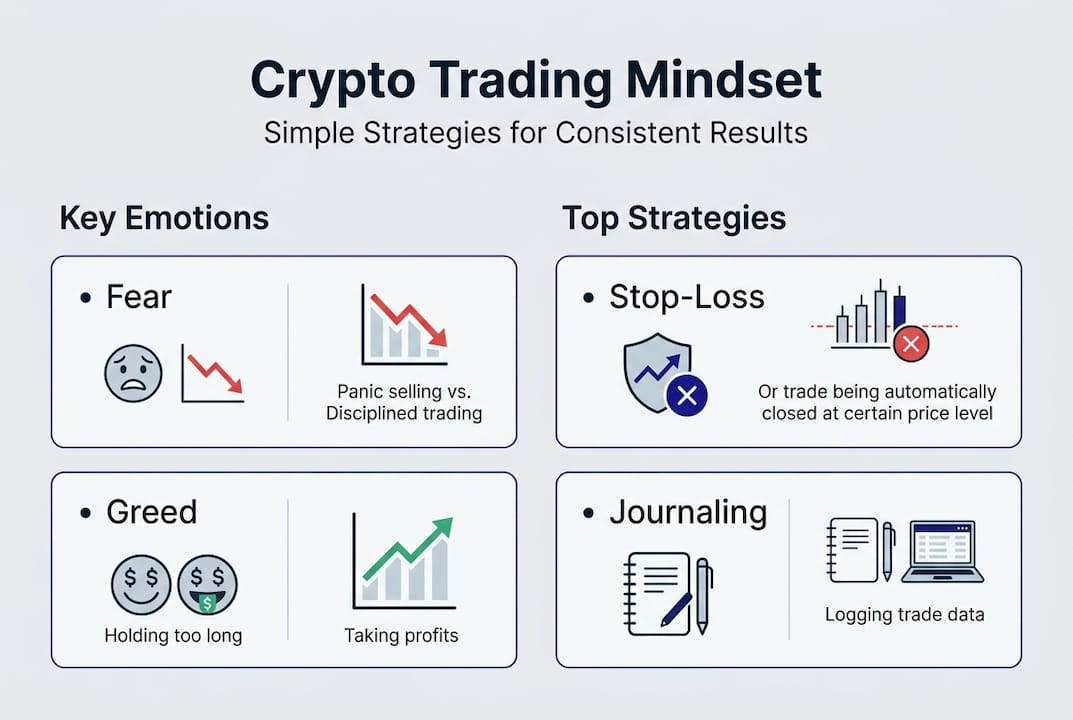
Pro Tip: If you’ve just taken a significant loss, activate a mandatory 24-hour cooldown before making another trade. Decisions made in loss-recovery mode are almost always worse than decisions made with a clear head.
Adapting psychological techniques for novice and expert traders
Not every psychological strategy fits every trader. Where you are in your journey shapes which tools will actually help you most. Novices and experienced traders face different psychological pressures, and the solutions look different too.
For beginners, the priority is building basic rules and sticking to them. The temptation to improvise is strong when you’re learning, but improvisation is where emotions take over. Simple trade strategies with clear entry and exit criteria give you a framework to follow when your emotions push back. Journaling every trade, even small ones, builds the self-awareness that experienced traders have developed over years.
For experienced traders, the challenge shifts. You’ve seen enough market cycles to know the patterns, but stress still hits hard during extreme volatility. The expert advice is direct: under stress, revert to pre-planned automation and grade your process rather than your profit and loss. A good process repeated consistently will produce better long-term results than chasing individual wins.
Novice versus expert psychological tools:
- Novice: Simple rules, journaling every trade, avoiding social media noise, starting with small position sizes
- Novice: Recognizing that emotions are normal and don’t reflect market reality
- Expert: Pre-planned automation for high-stress scenarios, cooldown protocols, daily loss limits
- Expert: Process grading over profit chasing, reviewing patterns across hundreds of trades
- Both: Environmental design, using alerts instead of staring at charts, fixed rules that remove negotiation
The top trading strategies that work long-term share one trait: they reduce the number of decisions you make in real time. The environmental design principle is simple but powerful. Set alerts instead of watching charts constantly. Fixed rules remove the “just this once” negotiation that erodes discipline over time.
Pro Tip: Grade your trades on process, not outcome. A trade that followed your rules perfectly but lost money is a better trade than one that broke your rules and got lucky. Consistent process is what compounds over time.
A fresh take: What most crypto traders get wrong about psychology
Here’s the uncomfortable truth we’ve seen play out repeatedly: most traders treat psychology as a motivation problem. They read an article, feel inspired, and then make the same impulsive trade two days later. Willpower is not a reliable trading tool.
The real solution is environmental design and pre-planned process. When your rules are set in advance and your automation handles routine decisions, your emotional state in the moment matters far less. Trading process design is the actual lever, not mental toughness.
“Fixed rules remove the ‘just once’ negotiation.”
Most traders overestimate their ability to stay disciplined under pressure. We all do. The market is specifically designed to create conditions where emotional decisions feel rational. The answer isn’t to become a robot. It’s to build systems that protect you from your worst moments.
Pro Tip: Use price alerts instead of watching live charts. Every minute you spend staring at a moving price is a minute your emotions are being activated. Alerts keep you informed without keeping you in a constant state of reaction.
The traders who improve fastest aren’t the ones with the most willpower. They’re the ones who design their environment to make good decisions the default.
Start mastering crypto trading psychology with CryptoCracker
Putting these principles into practice is much easier when you have the right tools supporting you. CryptoCracker is built specifically to help crypto investors trade with more structure and less emotional noise.

Our crypto analysis tool gives you clear, data-driven market insights so your decisions are grounded in information rather than impulse. The portfolio optimization features help you maintain balance and discipline across your holdings, while our automated savings functionality supports consistent DCA strategies without requiring manual action every time. We’ve designed CryptoCracker to reduce the friction between good intentions and good execution, so your trading psychology works for you, not against you.
Frequently asked questions
What is the main goal of mastering crypto trading psychology?
The main goal is to minimize emotional bias and improve consistent decision-making for better long-term trading results. Managing thoughts and habits that influence trade decisions is the foundation of every effective trading approach.
How do experienced traders manage stress in crypto markets?
They use pre-planned automation and set daily loss limits, prioritizing process review over focusing solely on profit and loss. This shifts the focus from reactive emotion to structured habit.
What are practical tools to reduce emotional trading mistakes?
Structured rules like stop-losses and journaling, combined with risk limits and automation, are the most effective tools for reducing emotional mistakes in trading.
How does dollar-cost averaging minimize emotional mistakes?
DCA creates a routine that removes market timing pressure. 59% of crypto investors use this strategy specifically to reduce emotion-driven decision-making.
How can environmental design help improve trading psychology?
Using alerts and fixed rules minimizes impulsive decisions by removing the temptation to act, which is more reliable than depending on willpower alone.
Recommended
- How to automate crypto trading for better results in 2026 | CryptoCracker
- Master crypto trading workflow for smarter investing in 2026 | CryptoCracker
- Simplified crypto trading explained: easy strategies in 2026 | CryptoCracker
- Top crypto investing tips to optimize your portfolio in 2026 | CryptoCracker