TL;DR:
- Many crypto investors struggle with unstructured goals or random efforts, leading to inconsistent results and emotional reactions. Setting SMART, realistic targets aligned with risk tolerance helps guide disciplined portfolio management, automation, and regular review. Using structured strategies like core-satellite allocation, dollar-cost averaging, and benchmarks fosters steady progress toward long-term crypto success.
Most crypto investors fall into one of two traps: they either aim for the moon with no plan to get there, or they invest randomly and hope for the best. Both paths lead to the same frustrating place, which is inconsistent results, emotional reactions to market moves, and no clear sense of progress. The good news is that setting structured, trackable crypto goals is not complicated. We’ll walk you through exactly how to define your targets, structure your portfolio, automate your savings, and measure your progress, so that every decision you make has a clear purpose behind it.
Table of Contents
- Clarify your crypto vision and set SMART goals
- Structure your portfolio for goal alignment
- Automate savings and regular investments with DCA
- Track progress with benchmarks and rebalance rules
- A smarter approach to crypto goals: don’t chase, calibrate and commit
- Next steps: take action with tools designed for your crypto goals
- Frequently asked questions
Key Takeaways
| Point | Details |
|---|---|
| Set SMART goals | Translate your crypto aspirations into specific, measurable, and time-bound targets for tracking progress. |
| Build a structured portfolio | Use core-satellite allocation to align your investment structure with your risk appetite and growth plans. |
| Automate with DCA | Reduce the stress of timing the market by setting up recurring buys to stay consistent with your savings goals. |
| Measure and rebalance regularly | Use benchmarks and fixed rules to review and adjust your portfolio so your goals stay on track. |
| Prioritize process over prediction | Consistent, rules-based actions typically outperform impulse decisions in crypto investing. |
Clarify your crypto vision and set SMART goals
Now that you know you need real targets, start by defining what meaningful progress actually looks like for your crypto journey.
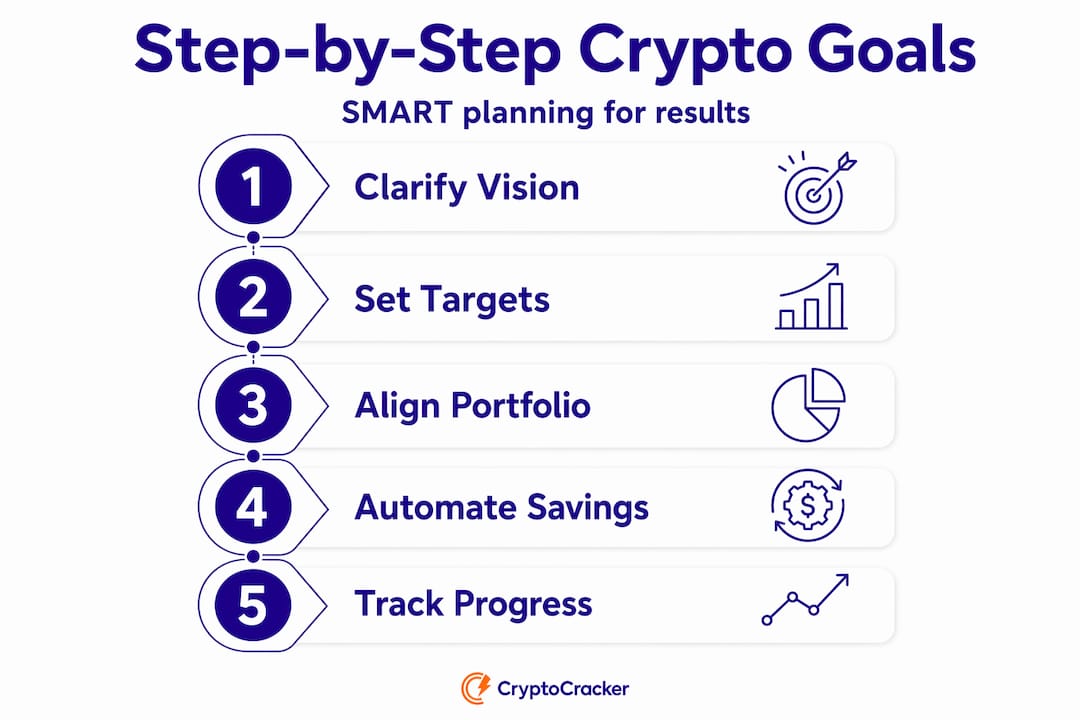
The SMART framework gives investors a practical way to turn vague ambitions into clear, actionable plans. SMART stands for Specific, Measurable, Achievable, Relevant, and Time-bound. Instead of saying “I want to grow my crypto,” a SMART goal sounds like “I want to grow my Bitcoin position by 20% over 12 months by investing $150 per month.” That single shift from fuzzy to focused changes everything about how you approach your portfolio.
Following crypto investing best practices means you set crypto goals by translating what you want into structured targets tied to your broader financial situation and risk appetite. This connection matters because a goal that works for a 25-year-old with disposable income looks very different from one that fits a 45-year-old saving for retirement.
Here are some examples of what well-formed crypto goals actually look like:
- Growth target: Grow the overall portfolio value by 15% within 12 months, measured against current baseline.
- Diversification goal: Allocate 10% of the portfolio to two new altcoins by the end of Q3, selected based on market cap and use case.
- Savings milestone: Invest $200 per month for 6 consecutive months, building toward a defined total balance.
- Risk management goal: Reduce portfolio volatility by rebalancing every quarter to maintain a set allocation ratio.
- Income goal: Generate $100 per month in staking rewards by allocating a fixed amount to staking-eligible assets within 3 months.
Pro Tip: Avoid vague goals like “get rich from crypto.” They create no accountability and give you nothing to measure. Instead, attach a number, a date, and a clear metric to every goal you set.
Part of setting realistic goals is also being honest about your risk tolerance. Assessing your risk appetite before locking in targets prevents you from chasing returns that are possible but not suitable for your actual situation.
| Goal type | Example | How to measure it |
|---|---|---|
| Growth target | 15% portfolio gain in 12 months | Compare starting vs. ending portfolio value |
| Savings milestone | $200/month for 6 months | Track total contributions vs. plan |
| Diversification | Add 2 altcoins by Q3 | Count holdings and allocation percentages |
| Volatility control | Rebalance quarterly to target allocation | Measure allocation drift each quarter |
| Staking income | $100/month in staking rewards | Track monthly reward payments |
Structure your portfolio for goal alignment
With your goals clearly defined, you need a system to achieve them. Structuring your portfolio is the next essential step.
A well-structured portfolio doesn’t happen by accident. It reflects your goals, your timeline, and your risk comfort level. One proven method is the core-satellite model, where the majority of your portfolio sits in a stable, large-cap “core” asset like Bitcoin, and smaller portions are allocated to higher-risk, higher-potential “satellite” positions. This approach, as noted in portfolio diversification research, provides a goal-aligned structure where the core delivers stability and the satellites offer growth potential, with rebalancing built in as part of the goal mechanics.
A typical core-satellite allocation looks like this:
- Determine your risk profile. Decide whether you lean conservative, balanced, or aggressive before assigning any percentages.
- Assign 50 to 70% to Bitcoin. This is your stability anchor. It captures broad market growth while keeping your foundation solid.
- Assign 15 to 25% to Ethereum. Ethereum provides exposure to smart contract growth and a maturing ecosystem without the extreme volatility of smaller coins.
- Assign 5 to 15% to altcoins. These are your higher-risk satellites. Choose projects with real use cases and liquidity rather than speculation alone.
- Reserve 5 to 10% in stablecoins. This is your emergency buffer, ready to deploy during corrections without forcing you to sell core positions at a loss.
Pro Tip: Always maintain a stablecoin buffer in your portfolio. Without it, a sudden market drop can force you to sell assets at the worst possible time just to rebalance or cover expenses.
Here’s how allocations shift based on your goal profile:
| Profile | Bitcoin | Ethereum | Altcoins | Stablecoins |
|---|---|---|---|---|
| Conservative | 70% | 20% | 5% | 5% |
| Balanced | 55% | 25% | 10% | 10% |
| Aggressive | 40% | 25% | 25% | 10% |
Structure also creates discipline. When every asset has a defined role and a target percentage, you stop making impulse allocation decisions based on what’s trending on social media. That kind of clarity is what separates goal-driven investors from those who are just reacting. Pairing structure with smart tactics to reduce crypto trading risk keeps your portfolio working toward a destination rather than drifting.
Automate savings and regular investments with DCA
Portfolio structure set, the next challenge is consistency. Automation lets you overcome market impulses and build your goals piece by piece.
Dollar-cost averaging, or DCA, is one of the most reliable tools in any investor’s kit. The concept is simple: instead of investing a lump sum at a single point in time, you invest a fixed amount on a regular schedule, whether that’s weekly, biweekly, or monthly. DCA mechanics mean that recurring buys at a fixed amount automate contributions and significantly reduce the market-timing pressure that trips up so many investors. Some weeks you buy at a higher price, some weeks lower. Over time, those averages out in your favor.
Here’s how to set up a working DCA plan from scratch:
- Choose your target assets. Identify which cryptocurrencies align with your SMART goals. This is usually your core positions first, like Bitcoin and Ethereum, before adding satellite assets.
- Set your investment frequency. Weekly DCA builds habits faster; monthly DCA is easier to manage around paydays. Pick the cadence you’ll actually stick to.
- Fix your order size. Decide on an amount that fits your budget without strain. Even $50 per week compounds meaningfully over time. The key is consistency, not size.
- Link your DCA to a specific goal. Tie each automated buy to a defined milestone, such as hitting a portfolio balance target or completing a set number of contributions.
- Activate automation. Use a platform that supports recurring purchases so the process runs without you needing to manually trigger each transaction.
“Automated DCA follows a fixed schedule regardless of market conditions, helping investors avoid emotional, mistimed decisions.”
The real power of DCA isn’t just the math, although understanding dollar-cost averaging explained shows clearly how it lowers average cost over time in volatile markets. The real power is psychological. When you know a buy is happening automatically on Tuesday regardless of what Bitcoin did over the weekend, you stop agonizing over whether now is the right time. You stop checking prices every hour. You move from reactive investor to systematic saver.
When you automate crypto savings through a structured platform, you also reduce the friction that causes most people to abandon their plans after a few weeks. A solid crypto savings strategy treats investing like a recurring bill rather than an optional decision, which is exactly the mindset shift that drives real long-term results.
Track progress with benchmarks and rebalance rules
Once automation runs, you need checkpoints. Tracking and adjusting ensure goals stay relevant and within your comfort zone, and your plan stays disciplined when the market tests your resolve.

Setting a goal without measuring it is like running a race without a finish line. Benchmarks give your progress context. Rather than only measuring returns in dollar terms, you can compare your portfolio’s performance against recognized indices. Tools like Bitwise crypto index results ground your performance expectations in market-relative context and provide a credible comparison point. If the market broadly gained 30% and your portfolio gained 12%, that gap deserves analysis. If the market dropped 25% and you held steady at minus 8%, your structure is working.
Here are the key metrics to keep on your review radar:
- Allocation drift: How far has each asset’s actual percentage moved from your target allocation?
- Returns vs. benchmark: Are you keeping pace with, beating, or trailing a relevant market index?
- Savings rate: Are you contributing the amount you planned, on schedule?
- Goal milestone proximity: How close are you to each defined target, and is your trajectory on track?
Beyond monitoring, you need rules for when to act. There are two main approaches: fixed-interval rebalancing, where you rebalance on a set schedule like monthly or quarterly, and threshold-based rebalancing, where you rebalance only when an asset drifts beyond a set percentage from its target. Rebalancing rules work best as a predefined mechanism so that your goals don’t depend on prediction or emotional responses during drawdowns.
When tracking portfolio performance, you should also connect your data to market-relative benchmarks to verify whether your returns reflect smart allocation or just favorable market conditions.
| Rebalancing type | Trigger | Best for |
|---|---|---|
| Interval rebalancing | Monthly or quarterly schedule | Steady, low-maintenance portfolios |
| Threshold rebalancing | Asset drifts 5% or more from target | Active, growth-focused portfolios |
| Hybrid approach | Quarterly check + 5% drift cap | Balanced and aggressive profiles |
Pro Tip: Never change your rebalancing rules or long-term targets mid-market in a panic. Review your predefined plan instead. If the rules no longer fit your life, update them during a calm period, not during a 30% correction.
Portfolio optimization becomes far easier when your review process is systematic and scheduled rather than triggered by anxiety.
A smarter approach to crypto goals: don’t chase, calibrate and commit
Here’s an uncomfortable truth most investing guides skip over: the majority of underperformance in crypto doesn’t come from picking the wrong assets. It comes from abandoning a solid plan too early because it didn’t produce results fast enough.
We see this pattern repeatedly. Someone sets an ambitious returns-based goal, watches the market move sideways for two months, gets frustrated, shifts into a higher-risk altcoin looking for faster gains, takes a loss, and then decides crypto “doesn’t work.” The problem was never the market. It was the mindset behind the goal.
Rule-based processes, including DCA and structured rebalancing, have a quiet but powerful advantage over impulsive strategies. They don’t require you to predict the market. They just require you to follow through. And in crypto’s notoriously volatile environment, that consistency is worth more than any single clever trade.
“The uncomfortable truth: investors who automate consistent steps often outperform those who aim for high, unpredictable returns.”
Process discipline means showing up for your monthly review, checking allocation drift, confirming your DCA is running, and comparing progress against your benchmark. That’s it. It isn’t exciting. But it’s what works. Following structured crypto investing strategies over time builds the kind of compounding results that feel like luck to outsiders but are actually just the reward for sticking to a plan.
Pro Tip: If your results are lagging, look at your process first. Did you skip contributions? Did you drift from your target allocation? Did you let a market dip spook you out of a position? Adjust the process or the benchmarks during a calm period, not your risk tolerance in a moment of fear.
Next steps: take action with tools designed for your crypto goals
You’re ready to set and achieve smarter crypto goals. Here are proven resources to help you put this plan into motion.
At CryptoCracker, we built our platform specifically to remove the friction between your goals and your results. Whether you’re just defining your first SMART targets or looking to optimize a more advanced portfolio, our tools are designed to meet you where you are.

You can track your crypto performance against real benchmarks in one clear dashboard, set up automated contribution schedules to keep your savings on track, and use our portfolio tool to see exactly when and how to rebalance. Our auto-savings features let you automate your savings with just a few clicks, pulling all the manual effort out of the consistency equation. From goal setting to execution to verification, CryptoCracker is the platform designed to make your crypto ambitions feel achievable and measurable every single day.
Frequently asked questions
What are SMART goals in crypto investing?
SMART goals are specific, measurable, achievable, relevant, and time-bound targets for your crypto portfolio, such as aiming for a defined return or completing a diversification milestone by a set date. You can set crypto goals most effectively by tying them to your broader financial situation and risk appetite.
How does dollar-cost averaging help achieve crypto goals?
DCA automates regular purchases at a fixed amount, which reduces the pressure of market timing and helps you build toward your savings targets consistently. As DCA mechanics demonstrate, this approach keeps contributions running on schedule regardless of short-term price movement.
What’s the best way to allocate a beginner crypto portfolio?
Most experts recommend starting with a majority in Bitcoin, a moderate allocation to Ethereum, a smaller slice for altcoins, and a stablecoin buffer for flexibility. A core-satellite diversification approach gives beginners a goal-aligned structure that supports both stability and growth.
How often should I review and rebalance my crypto goals?
Monthly or quarterly reviews work well for most investors, using predefined rules for when to rebalance based on either a time schedule or when allocations drift beyond a set threshold. Predefined rebalancing rules prevent emotional decisions from derailing long-term plans during drawdowns.
Can benchmarks really help keep my goals realistic?
Yes, comparing your portfolio against a recognized index gives your returns meaningful context, helping you assess whether performance reflects your strategy or just market conditions. Bitwise index results are one example of how institutional benchmarks ground expectations in real market data.