TL;DR:
- Use hardware wallets and cold storage to protect long-term crypto holdings.
- Secure seed phrases with offline, durable metal backups and limited physical copies.
- Follow verified transaction steps and recognize scam tactics to prevent theft and fraud.
Billions of dollars vanish from crypto portfolios every year, and the uncomfortable truth is that most of those losses trace back to avoidable mistakes. A forgotten seed phrase, a clicked phishing link, an asset left on an exchange too long. It happens to beginners and seasoned investors alike. We put together this guide because solid security isn’t about being a technical wizard. It’s about building the right habits, layer by layer, so your portfolio stays yours. Follow these proven practices and you’ll move from anxious to confident, knowing your digital assets are genuinely protected.
Table of Contents
- Start with secure storage: Hardware wallets and cold storage
- Protect your recovery phrases: Offline backup and disaster-proofing
- Safe transaction habits: Verification and approval management
- Defend against scams: Phishing, social engineering, and hygiene
- Why a layered approach is the only way to truly secure your crypto
- Take the next step to safeguard your crypto portfolio
- Frequently asked questions
Key Takeaways
| Point | Details |
|---|---|
| Use cold storage | Store most of your crypto offline for the best protection against online attacks. |
| Keep backups offline | Always store recovery phrases and keys on physical media, not digital devices. |
| Verify every transaction | Double-check all details and revoke unnecessary approvals to avoid scams. |
| Beware of phishing | Trust only bookmarked sites and ignore unsolicited messages or offers. |
| Layer your defenses | Combine technical tools and good habits for long-lasting security. |
Start with secure storage: Hardware wallets and cold storage
Building your crypto security foundation starts with one decision: where do your assets actually live? Most investors leave their holdings on exchanges far longer than they should, which is like keeping your life savings in cash on a park bench. The exchange holds the keys, not you.
A hardware wallet is a physical device that stores your private keys offline, completely disconnected from the internet. A cold wallet is any storage method that stays offline, and hardware wallets are the gold standard version of this. Popular options include Ledger, Trezor, and Coldcard, each offering strong encryption and PIN protection. Contrast this with a hot wallet, which is connected to the internet and therefore exposed to malware and remote attacks at all times.
The 80-90% offline rule is the benchmark we recommend: keep the vast majority of your holdings in cold storage and only maintain 10-20% in a hot wallet or exchange for active trading. This limits your exposure dramatically without sacrificing flexibility.
Here’s a quick comparison to help you choose:
| Storage type | Connected to internet | Best for | Risk level |
|---|---|---|---|
| Hardware wallet | No | Long-term holdings | Very low |
| Software wallet | Yes | Daily transactions | Medium |
| Exchange account | Yes | Active trading only | High |
| Paper wallet | No | Backup/archival | Low (if stored safely) |
Setting up a hardware wallet involves a few critical steps:
- Buy directly from the manufacturer, never a third party
- Initialize the device yourself and write down your seed phrase immediately
- Set a strong PIN and never share it
- Test a small recovery before storing large amounts
- Store the device in a secure, private location
Learn how to create a safe crypto wallet and follow a full cryptocurrency wallet guide to make sure every step is done correctly. If you’re moving assets off an exchange, our guide on how to move crypto to a secure wallet walks you through the process safely.
Pro Tip: Use two separate hardware wallets: one for long-term cold storage and one for occasional transactions. This way, even if your active wallet is compromised, your core holdings stay untouched.
Protect your recovery phrases: Offline backup and disaster-proofing
With your assets securely stored, the next vital layer is protecting the recovery information itself. Your seed phrase (usually 12 to 24 words) is the master key to your entire wallet. Lose it, and you lose everything. Someone else gets it, and they own your funds instantly. No customer support can fix either scenario.

The single most dangerous thing you can do is store your seed phrase digitally. Screenshots, cloud notes, email drafts, and text messages are all vulnerable to hacks, malware, and account breaches. Never store seed phrases digitally; use offline methods like metal backups or paper in secure physical locations instead.
Here are the safest backup options ranked by durability:
| Backup method | Fire resistant | Flood resistant | Recommended use |
|---|---|---|---|
| Metal plate (steel/titanium) | Yes | Yes | Primary long-term backup |
| Laminated paper in safe | Partial | No | Secondary backup |
| Safe deposit box (paper) | Partial | Partial | Off-site redundancy |
| Plain paper at home | No | No | Temporary only |
Follow these numbered steps to build a disaster-proof backup plan:
- Write your seed phrase by hand the moment you set up your wallet
- Never type it into any device
- Store one copy in a home safe (fireproof and waterproof if possible)
- Create a metal backup using a stamping kit or engraved plate
- Store a second copy in a bank safe deposit box or with a trusted legal arrangement
- Tell a trusted person (or attorney) where to find the backup, but not what it contains
- Test your recovery process with a small amount before relying on it fully
Mistakes to avoid include sharing your phrase with anyone claiming to be support staff, photographing the phrase on your phone, storing it in the same location as your hardware wallet, and using obvious hiding spots like drawers or envelopes labeled “crypto.”
“Your seed phrase is not a password you can reset. It is the wallet. Treat it like a physical asset worth everything you own.”
Pro Tip: Metal backup kits like Cryptosteel or Bilodeau offer fire and flood resistance that paper simply cannot match. The investment is minimal compared to what they protect. Explore more ways to maximize your crypto security with layered backup strategies.
Safe transaction habits: Verification and approval management
Once your wallet and recovery details are secured, safe transaction behavior is the front line against ongoing threats. This is where many investors, even careful ones, slip up. A single careless click or an unreviewed approval can drain a wallet in seconds.
Phishing and transaction scams work by tricking you into signing something you didn’t intend to. Fake websites mimic real ones pixel-for-pixel. Malicious smart contracts request permissions that give attackers full access to your tokens. Verify transactions before signing: check addresses fully, avoid blind signing, and review approvals every time.
Here’s what safe transaction behavior looks like in practice:
- Double-check the full wallet address before every send, not just the first and last few characters
- Review every permission a smart contract requests before approving
- Never use auto-sign features or browser extensions that approve transactions automatically
- Avoid clicking links in DMs, emails, or social posts to access wallets or dApps
- Use bookmarked URLs only when accessing exchanges or DeFi platforms
Blind signing (approving a transaction without seeing what it actually does) is one of the most exploited vulnerabilities in crypto today. Hardware wallets reduce this risk because they display transaction details on the device screen itself, requiring your physical confirmation.
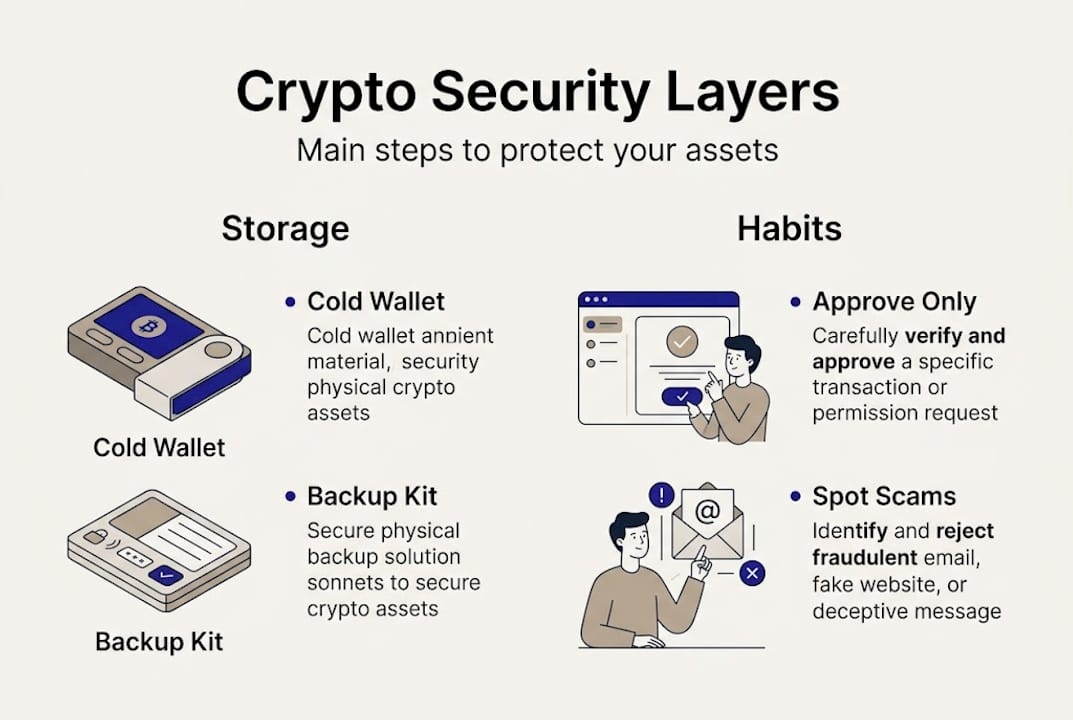
Token approval management is equally important. Many investors approve token access once and forget about it, leaving open doors for future exploits. Regularly audit and revoke unnecessary approvals using tools like Revoke.cash or Etherscan’s token approval checker.
Here’s a numbered process for every transaction:
- Verify the destination address from a trusted source, not a copied message
- Check the amount and network fee before confirming
- Review smart contract permissions line by line
- Confirm on your hardware wallet screen (not just your browser)
- After completing a DeFi interaction, revoke token approvals you no longer need
Explore secure crypto transaction methods for real-world examples of how to apply these steps across different platforms and asset types.
Defend against scams: Phishing, social engineering, and hygiene
Safe transactions aren’t enough unless you know how to spot and block the most common cons targeting investors. Phishing remains devastatingly effective because it targets human psychology, not software vulnerabilities.
Phishing caused 14.1% of 2025 losses, totaling $452 million in a single year. And social engineering outpaces technical hacks, accounting for 65% of crypto incidents, which means the weakest point in most security setups is human behavior, not code.
Phishing tactics include fake exchange login pages, impersonation emails from “support teams,” Discord and Telegram messages offering free tokens, and fraudulent wallet connection prompts. The psychological hooks are always the same: urgency, fear, or an offer that seems too good to pass up.
Essential habits to build right now:
- Bookmark every exchange, wallet, and DeFi site you use and only access them that way
- Never respond to unsolicited DMs, emails, or calls about your crypto
- Enable anti-phishing codes on exchanges that offer them (Binance and Coinbase both support this)
- Always verify the exact URL before entering credentials, including checking for subtle misspellings
- Use a dedicated email address for crypto accounts, separate from your personal or work email
Top warning signs of a scam include pressure to act immediately, requests for your seed phrase or private key, unsolicited offers of free tokens or “recovery services,” and URLs that look almost right but contain extra characters or different domains.
Pro Tip: If you receive an unexpected message about your crypto account, close the message and go directly to the official site via your bookmark. Never use a link provided in the message, even if it looks legitimate.
If you suspect you’ve been exposed, act fast: disconnect your wallet from any suspicious site, revoke recent token approvals, transfer assets to a fresh wallet, and change passwords on linked accounts immediately. Understanding the role of security in crypto and taking steps to reduce trading risk are ongoing commitments, not one-time fixes.
“The best security system in the world fails if the person using it doesn’t know what to watch for. Education is not optional.”
Why a layered approach is the only way to truly secure your crypto
We’ve seen a lot of guides that focus on a single solution, buy a hardware wallet, use a VPN, enable two-factor authentication, and call it done. That mindset is exactly what attackers count on. The reality is that no single tool protects you completely.
Most crypto losses come from people errors, not technical failures. A hardware wallet doesn’t help if your seed phrase is stored in a Google Doc. Strong transaction habits don’t matter if you click a phishing link. Every layer reinforces the others, and gaps between layers are where losses happen.
Security is also not a one-time setup. Threats evolve. New scam tactics emerge constantly. Your habits need to keep pace. Both new and experienced investors fall prey to shortcuts, often because familiarity breeds complacency. The investor who has traded for five years may be more likely to skip an address check because they’ve “done it a thousand times.”
Building savvy security practices means treating your crypto security like a living system: hardware storage, offline backups, verified transaction habits, and ongoing awareness working together. That combination is genuinely hard to beat.
Take the next step to safeguard your crypto portfolio
Knowing the best practices is a strong start, and putting the right tools in place makes all the difference over the long term. Whether you’re setting up your first hardware wallet or optimizing an existing portfolio, having reliable guidance and smart management options keeps you ahead of risks.

Our comprehensive wallet guide covers everything from choosing your first wallet to monitoring activity across platforms. If you’re exploring crypto management alternatives that prioritize security alongside performance, we’ve done the comparison work for you. The CryptoCracker management platform brings portfolio tracking, market insights, and secure Coinbase integration into one clear, accessible dashboard, so you can stay informed and in control without the complexity.
Frequently asked questions
What is the safest way to store large amounts of cryptocurrency?
Use a hardware wallet (cold storage) and keep 80-90% offline for the strongest protection against online threats and exchange failures.
Why shouldn’t I store my recovery phrase on my computer or phone?
Digital storage is exposed to malware, hacking, and device loss; never store seed phrases digitally and always use offline physical backups for maximum safety.
How do I spot a crypto phishing attempt?
Phishing scams use fake websites, urgent messages, and impersonation tactics; phishing caused $452M in losses in 2025, so always verify URLs and never share details in response to unsolicited contact.
Is it safer to use custodial services or self-custody?
Self-custody gives you direct control over your assets, but it requires careful discipline; most experts recommend hardware wallets for maximum safety over custodial services for serious holdings.
Recommended
- Mastering the role of security in crypto for safer investing | CryptoCracker
- Secure crypto transactions: practical examples and methods | CryptoCracker
- Key features that make crypto platforms secure and user-friendly | CryptoCracker
- Crypto risk assessment: Proven strategies for smart investors | CryptoCracker