TL;DR:
- Simple, naive diversification strategies often outperform complex models in crypto investing.
- Crypto asset allocation requires balancing high volatility, correlation spikes, and risk tolerance.
- Regular, disciplined rebalancing and clear rules improve long-term investment resilience.
Most investors assume that the more complex their crypto strategy, the better their results. It turns out that assumption is often wrong. Even naive strategies can outperform sophisticated models in cryptocurrency allocation, and that insight alone should make you rethink how you approach your portfolio. Whether you are just starting out or looking to sharpen your edge, understanding how asset allocation actually works in crypto is one of the most valuable things you can do. This article walks you through the key frameworks, the surprising research, and the practical steps you need to build a smarter, more resilient portfolio.
Table of Contents
- Understanding crypto asset allocation fundamentals
- Popular allocation methodologies: From simple to advanced
- Why simple approaches often win in crypto
- Building and rebalancing your crypto portfolio
- What most crypto investors get wrong about asset allocation
- Next steps for optimized crypto allocation
- Frequently asked questions
Key Takeaways
| Point | Details |
|---|---|
| Simple strategies outperform | Naive diversification and risk allocation often yield better results than complex models in crypto markets. |
| Importance of rebalancing | Regular portfolio rebalancing helps control risk and maintain your allocation targets. |
| Use benchmarks | Adopt institutional benchmarks and indices as guides to structure your crypto portfolio efficiently. |
| Factor volatility | Account for high volatility and possible drawdowns when planning your crypto asset allocation. |
Understanding crypto asset allocation fundamentals
Crypto asset allocation is the process of deciding how to distribute your investment capital across different digital assets. Think of it as the blueprint for your portfolio. Just like a traditional investor might split funds between stocks, bonds, and real estate, a crypto investor decides how much to hold in Bitcoin, Ethereum, altcoins, and stablecoins. The goal is to balance potential returns against the risks you are willing to take.
What makes crypto allocation uniquely challenging is the extreme nature of its market behavior. We are not talking about the mild fluctuations you see in equities. Crypto assets experience volatility of 50 to 70% annually and drawdowns exceeding 80%, which is a reality that changes everything about how you should think about risk. A strategy that works in traditional finance can fall apart quickly when applied to crypto without adjustment.
Several factors shape how you should approach allocation:
- Volatility: Crypto assets move dramatically, often without warning. High volatility means your allocation can shift fast.
- Correlations: During market stress, many crypto assets move together, reducing the benefit of diversification just when you need it most.
- Drawdown tolerance: How much loss can you absorb before panic sets in? This is personal and critical to your strategy.
- Liquidity: Some assets are harder to exit quickly, which affects how much you should hold.
- Time horizon: Long-term holders can absorb more volatility than short-term traders.
“Crypto behaves like a risk asset under stress, meaning correlations spike and diversification benefits shrink exactly when markets fall hardest.”
Understanding these dynamics is the foundation for making smarter decisions. Learning how to reduce crypto risk through allocation is not just about picking winners. It is about structuring your portfolio so that no single loss event destroys your position. A solid crypto risk assessment is where every good allocation strategy begins.
With the importance of asset allocation established, let’s break down the main strategies investors use.
Popular allocation methodologies: From simple to advanced
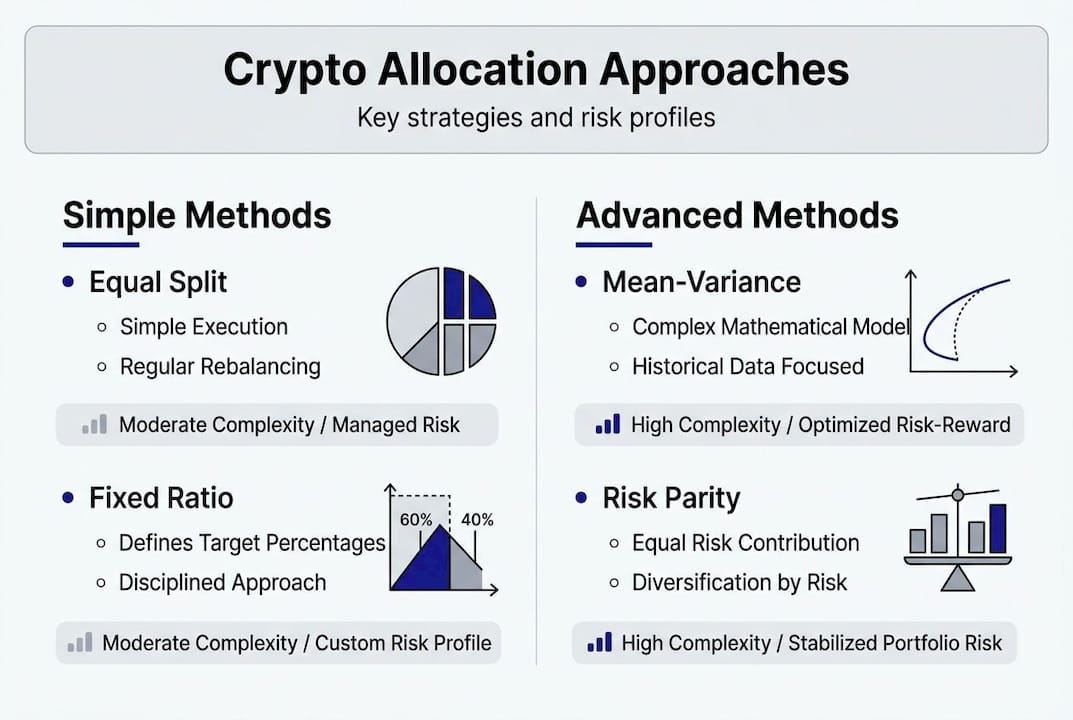
There is no single right way to allocate a crypto portfolio. Methodologies range from risk parity and mean-variance optimization to dollar-cost averaging, HODL strategies, risk allocation, and periodic rebalancing. Each has its own logic, and each fits a different type of investor.

Here is a quick comparison to help you orient yourself:
| Method | Complexity | Best suited for | Transaction cost impact |
|---|---|---|---|
| 1/N (equal weight) | Low | Beginners, passive investors | Minimal |
| HODL | Low | Long-term believers | Very low |
| DCA | Low | Regular savers | Low |
| Risk parity | Medium | Balanced risk seekers | Moderate |
| Mean-variance | High | Quantitative investors | High |
| Risk allocation | Medium | Experienced investors | Moderate |
Here is a simple way to think through each approach:
- Equal weight (1/N): Divide your capital equally across your chosen assets. Simple, transparent, and surprisingly effective.
- HODL: Buy and hold your selected assets through market cycles, minimizing trading and transaction costs.
- DCA (dollar-cost averaging): Invest a fixed amount at regular intervals regardless of price, smoothing out your entry points over time.
- Risk parity: Allocate based on each asset’s contribution to total portfolio risk rather than its dollar value.
- Mean-variance optimization: Use historical returns and correlations to find the mathematically optimal allocation. This is the Markowitz model in crypto applied to digital assets.
- Periodic rebalancing: Set target allocations and rebalance back to them on a schedule or when drift exceeds a threshold.
Pro Tip: Match your method to your actual risk profile, not your ideal one. If a 40% drawdown would cause you to sell everything, a high-complexity strategy that requires holding through pain is not for you. Start with easy crypto trading approaches and build from there. DCA is particularly powerful for building positions steadily, and you can explore crypto savings with DCA to automate the process entirely.
Now that you know the key frameworks, it is vital to compare how simple versus advanced approaches perform in real markets.
Why simple approaches often win in crypto
Here is something most investors find counterintuitive: keeping it simple frequently beats going complex. Research confirms that naive diversification often outperforms sophisticated optimization models, especially in crypto, where time-varying moments and high transaction costs erode the theoretical advantages of complex methods.
Let’s look at the performance picture:
| Strategy | Avg. annual return | Sharpe ratio | Drawdown sensitivity | Transaction costs |
|---|---|---|---|---|
| 1/N equal weight | Competitive | Moderate to high | Moderate | Low |
| Mean-variance optimized | Variable | Often lower | High | High |
| Risk parity | Moderate | Higher | Lower | Moderate |
| HODL (BTC/ETH) | High (long-term) | Variable | Very high | Very low |
Academic research confirms that simple risk allocation strategies rival optimized methods, and while adding crypto to a traditional portfolio improves the efficiency frontier, it also demands genuine drawdown tolerance. The math behind complex models looks great on paper. Reality is messier.
Why do simple strategies hold up so well? Several reasons:
- Crypto statistics shift constantly. The correlations and volatilities that feed complex models today may be completely different next quarter.
- Transaction costs compound quickly. Every rebalancing trade in a complex strategy eats into returns. Simple strategies trade less.
- Estimation error is brutal. Mean-variance models are highly sensitive to input assumptions. Small errors in expected return estimates lead to wildly different allocations.
- Behavioral consistency. Simple strategies are easier to stick with. Complexity breeds doubt, and doubt leads to abandonment at exactly the wrong moment.
Pro Tip: Do not let the appeal of a sophisticated algorithm convince you to abandon a clear, consistent plan. Understanding naive allocation in crypto is not a beginner move. It is a smart one. Many experienced investors gravitate toward mainstream allocation strategies precisely because they work without requiring constant recalibration.
To make these findings actionable, let’s see how to build and rebalance your portfolio in practice.
Building and rebalancing your crypto portfolio
Knowing the theory is one thing. Putting it into practice is where most investors struggle. Here is a straightforward process for building and maintaining a crypto portfolio that holds up over time.
- Define your risk tolerance. Before picking a single asset, know how much loss you can absorb emotionally and financially. This drives every decision that follows.
- Choose your core assets. Bitcoin and Ethereum form the backbone of most serious portfolios. They offer the deepest liquidity and the most established track records.
- Set your target allocation. Decide on percentages for each asset class. A common institutional starting point is a 60/30/10 split across BTC, ETH, and altcoins.
- Select your methodology. Based on your risk profile and time commitment, pick one of the strategies above and commit to it.
- Establish a rebalancing schedule. Decide in advance when you will rebalance, not in response to panic.
- Track performance against a benchmark. Use established reference points to measure how your portfolio is doing.
Speaking of benchmarks, institutions do not guess. Grayscale indices serve as benchmarks, with their GDLC fund allocating roughly 80% to Bitcoin, and institutional norms increasingly trend toward structured 60/30/10 splits. These benchmarks give you a reality check on whether your allocation is reasonable.
Common benchmarks worth knowing:
- Grayscale GDLC: Approximately 80% BTC, with the remainder in ETH and select altcoins
- Institutional 60/30/10: 60% BTC, 30% ETH, 10% diversified altcoins
- Equal weight across top 10: A simple alternative that captures broad market exposure
“Rebalancing when allocations drift 5 to 10% helps manage risk without triggering excessive transaction costs.”
Rebalancing is most effective on a quarterly schedule or when any asset drifts more than 5 to 10% from its target. Doing it more often usually costs more than it gains. Smart crypto portfolio rebalancing is about discipline and timing, not constant activity.
With actionable steps in hand, let’s consider a deeper perspective most articles miss on crypto allocation success.
What most crypto investors get wrong about asset allocation
We see a consistent pattern among investors who struggle with crypto allocation: they equate complexity with competence. There is a psychological pull toward sophisticated models, elaborate dashboards, and multi-factor strategies. It feels like doing more means doing better. But in volatile markets, that instinct often works against you.
The research is clear. Optimal naive diversification beats complex models in many real-world scenarios, especially when you factor in the shifting statistics of crypto markets and the drag of transaction costs. Blending traditional finance approaches helps, but it also introduces drawdown risk that many investors underestimate.
Clarity outperforms complexity under market stress. When prices are falling fast, a simple, well-understood strategy is one you will actually follow. A complex one is one you will second-guess and abandon. The investors we see succeed long-term are not the ones with the most sophisticated models. They are the ones with the clearest rules and the discipline to follow them. Explore boosting portfolio strategies that prioritize consistency over cleverness, and you will likely be ahead of most of the market.
Next steps for optimized crypto allocation
Putting allocation principles into practice is much easier when you have the right tools working alongside you. CryptoCracker is built exactly for this moment in your investment journey.

With CryptoCracker’s portfolio optimization tools, you can track your allocations in real time, set rebalancing alerts, and see clearly when your portfolio drifts from your targets. Our platform also helps with reducing crypto risk through visual dashboards and personalized recommendations that translate strategy into action. For deeper market context, our crypto market analytics give you the data-driven insights you need to stay informed without getting overwhelmed. Simple, clear, and built for investors who want results.
Frequently asked questions
What is the simplest crypto asset allocation strategy?
Naive diversification, or 1/N allocation, splits your portfolio equally across chosen assets and often outperforms complex models in real-world crypto markets due to lower costs and fewer estimation errors.
How often should I rebalance my crypto portfolio?
Most research supports quarterly rebalancing or rebalancing whenever any allocation drifts more than 5 to 10% from your target, balancing risk management with transaction cost efficiency.
Do professional investors use simple allocation strategies?
Yes. Institutional benchmarks like Grayscale’s GDLC and common 60/30/10 BTC/ETH/alt splits show that even sophisticated players favor structured, transparent allocation frameworks over pure complexity.
What are the main risks in crypto asset allocation?
The biggest risks are high volatility and deep drawdowns exceeding 80%, compounded by correlation spikes during stress periods that reduce the protective benefit of diversification exactly when you need it most.