Crypto trading strategies often feel overwhelming, especially when you’re trying to balance risk and reward. Many investors assume that effective strategies are reserved for Wall Street experts or require complex algorithms. The truth is simpler: understanding a handful of proven strategies can transform how you manage your crypto portfolio. This guide breaks down the most practical approaches for both novice and experienced investors, showing you how to optimize returns, manage risk, and make smarter decisions. You’ll discover actionable techniques that fit your goals and risk tolerance, empowering you to take control of your crypto investments.
Table of Contents
- Key takeaways
- Understanding crypto trading strategies: an overview
- Technical and fundamental analysis in forming strategies
- Popular crypto trading strategies explained and compared
- Risk management and portfolio optimization techniques
- Optimize your crypto trading with CryptoCracker
- FAQ
Key Takeaways
| Point | Details |
|---|---|
| Strategy matches risk tolerance | Identify your investment timeline and risk tolerance before choosing a strategy. |
| Technical and fundamental analysis | Use both analysis approaches to guide entry and exit decisions. |
| Automated trading benefits portfolios | Automated systems execute trades according to predefined rules to optimize returns. |
| Different strategies fit goals | Choose day trading, swing trading, HODLing, scalping, or algorithmic styles based on your time horizon and risk tolerance. |
Understanding crypto trading strategies: an overview
Crypto trading strategies are planned methods to buy and sell cryptocurrencies based on specific criteria, market conditions, and personal goals. They’re not random guesses or gut feelings. Instead, they’re systematic approaches that help you make consistent decisions in a volatile market. Without a strategy, you’re essentially gambling, letting emotions drive your trades and exposing yourself to unnecessary losses.
Why do strategies matter so much? They optimize returns by identifying the best entry and exit points for trades. They manage risk by setting clear boundaries on how much you’re willing to lose. Most importantly, they reduce emotional decisions that often lead to panic selling or FOMO buying. When the market swings wildly, a solid strategy keeps you grounded.
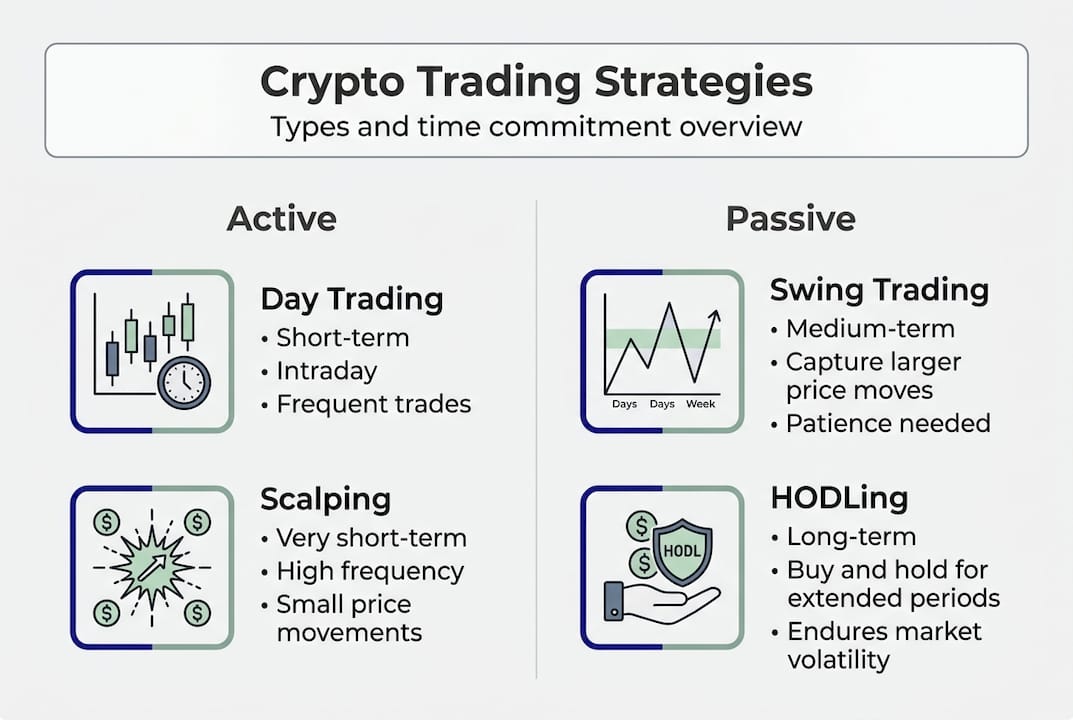
Common crypto trading strategies include:
- Day trading: buying and selling within the same day to capitalize on short term price movements
- Swing trading: holding positions for days or weeks to profit from medium term trends
- HODLing: long term holding strategy where you buy and hold assets for months or years
- Scalping: making dozens of trades daily to profit from tiny price changes
- Algorithmic trading: using automated systems to execute trades based on predefined rules
Each strategy demands different time commitments, skill levels, and risk tolerance. Day trading requires constant market monitoring and quick decision making. HODLing suits investors who believe in long term crypto adoption and can weather short term volatility. Scalping needs lightning fast execution and deep market knowledge. The key is matching your strategy to your lifestyle, goals, and comfort with risk.
Pro Tip: Start by identifying your investment timeline and risk tolerance before choosing a strategy. A mismatch between your personality and strategy leads to stress and poor performance.
Understanding crypto trading strategies overview helps you build a framework for consistent portfolio management. The right strategy transforms random trades into purposeful actions aligned with your financial objectives.
Technical and fundamental analysis in forming strategies
Every successful crypto trading strategy relies on solid analysis. You can’t just pick random entry points and hope for the best. Two main analytical approaches guide strategy development: technical analysis and fundamental analysis. Understanding both gives you a complete picture of market opportunities.
Technical analysis studies price charts, trading volume, and mathematical indicators to predict future price movements. It assumes that historical patterns repeat and that price action reflects all available information. Traders use charts to identify trends, support and resistance levels, and momentum shifts. Common technical analysis tools include:
- Moving averages: smooth out price data to identify trend direction over specific periods
- Relative Strength Index (RSI): measures momentum to spot overbought or oversold conditions
- MACD (Moving Average Convergence Divergence): tracks trend changes and momentum shifts
- Bollinger Bands: shows volatility and potential price breakouts based on standard deviations
These indicators help you time your trades more effectively. For example, when RSI drops below 30, an asset might be oversold and due for a bounce. When price breaks above a resistance level with high volume, it signals a potential upward trend.
Fundamental analysis evaluates the underlying value of a crypto project. Instead of focusing on price charts, you examine the project’s technology, team, adoption rates, partnerships, and market conditions. This approach helps you identify cryptocurrencies with strong long term potential. You might analyze a project’s whitepaper, assess its real world use cases, or track developer activity on GitHub.

Market volatility significantly impacts strategy choice. High volatility suits day traders and scalpers who profit from rapid price swings. Lower volatility periods favor swing traders who need clear trends to develop. Understanding crypto market analysis guide principles helps you adapt your approach to current market conditions.
Pro Tip: Combine technical and fundamental approaches for balanced strategy development. Technical analysis helps you time entries and exits, while fundamental analysis ensures you’re trading quality assets with long term potential.
Neither approach is perfect alone. Technical analysis can generate false signals, especially during unexpected news events. Fundamental analysis might identify great projects, but timing your entry poorly can still lead to losses. The most successful traders blend both methods, using fundamentals to select assets and technicals to time their trades.
Popular crypto trading strategies explained and compared
Let’s break down specific strategies so you can choose the right approach for your portfolio. Each strategy has unique characteristics, advantages, and challenges.
Day trading involves opening and closing positions within a single trading day. You capitalize on intraday price movements, never holding positions overnight. This strategy requires significant time commitment and constant market monitoring. Day traders use technical indicators to spot short term opportunities and execute multiple trades daily.
Swing trading holds positions for several days to weeks, capturing medium term price trends. You’re not glued to your screen all day, making this strategy more manageable for people with other commitments. Swing traders identify trends early and ride them until momentum shifts.
Scalping is the most intense strategy, involving dozens or even hundreds of trades daily. Scalpers profit from tiny price movements, often holding positions for just minutes. This approach demands exceptional focus, fast execution, and low trading fees to remain profitable.
HODLing is the simplest strategy: buy quality cryptocurrencies and hold them long term regardless of short term volatility. The term originated from a misspelled forum post but became a philosophy. HODLers believe in crypto’s long term adoption and avoid trying to time the market.
Automated trading uses algorithms and bots to execute trades based on predefined rules. You set parameters like entry signals, exit points, and risk limits, then let the system trade for you. This removes emotional decisions and allows 24/7 market participation.
Here’s how these popular crypto strategies overview compare:
| Strategy | Time Commitment | Risk Level | Required Skills | Typical Returns |
|---|---|---|---|---|
| Day Trading | Very High | High | Advanced technical analysis | Variable, potentially high |
| Swing Trading | Moderate | Medium | Intermediate analysis | Moderate, consistent |
| Scalping | Extreme | High | Expert execution speed | Small per trade, cumulative |
| HODLing | Very Low | Medium to Low | Basic research | Long term growth |
| Automated | Low setup, minimal monitoring | Varies | Programming or platform use | Depends on strategy |
To implement swing trading, follow these steps:
- Identify cryptocurrencies showing clear trends using moving averages and volume indicators
- Wait for a pullback or consolidation period within the larger trend
- Enter the position when momentum indicators confirm trend continuation
- Set a stop loss below recent support levels to limit downside risk
- Hold the position for several days to weeks as the trend develops
- Exit when momentum weakens or price reaches a predetermined target
Pro Tip: Start small and track performance to refine your strategy before scaling. Keep a trading journal documenting every trade, including your reasoning, emotions, and outcomes. This helps you identify patterns in your decision making and improve over time.
The best strategy depends on your lifestyle and goals. If you have a full time job, day trading probably won’t work. If you’re patient and believe in crypto’s future, HODLing might be perfect. If you enjoy analysis but can’t monitor markets constantly, swing trading offers a middle ground. Many successful investors combine strategies, using HODLing for core holdings while swing trading with a smaller portion of their portfolio.
Risk management and portfolio optimization techniques
Even the best trading strategy fails without proper risk management. Protecting your capital is more important than chasing gains. One bad trade can wipe out weeks of profits if you’re not careful.
Risk management techniques safeguard your investments and ensure you can keep trading even after losses. Here are essential practices every crypto trader should implement:
- Setting stop loss orders: automatically exit positions when price drops to a specified level, limiting potential losses
- Position sizing: never risk more than 1 to 2 percent of your portfolio on a single trade
- Diversification: spread investments across multiple cryptocurrencies to reduce exposure to any single asset
- Regular portfolio review: assess performance monthly and rebalance allocations based on changing market conditions
- Taking profits systematically: lock in gains at predetermined price targets rather than getting greedy
Automated tools make risk management easier and more consistent. Trailing stop loss orders, for example, automatically adjust your exit point as price moves in your favor. If you buy Bitcoin at $50,000 and set a 10 percent trailing stop, your exit point starts at $45,000. If Bitcoin rises to $60,000, your stop automatically adjusts to $54,000, protecting gains while giving the trade room to grow.
“Effective risk management isn’t about avoiding losses entirely. It’s about ensuring that when losses occur, they’re small and manageable, while letting winners run to maximize gains. The traders who survive long term are those who protect their capital first and pursue profits second.”
Position sizing is particularly crucial in crypto’s volatile environment. If you risk 10 percent of your portfolio on each trade, just three consecutive losses cut your capital by nearly 30 percent. Recovery becomes exponentially harder. By risking only 1 to 2 percent per trade, you can withstand a string of losses without devastating your portfolio.
Diversification reduces concentration risk. Don’t put everything into one cryptocurrency, no matter how promising it seems. Spread investments across different sectors: layer 1 blockchains, DeFi protocols, NFT platforms, and stablecoins. This way, poor performance in one area doesn’t sink your entire portfolio.
Regular portfolio reviews keep you aligned with your goals. Markets change, and so should your allocations. Maybe a cryptocurrency that was 10 percent of your portfolio six months ago has grown to 40 percent. That concentration increases your risk. Rebalancing by taking some profits and redistributing them maintains your desired risk profile.
Discipline separates successful traders from gamblers. Stick to your risk management rules even when you’re on a winning streak. Overconfidence leads to larger position sizes and ignored stop losses. That’s when catastrophic losses happen. The most successful crypto investors treat risk management as non negotiable, following their rules regardless of market conditions or emotions.
Optimize your crypto trading with CryptoCracker
Understanding crypto trading strategies is one thing. Implementing them effectively is another challenge entirely. That’s where CryptoCracker comes in, offering tools designed specifically to help you apply these strategies and optimize your portfolio performance.

CryptoCracker provides comprehensive portfolio optimization features that align perfectly with the strategies we’ve discussed. The platform’s market analysis dashboard gives you real time insights into price trends, volume patterns, and momentum indicators. You can spot opportunities faster and make informed decisions based on data rather than guesswork. The crypto market analysis tool simplifies technical analysis, making it accessible even if you’re not a charting expert.
Automation features let you implement strategies without constant monitoring. Set up automated crypto trading rules that execute trades based on your criteria, whether you’re swing trading or using algorithmic approaches. The platform integrates seamlessly with Coinbase, providing secure access to your portfolio and enabling automated rebalancing and stop loss management. This means you can apply professional level strategies without needing programming skills or staying glued to your screen.
FAQ
What are the most beginner friendly crypto trading strategies?
HODLing and swing trading are often best for beginners due to lower complexity and time requirements. HODLing simply involves buying quality cryptocurrencies and holding them long term, which eliminates the stress of constant trading decisions. Swing trading requires some technical analysis skills but doesn’t demand the intense monitoring of day trading. Starting with clear goals and small positions helps novices learn market dynamics while managing risk effectively.
How do automated trading strategies benefit crypto investors?
Automation reduces emotional decisions that often lead to poor trading outcomes. Automated systems execute trades based on predefined rules, removing fear and greed from the equation. They allow investors to seize opportunities 24/7 without manual monitoring, which is crucial in crypto markets that never sleep. Automation also ensures consistent application of your strategy, eliminating the inconsistency that comes from manual trading when you’re tired, distracted, or emotional.
What is the role of technical analysis in crypto trading?
Technical analysis uses price charts, volume data, and mathematical indicators to forecast market direction and identify trading opportunities. It guides entry and exit points by revealing trends, momentum shifts, and support or resistance levels. Traders rely on technical analysis to time their trades more effectively, aligning their actions with specific trading strategies. While not perfect, technical analysis provides a systematic framework for making trading decisions based on observable market behavior rather than guesswork.
How can I manage risk while trading cryptocurrencies?
Use stop loss orders to automatically exit positions when price moves against you, limiting potential losses to acceptable levels. Diversify holdings across multiple cryptocurrencies to avoid overexposure to any single asset. Never risk more than 1 to 2 percent of your portfolio on a single trade, ensuring that even a series of losses won’t devastate your capital. Regularly review your portfolio to adapt to changing market conditions and rebalance allocations when necessary to maintain your desired risk profile.