Many crypto users mistakenly believe exchange integration is complex or only for experts. The reality is far more accessible. Exchange integration allows automated, streamlined access to exchanges for managing trades and portfolios, benefiting both novices and experienced traders. This guide explains what exchange integration is, how it works technically, and why it matters for optimizing your crypto management in 2026. You’ll discover the tools that simplify connectivity, understand different exchange API types, and learn practical applications that can transform your trading efficiency.
Table of Contents
- What Is Exchange Integration In Crypto? Explained
- Understanding Different Types Of Crypto Exchange Apis And Platforms
- Tools And Libraries Simplifying Exchange Integration
- Practical Applications And Benefits Of Exchange Integration For Investors And Traders
- Explore CryptoCracker’s Tools For Seamless Exchange Integration
- Frequently Asked Questions About Exchange Integration In Crypto
Key takeaways
| Point | Details |
|---|---|
| API connectivity | Exchange integration uses APIs to connect software tools with crypto exchanges for automated trading and data access. |
| Platform variety | Different exchange types require varying integration approaches, from centralized to decentralized platforms. |
| Unified libraries | Tools like CCXT simplify multi-exchange connectivity by providing standardized interfaces across platforms. |
| Rate limit management | Managing API rate limits is crucial for maintaining stable integration and avoiding service disruptions. |
| Practical benefits | Integration enables automated portfolio management, real-time market analysis, and reduced manual trading errors. |
What is exchange integration in crypto? Explained
Exchange integration in crypto refers to connecting external software applications to cryptocurrency exchanges via APIs to enable automated access to market data, account balances, order execution, and portfolio management without manual interaction through the exchange’s web interface. This connection creates a bridge between your chosen tools and the exchange’s systems, allowing seamless data flow and command execution.
APIs, or Application Programming Interfaces, serve as the technical foundation for this connectivity. They act as messengers that carry requests from your software to the exchange and return responses with the requested data or confirmation of actions. When you use a trading bot to place orders or a portfolio tracker to monitor your holdings, APIs handle these communications behind the scenes.
Common types of integrated tools include:
- Trading bots that execute strategies automatically based on market conditions
- Portfolio trackers that aggregate holdings across multiple exchanges
- Custom dashboards that visualize market trends and account performance
- Alert systems that notify you of price movements or order completions
Integration automates tasks that would otherwise require manual effort through exchange websites. Instead of logging into multiple platforms to check balances, place orders, or analyze market data, integrated software handles these operations programmatically. This automation saves time and enables strategies that would be impossible to execute manually, such as high-frequency trading or instant rebalancing across multiple exchanges.
The benefits over manual exchange web interfaces are substantial. You gain speed, as automated systems react to market conditions in milliseconds rather than minutes. You achieve consistency, since programmatic rules eliminate emotional decision making. You also enable sophisticated strategies that require simultaneous actions across multiple exchanges or rapid responses to market signals. Understanding crypto exchanges, brokers, and bots helps clarify how these integrated tools fit into the broader crypto ecosystem.
Understanding different types of crypto exchange APIs and platforms
Centralized exchanges and decentralized exchanges offer fundamentally different integration experiences. Centralized exchanges like Binance, Coinbase, and Kraken provide well-documented REST and WebSocket APIs with predictable endpoints and response formats. These APIs typically offer comprehensive access to trading, account management, and market data through standardized HTTP requests.
Decentralized exchanges present more complex integration challenges. Cardano exchange integrations demonstrate how DEX APIs must handle native asset protocols and minimum ADA requirements that don’t exist in centralized systems. DEX integrations often require understanding blockchain-specific transaction models, such as eUTXO architecture, and managing gas fees or network congestion directly.
API rate limits vary significantly across platforms and directly impact integration design. Binance allows 1200 weight per minute, while Coinbase permits 10 to 15 requests per second for public endpoints and 15 for private endpoints. Kraken implements tiered limits based on verification level. Exceeding these limits triggers 429 error responses, temporarily blocking your access.
Strategies to manage rate limits effectively:
- Implement exponential backoff when receiving rate limit errors, waiting progressively longer between retry attempts
- Cache frequently accessed data like market information to reduce redundant API calls
- Batch multiple operations into single requests when the API supports it
- Distribute requests evenly over time rather than bursting activity
- Monitor your usage against limits proactively to avoid hitting thresholds
The following table compares key characteristics across exchange types:
| Exchange Type | API Complexity | Speed/Liquidity | Rate Limit Flexibility |
| — | — | — |
| Centralized (CEX) | Low to Medium | Highest | Generous, tiered |
| Decentralized (DEX) | High | Variable | Network dependent |
| Hybrid | Medium | Moderate | Platform specific |
Centralized exchanges generally favor speed and liquidity, making their APIs ideal for active trading strategies. Binance consistently ranks as the top choice for high-frequency operations due to its robust infrastructure and generous rate limits. DEX integrations suit users prioritizing decentralization and direct blockchain interaction, though they require more technical expertise.

Pro Tip: Always implement rate limit handling from the start of your integration project. Waiting until you encounter 429 errors in production can disrupt live trading operations and lead to missed opportunities. Test your rate limit handling thoroughly in development environments before going live.
Understanding the differences between Coinbase and Coinbase Wallet illustrates how even within one company’s ecosystem, integration approaches can vary based on whether you’re connecting to a centralized exchange or a self-custody wallet interface.
Tools and libraries simplifying exchange integration
Handling different exchange APIs individually creates significant development overhead. Each exchange implements unique endpoint structures, authentication methods, error codes, and data formats. Writing custom code for Binance, then rewriting similar logic for Kraken, Coinbase, and others multiplies your workload and maintenance burden.
The CCXT library provides unified multi-exchange access, reducing custom code for different API quirks. CCXT abstracts away exchange-specific differences behind a consistent interface. You write code once using CCXT’s standardized methods, and it translates your requests into the appropriate format for whichever exchange you’re targeting.
These unification tools simplify coding in several ways:
- Standardized method names across all exchanges for common operations like fetching balances or placing orders
- Normalized data structures that present information consistently regardless of the underlying exchange format
- Built-in error handling that translates exchange-specific errors into common error types
- Automatic retry logic and rate limit management for supported exchanges
- Regular updates that adapt to exchange API changes without requiring code modifications
Popular crypto software leverages these tools extensively. Trading bots, portfolio management platforms, and market analysis applications rely on CCXT and similar libraries to support multiple exchanges without maintaining separate codebases for each. This approach accelerates development and improves reliability by building on battle-tested integration code.
The reliability improvements stem from community-driven development. When thousands of developers use the same library, edge cases get discovered and fixed quickly. Exchange API changes that might break custom integrations get addressed in library updates before impacting your application. This shared maintenance burden significantly reduces the technical risk of exchange integration.
Pro Tip: Always test your integrations in sandbox or testnet environments before connecting to live trading accounts. Most major exchanges offer test environments with fake funds that mirror production API behavior. This practice lets you verify your integration logic, rate limit handling, and error recovery without risking real capital or triggering actual trades.
Platforms like CryptoCracker demonstrate how portfolio optimization benefits from robust exchange integration. By connecting seamlessly to exchanges through proven libraries, these tools can offer reliable automated trading and portfolio management features that would be prohibitively complex to build from scratch.
The ecosystem of integration tools continues evolving. New libraries emerge to address specific needs like WebSocket stream management, order book reconstruction, or advanced trading features. Staying current with these tools helps you leverage the latest capabilities while minimizing development effort. The key is choosing mature, well-maintained libraries with active communities and comprehensive documentation.
Practical applications and benefits of exchange integration for investors and traders
Exchange integration enables automated access to market data, account balances, order execution, and portfolio management without manual interaction. This automation translates into concrete benefits that improve both trading performance and operational efficiency.
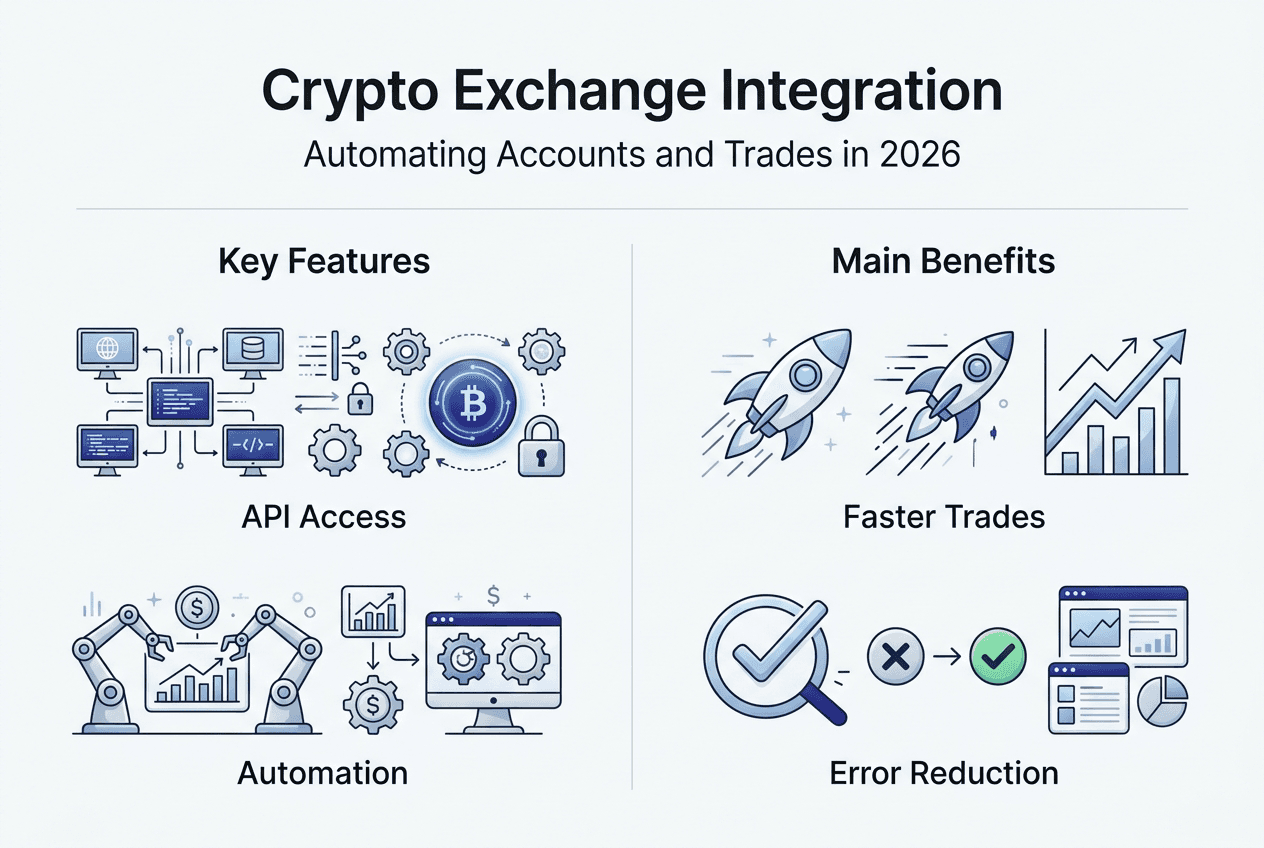
Automation of trades and portfolio tracking improves speed and accuracy dramatically. Manual order entry introduces delays measured in seconds or minutes, during which market conditions can shift unfavorably. Automated systems execute trades in milliseconds, capturing intended prices more reliably. Portfolio tracking becomes continuous rather than periodic, giving you real-time visibility into position values and performance metrics.
Managing multiple exchange accounts through integrated software eliminates the friction of juggling different platforms. Instead of maintaining separate logins, navigating different interfaces, and manually reconciling positions across exchanges, you access everything through a unified dashboard. This consolidation is particularly valuable for traders who arbitrage price differences between exchanges or maintain diversified holdings across platforms for risk management.
The reduction in manual errors and workload compounds over time. Every manual trade entry carries risk of typos in price, quantity, or order type. Every manual portfolio check requires time and attention. Integrated systems eliminate these error sources while freeing your time for higher-value activities like strategy development and market analysis.
Enhanced decision making with real-time market data access gives you a competitive edge. Integrated tools can monitor multiple markets simultaneously, identify opportunities based on complex criteria, and alert you instantly. This capability is impossible to replicate manually, especially across dozens of trading pairs or multiple exchanges.
Stepwise benefits in crypto management from integration:
- Connect your exchange accounts to integrated software using secure API keys with appropriate permissions
- Aggregate your portfolio data across all connected exchanges for complete visibility into holdings and performance
- Set up automated alerts for price movements, order completions, or portfolio rebalancing triggers
- Implement automated trading strategies that execute based on technical indicators or market conditions
- Monitor performance metrics in real-time through customized dashboards that highlight relevant information
- Optimize portfolio allocation automatically based on predefined rules or machine learning recommendations
Tools for crypto market analysis leverage exchange integration to provide insights that would require hours of manual data collection and calculation. By automatically pulling price data, volume information, and order book depth from multiple exchanges, these tools can identify trends, correlations, and opportunities that inform better trading decisions.
Similarly, crypto trade recommendation tools use integrated exchange data to generate actionable suggestions. These recommendations consider your current portfolio composition, market conditions, and trading objectives to suggest specific actions like rebalancing, taking profits, or entering new positions. The integration ensures recommendations reflect current market reality rather than stale data.
The cumulative effect of these benefits is substantial. Traders report spending less time on routine tasks while achieving better execution quality. Portfolio managers gain confidence in their positions through continuous monitoring and automated risk management. Even casual investors benefit from simplified account management and clearer visibility into their crypto holdings across multiple platforms.
Explore CryptoCracker’s tools for seamless exchange integration
Now that you understand how exchange integration transforms crypto management, you’re ready to experience these benefits firsthand. CryptoCracker harnesses exchange integration to deliver portfolio optimization that adapts to your goals and market conditions.

Our platform connects securely to your Coinbase account through API integration, enabling automated trading, comprehensive market analysis, and real-time portfolio tracking without manual data entry. You get personalized trading recommendations based on your holdings and market trends, plus auto savings features that grow your portfolio systematically.
Whether you’re new to crypto or an experienced trader, CryptoCracker eliminates integration complexity while delivering professional-grade tools. Explore how automated crypto trading can improve your portfolio performance in 2026, and discover comprehensive guides to cryptocurrency wallets and platform monitoring that complement your exchange integration strategy.
Frequently asked questions about exchange integration in crypto
What security measures protect API keys during exchange integration?
Never share API keys publicly or store them in code repositories. Use environment variables or secure key management systems to protect credentials. Enable IP whitelisting on your exchange API settings to restrict access to known addresses. Set minimum necessary permissions, avoiding withdrawal rights unless absolutely required. Rotate keys periodically and immediately revoke any potentially compromised credentials.
Can I integrate multiple exchanges in one platform?
Yes, most modern portfolio management and trading platforms support multi-exchange integration through unified libraries like CCXT. You connect each exchange separately using its unique API keys, and the platform aggregates data across all accounts. This approach lets you manage diversified holdings, compare prices across exchanges, and execute cross-exchange strategies from a single interface.
Is coding knowledge necessary to start using exchange integration?
Not for end users of integrated platforms. Services like CryptoCracker handle integration complexity behind the scenes, requiring only that you provide API keys through a user-friendly interface. However, if you’re building custom integrations or trading bots, programming knowledge in languages like Python or JavaScript is essential for working with APIs and integration libraries.
How often should I check API rate limits when integrating?
Monitor rate limits continuously through your integration code rather than checking manually. Implement automatic tracking that counts requests against known limits and throttles activity before hitting thresholds. Most exchanges provide rate limit information in API response headers, allowing real-time adjustment. Review your usage patterns weekly during development and monthly in production to optimize request efficiency.
What are common issues when first setting up exchange integration?
Authentication errors from incorrect API key configuration or insufficient permissions are most common. Users often forget to enable specific permissions like trading or data access when generating keys. Network connectivity issues, including firewall blocks or IP restrictions, can prevent API communication. Misunderstanding data formats or endpoint requirements leads to parsing errors. Finally, exceeding rate limits during initial testing causes temporary blocks that confuse new integrators.