TL;DR:
- Effective crypto risk management focuses on establishing guardrails to protect capital during unpredictable market shocks. A layered approach at trade, portfolio, and venue levels helps mitigate diverse risks, including liquidity gaps and systemic events. Consistent habits like pre-trade checklists, position sizing, and disciplined review are essential for resilient investing and avoiding catastrophic losses.
You can study charts for hours, backtest strategies all weekend, and still watch your portfolio bleed out during a single chaotic market session. Skill matters, but it rarely saves you when conditions shift without warning. As flash crash lessons from October 2025 reveal, crypto markets are prone to mechanically-driven drawdowns where liquidity evaporates and prices gap in ways that no forecast could anticipate. Risk management, not prediction, is what keeps your capital intact. This guide walks through layered, practical strategies you can start applying right now, whether you’re a casual holder or an active trader.
Table of Contents
- Why risk management is the backbone of crypto investing
- Essential risk management tools for retail traders
- Managing leverage and derivatives: Controls for advanced traders
- Portfolio and systemic risks: The crucial edge cases
- Risk management for institutional and advanced investors
- The truth most investors miss about crypto risk
- Take the next step: Smarter tools for crypto risk and portfolio management
- Frequently asked questions
Key Takeaways
| Point | Details |
|---|---|
| Layers of defense | Effective crypto risk management combines trade-level stops, portfolio strategy, and platform controls. |
| Predefined loss limits | Using stop-loss orders and strict position sizing limits the damage of any one trade. |
| Beware systemic events | Portfolio-level risks and liquidation cascades can rapidly affect all holdings. |
| Institutional rigor | Organizations utilize formal policies, risk profiling, and ongoing assessment beyond retail approaches. |
| Routine review wins | Consistent risk checks and habit-forming are more valuable than predicting market direction. |
Why risk management is the backbone of crypto investing
Let’s be clear about what risk management actually means in the crypto context. It is not about predicting where Bitcoin will go next week. It is about building guardrails that prevent any single event, mistake, or market shock from wiping out a meaningful chunk of your portfolio. That distinction matters enormously, especially given how fast crypto market volatility can escalate.
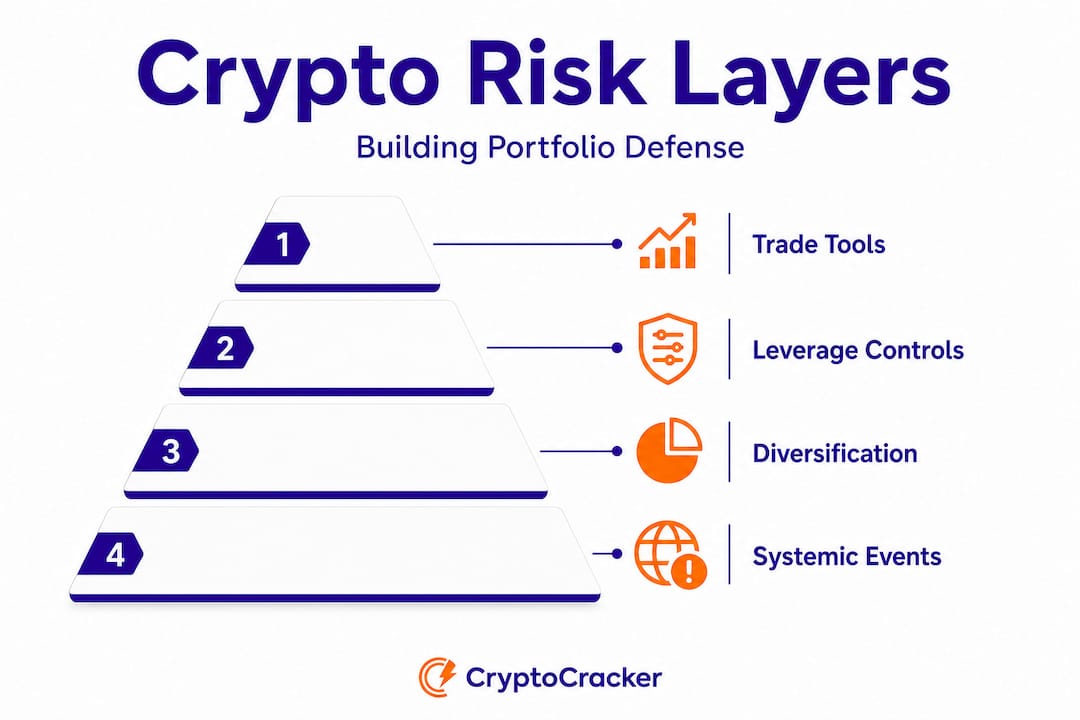
A layered approach is the most effective way to think about it. According to cryptocurrency risk management best practices, this means applying controls at three distinct levels:
- Trade level: Setting loss caps and defining exit points before entering a position
- Portfolio level: Balancing position sizes and managing correlation across holdings
- Venue and product level: Managing the specific risks introduced by platforms, derivatives, leverage, and operational exposure
Each layer addresses a different category of danger. Ignore one, and a gap forms where losses can sneak through.
“Risk management in crypto is less about predicting price direction and more about preventing catastrophic outcomes when conditions gap and liquidity changes.”
The realistic risks you face span far more than price swings. Volatility is the obvious one, but operational errors, exchange outages, smart contract vulnerabilities, and systemic events all belong on your risk radar. Following best practices for crypto investors means acknowledging every layer of exposure, not just the price chart.
Essential risk management tools for retail traders
With the rationale established, it’s time to dive into specific tools and habits that individual traders should adopt for real-world protection.
A common retail approach is to define your exit before you ever enter a trade. That means setting a stop-loss order at a specific price level and deciding in advance exactly how much of your portfolio you’re willing to lose on that one position. This single habit removes emotion from some of your most critical decisions.
Here’s a practical pre-trade checklist you can follow every time:
- Define your entry price. Know exactly why you’re entering at this level, based on your analysis.
- Set your stop-loss before buying. Place it at a level that makes your thesis invalid, not just a level that feels painful.
- Calculate your position size. Most experienced traders risk no more than 1 to 2 percent of their total portfolio on a single trade.
- Check liquidity and spreads. Thin order books mean your stop-loss may not fill where you expect, especially during rapid moves.
- Identify your take-profit target. Know your reward-to-risk ratio before entering. A ratio of at least 2:1 is a healthy baseline.
- Review correlation with existing holdings. If you already hold three altcoins that move with Bitcoin, adding a fourth does not truly diversify your risk.
Position sizing is where many newer investors underestimate the math. Imagine you have a $10,000 portfolio and you’re willing to lose no more than $100 on any single trade (1%). If your stop-loss is set 5% below your entry price, your maximum position size is $2,000. That simple formula keeps one bad trade from becoming a portfolio catastrophe.
Pro Tip: Keep your checklist as a physical card or pinned note near your screen. Following it before every trade builds the kind of consistent discipline that pays off over months and years, not just during good market conditions.
When you reduce crypto trading risk through systematic habits like these, you’re also protecting yourself from your own psychology. Fear and greed are the real enemies, and a checklist is one of the most underrated tools for managing them. For those still building their foundation, reviewing cryptocurrency trading key concepts will help you put these mechanics in context.

Managing leverage and derivatives: Controls for advanced traders
Retail tools form the foundation, but handling derivatives and leverage requires a new set of risk controls. Let’s break down how these work and what sets them apart.
When you trade with leverage, you’re borrowing capital to increase your exposure. That amplifies gains, but it also amplifies losses and introduces a brutal mechanic called liquidation. If the market moves against you enough to wipe out your margin, your position is automatically closed at a loss, often before you even have a chance to react.
For leveraged crypto derivatives like futures and perpetuals, risk management must explicitly account for leverage, liquidation mechanics, funding rates, and margin risk. Funding rates, for example, are periodic payments between long and short traders in perpetual contracts. A high positive funding rate means longs are paying shorts, which adds a continuous cost to holding a leveraged long position over time.
| Factor | Spot trading | Leveraged derivatives |
|---|---|---|
| Liquidation risk | None | High, amplified by leverage ratio |
| Funding costs | None | Ongoing, can erode profits significantly |
| Complexity | Moderate | High, requires active monitoring |
| Margin calls | Not applicable | Triggered when margin falls below threshold |
| Maximum loss | Limited to investment | Can exceed initial margin in some structures |
Key rules for managing leveraged positions:
- Never use maximum available leverage. Even 2x to 3x can create meaningful liquidation risk during high volatility events.
- Maintain a buffer of extra margin above your liquidation price to give your position room to breathe.
- Monitor funding rates daily on perpetual contracts. When funding is excessively positive, consider reducing long exposure.
- Keep your leverage consistent with your stop-loss distance. Tighter stops allow for slightly higher leverage; wider stops demand lower leverage.
Reviewing secure trading practices is especially important when you move into leveraged products, because the stakes are simply higher and the margin for error is smaller.
Statistic callout: During the October 2025 flash crash, over $2 billion in leveraged positions were liquidated within hours, demonstrating just how quickly automated systems can cascade into broader market chaos. No single trader’s analysis could have predicted the exact trigger, but those with conservative leverage and pre-set stops preserved far more capital than those who were fully deployed with high leverage.
Portfolio and systemic risks: The crucial edge cases
Mastering single trades and leverage isn’t enough. System-wide risks and portfolio-level thinking make the difference between surviving shocks and being wiped out.
Systemic risks in crypto are genuinely different from those in traditional markets. Liquidation cascades, where forced selling from leveraged positions triggers automated liquidation systems across multiple venues, can amplify volatility far beyond what any single catalyst would suggest. One exchange’s liquidity crunch can ripple into another platform’s order books within minutes.
Here’s what makes these events especially dangerous:
- Speed: Cascades unfold in minutes, not hours, leaving little time to react manually
- Correlation spikes: Assets that usually move independently start declining together during systemic events
- Liquidity gaps: Bid-ask spreads widen dramatically, making it expensive or impossible to exit positions at expected prices
- Exchange-specific risk: A platform insolvency or technical outage can freeze your assets during exactly the moments you need to act
| Systemic event type | Example | Portfolio impact |
|---|---|---|
| Liquidation cascade | Flash crash October 2025 | Billions in positions wiped in hours |
| Exchange failure | Platform insolvency | Asset access frozen for months |
| Smart contract exploit | DeFi protocol hack | Immediate, irreversible asset loss |
| Regulatory shock | Government ban announcement | Sector-wide rapid price decline |
Diversification is your primary buffer against systemic risks, but it needs to be genuine. Holding ten different altcoins that all correlate heavily with Bitcoin is not meaningful diversification. True portfolio resilience comes from understanding why diversify crypto holdings across genuinely uncorrelated asset types, timeframes, and even off-chain assets.
The flash crash lessons from 2025 are a reminder that no strategy removes all risk. The goal is to ensure that even a worst-case scenario doesn’t permanently end your ability to participate in the market. Understanding the crypto trading benefits over the long term also reinforces why protecting access to the market matters so much.
Risk management for institutional and advanced investors
While most strategies also apply to individuals, the institutional approach introduces formal risk frameworks for more robust, ongoing controls.
For professional and regulated entities, crypto-asset risk management extends well beyond trading signals. It includes categorizing exposures by risk profile and implementing written policies, procedures, and regular assessments. This structure creates accountability and catches problems before they become portfolio-damaging events.
Institutional risk profiles typically break down into four categories:
- Market risk: Exposure to price movements in held assets
- Credit risk: Counterparty risk from lending, staking, or derivatives counterparties
- Operational risk: Internal process failures, technology outages, or human error
- Liquidity risk: The inability to exit positions quickly without significant price impact
What separates the institutional approach from most retail strategies is documentation and review cycles. Policies are written down and revisited regularly. Risk limits are formally approved and tracked. Positions are reviewed against pre-set thresholds, not just when something goes wrong.
Individual investors can adopt a simplified version of this framework. Setting a monthly review of your portfolio exposure, writing down your personal risk tolerance and position size rules, and reviewing whether your current holdings still align with your original thesis are all habits borrowed from institutional practice.
Pro Tip: Treat your own portfolio like a small fund. Write down your risk rules in a document, review them monthly, and ask yourself whether your current positions would survive a 40% market drop. If the answer makes you uncomfortable, adjust before the market forces you to.
Using a structured crypto risk assessment approach turns risk management from a reactive scramble into a proactive habit.
The truth most investors miss about crypto risk
Tying it all together, here’s a candid perspective on what truly separates resilient investors from those who get caught off guard by the next big move.
We’ve seen investors with years of experience, sophisticated tools, and deep market knowledge still get hurt by events they didn’t anticipate. What tends to save them isn’t better forecasting. It’s the boring, unglamorous habits: consistent position sizing, documented rules they actually follow, and the humility to reduce exposure when they’re uncertain.
The most dangerous mindset in crypto is believing that skill and conviction cancel out the need for risk controls. They don’t. As best practices confirm, risk management is fundamentally about preventing catastrophic outcomes when conditions gap and liquidity changes, not about predicting when those moments will arrive.
Rare, systemic events are underestimated by almost everyone until they’ve lived through one. A flash crash, an exchange failure, a regulatory shock. These are not theoretical risks. They happen. And when they do, the investors who survive with their capital mostly intact are the ones who built guardrails long before the crisis arrived.
We genuinely believe that the discipline to review, adapt, and maintain humility is more valuable than any single trading strategy. If you optimize crypto investments with that mindset, you’re already ahead of most participants in the market.
Take the next step: Smarter tools for crypto risk and portfolio management
Reading about risk management is valuable. Acting on it is what actually protects your portfolio.

CryptoCracker gives you the tools to move from theory to practice without needing to be a financial expert. Our crypto market analysis tool delivers real-time data and clear visualizations so you can spot risks before they escalate. Our platform also helps you optimize your portfolio with personalized insights, automated savings features, and position tracking built for investors at every level. You can easily track portfolio performance across your holdings, review exposure at a glance, and make informed decisions backed by data rather than gut feeling. Smart risk management starts with having the right information in front of you at the right time.
Frequently asked questions
What is the main goal of risk management in crypto?
Risk management in crypto aims to prevent catastrophic losses by capping risks at each trade, across your portfolio, and through operational safeguards. A layered approach covers trade-level exits, portfolio sizing, and venue-level controls for derivatives and institutional exposure.
Which tools should every crypto trader use to manage risk?
Stop-loss orders, position sizing, and a pre-trade checklist are essential tools for all types of crypto traders. The core principle is to predefine exits and size positions so any single loss stays proportional to your total portfolio.
How do liquidation cascades impact crypto portfolios?
Liquidation cascades trigger rapid, forced selling that can create chain reactions and sharply increase volatility across crypto markets. Forced selling from leveraged positions and automated liquidation systems amplifies these effects across multiple trading venues simultaneously.
What is different about institutional crypto risk management?
Institutions use formal frameworks to assess, categorize, and document crypto-asset risks beyond individual trades, including credit and operational exposure. Regulated entities implement written policies and regular assessments that go far beyond what most retail traders apply.
Is risk management only important for trading?
No, risk management is also vital for holders and long-term investors to avoid portfolio-damaging events from market or operational disruptions. The layered framework applies equally to passive holders who need portfolio-level and operational safeguards even without active trading.