TL;DR:
- Crypto fee structures vary widely, with hidden costs like spreads and slippage impacting returns.
- Transparent fee disclosures are crucial for accurately comparing platforms and minimizing costs.
- Selecting cost-effective exchanges based on full fee analysis significantly boosts long-term investment profitability.
Two investors trade the same $10,000 monthly volume on different platforms. One pays roughly $25 per year in fees. The other pays around $1,200. Same market, same trades, wildly different outcomes. That gap isn’t an accident — it’s the result of fee structures most investors never fully read. Fee benchmarks for 2026 show spot trading rates ranging from 0% on MEXC to 0.6% on Coinbase’s simple interface, a spread that compounds quietly over time. This guide breaks down every fee type you’ll encounter, shows you how the major platforms actually compare, and gives you practical tools to stop paying more than you should.
Table of Contents
- What crypto fees really mean: Types and definitions
- Comparison of major exchange fees in 2026
- Why transparency beats zero-fee marketing
- How to evaluate and minimize your crypto fees
- Our perspective: The uncomfortable truth about crypto fees
- Ready to optimize your trading? Start with full fee clarity
- Frequently asked questions
Key Takeaways
| Point | Details |
|---|---|
| Fee types matter | Understanding maker/taker, withdrawal, and network fees is critical for managing costs. |
| Transparency over marketing | Platforms that disclose all fees clearly help you avoid hidden costs and poor decisions. |
| Smart comparison saves money | Comparing annual fee impact can reveal savings of hundreds or thousands of dollars. |
| Tools help optimize | Using fee calculators and analytics tools enables regular investors to minimize crypto costs. |
What crypto fees really mean: Types and definitions
Before you can compare platforms, you need to speak the language. Crypto fees come in several distinct forms, and each one hits your returns differently.
Maker and taker fees are the most common trading fees on centralized exchanges (CEXs). A maker adds liquidity to the order book by placing a limit order that doesn’t fill immediately. A taker removes liquidity by placing a market order that fills right away. Taker fees are almost always higher because you’re consuming existing liquidity. On Binance, for example, standard maker/taker fees sit at 0.10% each, while Coinbase’s simple interface charges up to 0.6% per trade.
Withdrawal fees are charged when you move crypto off an exchange to your own wallet. These vary by asset and platform. OKX and Binance currently offer some of the lowest Bitcoin withdrawal fees at approximately 0.0001 BTC per withdrawal, while other platforms charge multiples of that.
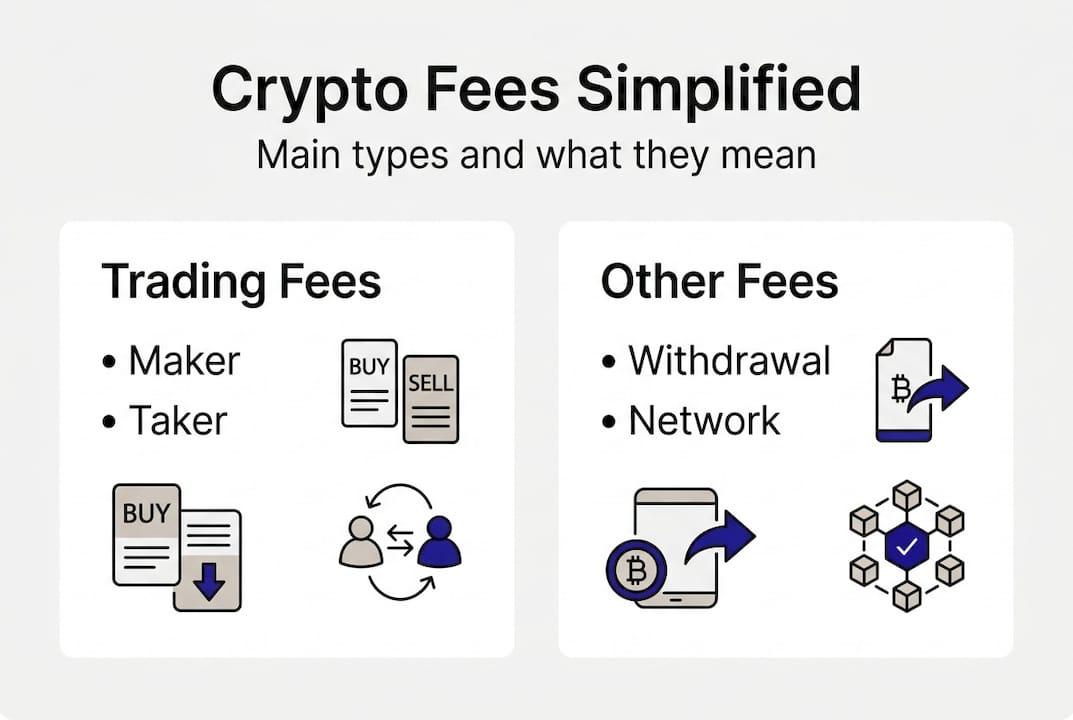
Network fees, often called gas fees, apply mainly on decentralized exchanges (DEXs) like Uniswap. These fees go directly to blockchain validators, not the platform, and they fluctuate based on network congestion. During high-traffic periods, a single Ethereum transaction can cost more than a week’s worth of CEX trading fees.
Here’s the part most investors miss: zero-fee platforms aren’t actually free. When a platform advertises no trading fee, it typically earns revenue through the spread, which is the difference between the buy and sell price. Slippage, where your order fills at a slightly worse price than expected, adds another invisible cost. These aren’t line items on your receipt, but they absolutely affect your returns.
- Maker fee: charged when you add liquidity (limit orders)
- Taker fee: charged when you remove liquidity (market orders)
- Withdrawal fee: charged when moving assets off the exchange
- Network/gas fee: paid to blockchain validators, not the platform
- Spread cost: hidden in the bid/ask gap on zero-fee platforms
- Slippage: difference between expected and actual fill price
Understanding crypto exchanges explained in full helps you see why each fee type matters. Low-fee CEXs typically offer better overall trading costs than DEXs once you factor in gas and slippage, which surprises many investors who assume decentralized always means cheaper.
Pro Tip: Never evaluate a platform based on its headline trading fee alone. Pull up the full fee schedule, including withdrawal fees for every asset you hold, and calculate your actual monthly cost based on your trading habits.
Comparison of major exchange fees in 2026
Now that you know what every fee truly means, let’s see how the main exchanges actually stack up. Numbers tell the real story here.
| Platform | Spot maker fee | Spot taker fee | BTC withdrawal fee | Annual cost ($10k/mo volume) |
|---|---|---|---|---|
| MEXC | 0.00% | 0.05% | Varies | ~$25 |
| OKX | 0.08% | 0.10% | ~0.0001 BTC | ~$120 |
| Bitunix | 0.08% | 0.10% | Varies | ~$120 |
| Binance | 0.10% | 0.10% | ~0.0001 BTC | ~$240 |
| Coinbase (Advanced) | 0.40% | 0.60% | Varies | ~$720+ |
| Average DEX (ETH) | N/A | 0.30% + gas | N/A | Highly variable |
The annual cost column is where things get real. The same $10,000 monthly volume can cost $25 per year on MEXC or over $1,200 per year on Binance, depending on your trading pattern. That’s not a rounding error. That’s a meaningful portion of your returns walking out the door.

For context, if you’re earning a 10% annual return on a $10,000 portfolio, paying $1,200 in fees wipes out more than your entire gain. MEXC’s near-zero maker fee is genuinely attractive, but it comes with trade-offs in platform depth, regulatory standing, and customer support quality that matter for serious investors.
DEX costs deserve special attention. Gas fees on Ethereum-based DEXs can spike to $50 or more per transaction during busy periods. A trader making ten transactions per month could easily pay $500 in gas alone, before any protocol fees. Understanding exchange integration and fees in detail helps you decide when a CEX is the smarter, more cost-efficient choice.
The variance across top platforms is striking. Even among the lowest-cost CEXs, annual fee differences can reach hundreds of dollars for moderate traders. Multiply that over three to five years of active trading and the numbers become impossible to ignore.
Why transparency beats zero-fee marketing
Let’s move from hard numbers to the core principle: why seeing all the numbers actually matters more than their size.
Zero-fee marketing is one of the most effective hooks in fintech. It works because most investors don’t look past the headline. But here’s the uncomfortable reality: a platform charging 0% on trades may still earn more from you than one charging 0.10%, simply by widening the spread or building fees into withdrawal structures.
“Transparency is more important than zero-fee marketing. Hidden fees often erode returns in ways traders never see coming.” — Best Crypto Exchange with Lowest Fees (2026)
This isn’t a minor concern. When hidden fees erode returns silently, investors often blame market conditions rather than their platform’s cost structure. That misattribution is expensive.
So what should you actually look for? Before committing to any platform, ask these questions:
- Does the platform publish a complete, itemized fee schedule?
- Are withdrawal fees listed per asset, not just in general terms?
- Is the spread disclosed, or is it embedded invisibly in quoted prices?
- Are there inactivity fees, deposit fees, or conversion fees?
- Does the platform update its fee schedule publicly when rates change?
Learning crypto investment basics early means building the habit of reading fee disclosures the same way you’d read a loan agreement. The realities of crypto trading include the fact that platforms are businesses, and their revenue comes from somewhere. When you can’t find where, that’s a red flag.
Transparency also signals something deeper about a platform’s values. Exchanges that clearly disclose every cost are generally more trustworthy partners for long-term investing. Those that bury fees in footnotes tend to make other decisions that don’t favor the user either.
How to evaluate and minimize your crypto fees
Now, let’s put this knowledge into action so you can cut your costs and trade smarter.
Evaluating fees isn’t a one-time task. Your trading behavior changes, platforms update their rates, and new options emerge. Here’s a practical process to stay on top of it:
- List every platform you use and pull its current full fee schedule, not the marketing page.
- Calculate your actual monthly volume across all platforms and asset types.
- Estimate your annual fee cost using the formula: volume x fee rate x 12.
- Compare withdrawal fees for every asset you move regularly, since these vary widely.
- Check for hidden spread costs by comparing quoted prices against a neutral market aggregator.
- Reassess quarterly, because fee schedules change and better options appear.
Fee calculators make this process much faster. The crypto market analysis tool at CryptoCracker, for instance, helps you visualize cost impacts alongside portfolio performance, so you’re not doing the math in a spreadsheet.
| Monthly volume | MEXC annual cost | Binance annual cost | Coinbase annual cost |
|---|---|---|---|
| $5,000 | ~$12 | ~$120 | ~$360 |
| $10,000 | ~$25 | ~$240 | ~$720 |
| $25,000 | ~$62 | ~$600 | ~$1,800 |
| $50,000 | ~$125 | ~$1,200 | ~$3,600 |
Sometimes paying higher fees is the right call. Coinbase offers strong regulatory compliance, robust insurance, and beginner-friendly interfaces that genuinely reduce risk for new investors. Liquidity depth on major platforms also matters: a slightly higher fee on a platform with tight spreads can still be cheaper than a low-fee platform with wide bid/ask gaps. Exploring trading strategies that align with your fee structure helps you get the most from every trade.
Pro Tip: Look for platforms that display all fee types side-by-side in a single dashboard view. If you have to visit three different help pages to understand your total cost, that’s a transparency problem worth taking seriously.
Our perspective: The uncomfortable truth about crypto fees
Here’s what most fee comparison articles won’t tell you: the real danger isn’t any single fee. It’s the compounding effect of fees you never noticed in the first place.
We’ve seen investors spend hours researching which coin to buy, then execute the trade on whatever platform they already have an account with, paying three to five times more in fees than necessary. That’s not a small oversight. Over two to three years of active trading, the difference between a 0.05% and a 0.60% fee structure on moderate volume can exceed the cost of a significant market correction.
The investors who reduce crypto trading risk most effectively aren’t necessarily the best market timers. They’re the ones who treat fee management as a core part of their strategy, not an afterthought. Choosing a platform based on disclosure quality and reliability, rather than just the lowest advertised rate, is genuinely one of the highest-leverage decisions you can make as an investor. The lowest fee number and the best fee deal are rarely the same thing.
Ready to optimize your trading? Start with full fee clarity
Understanding fees is one thing. Having the tools to act on that understanding is another.

At CryptoCracker, we built our platform around the belief that every investor deserves complete visibility into what they’re paying and why. Our market analysis tools surface fee impacts alongside performance data, so you can see the full picture in one place. Whether you want to optimize your portfolio for lower costs or explore fee-conscious trading alternatives, we make the comparison clear and actionable. Smarter investing starts with knowing exactly what you’re paying.
Frequently asked questions
What are the main types of crypto fees?
The main types are trading fees (maker and taker), withdrawal fees, and network or gas fees, each affecting your total cost in different ways. Fee benchmarks for 2026 show spot rates ranging from 0% on MEXC to 0.6% on Coinbase’s simple interface.
Why does fee transparency matter in crypto trading?
Complete transparency lets you accurately compare platforms and avoid costs hidden in spreads or withdrawal structures. Hidden fees erode returns in ways that are easy to miss until you calculate the annual impact.
Are decentralized exchanges more expensive than centralized ones?
DEXs often carry higher gas and slippage costs that make them pricier for regular traders. Low-fee CEXs typically offer better overall trading costs once you factor in those additional DEX expenses.
How can I minimize my crypto trading fees?
Start by reviewing the full fee schedule of every platform you use, then calculate your actual annual cost based on your trading volume. The same $10,000 monthly volume can cost $25 per year on MEXC or $1,200 per year on Binance, so the platform choice alone makes a major difference.